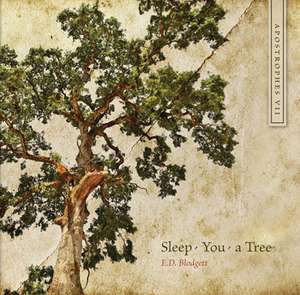
Apostrophes VII: Sleep, You, a Tree
Autor E.D. Blodgetten Limba Engleză Paperback – 5 apr 2011
Preț: 113.26 lei
Preț vechi: 138.04 lei
-18%
Puncte Express: 170
Carte disponibilă
Livrare economică 10-24 noiembrie
Livrare prin curier în România Termenul estimat este afișat lângă disponibilitate.
Transport gratuit de la 400.00 lei Plată online sau ramburs, în funcție de opțiunile comenzii.
Retur gratuit în 14 zile Comandă securizată și suport în română.
Specificații
ISBN-13: 9780888645548
ISBN-10: 0888645546
Pagini: 88
Dimensiuni: 165 x 165 x 25 mm
Greutate: 0.12 kg
Editura: University of Alberta Press
Colecția University of Alberta Press
Locul publicării:Edmonton, Canada
ISBN-10: 0888645546
Pagini: 88
Dimensiuni: 165 x 165 x 25 mm
Greutate: 0.12 kg
Editura: University of Alberta Press
Colecția University of Alberta Press
Locul publicării:Edmonton, Canada
V-ar putea interesa
-
 Rilke: PoemsRainer Maria RilkePreț: 109.29 lei
 -
 The Simple Truth: PoemsPhilip LevinePreț: 122.61 lei
 -
 Leaves of Grass: The Sesquicentennial EssaysSusan BelascoPreț: 228.72 lei
 -
 Red Hot SalsaLori Marie CarlsonPreț: 131.68 lei
 -
 Why I Wake EarlyMary OliverPreț: 96.05 lei
 -
 The Collected Poems of Robert Penn WarrenRobert Penn Warren-15%Preț: 530.97 lei624.66 lei
 -
 The House on Boulevard St.David KirbyPreț: 125.01 lei
 -
 InfernoDante AlighieriPreț: 101.17 lei
 -
 New PoemsRainer RilkePreț: 145.83 lei
 -
 The Essential NerudaPablo NerudaPreț: 97.30 lei
 -
 Continuations 2Douglas BarbourPreț: 111.13 lei
 -
 dear Hermes...Michelle SmithPreț: 110.92 lei
 -
 WellsJenna Butler-18%Preț: 113.22 lei138.03 lei
Recenzii
Front Flap: I have always admired E.D. Blodgett's poetry for its intellectual ambition, its refusal to accept the surface of things as their whole story, for its Wallace Stevens-like sensuous engagement with interiority. In Apostrophes VII: Sleep, You, a Tree, Blodgett turns to the impalpable, the richly numinous, not to escape the world, but to make the world more substantial so that it can accommodate all elements of our fullest dwelling, including a hyperbolic span of desire, the swoop of unfettered imagination and our unappeasable loneliness for the innerness of things. This makes his poetry reclamation work, drawing substance and light both into humans and the objects they live among and behold. -Tim Lilburn Back Cover: No one remembers when this dance began, the slow andante in our eyes, their disappearance and return as intimate as breath that we have known since we began to see, the nearest that we think of what we think is infinite. -from "Unknowing" Back Flap: E.D. Blodgett has published numerous books of poetry as well as diverse criticism and literary translations. He is Distinguished University Professor Emeritus of Comparative Literature at the University of Alberta. In 1996 he won the Governor General's Award for Poetry for Apostrophes: Woman at a Piano. From 2007 to 2009 he was Edmonton's Poet Laureate. Blodgett lives in Surrey, British Columbia.
"'The best part is the moment (often a long one) before one begins a poem. It is that state that Keats calls "negative capability," and it is a state that simply comes over one and almost dissolves one.' This moment or state leads to a particular sensibility that filters through Blodgett's work. "That the world, no matter how brutal and mindless it is tending to be, is a place of incomparable awe.'" Ariel Gordon, Prairie Books Now, Summer 2011
Blodgett's weaving of form and content is rare in contemplative poetics.... Blodgett's rhythms, both formal as in traditional sonnets but also relaxed in their line ends and break-up of rhythm, are delicious to the ear. Such poetry is made to read aloud." BC Bookworld
"Each time [the imagery of these interrelated poems is] transformed into an elegantly satisfying visual music that pulls the consciousness of the willing reader into a fresh perception of the connections among mind, language, and the world." Neil Querengesser, Canadian Literatures 214, Autumn 2012
"'The best part is the moment (often a long one) before one begins a poem. It is that state that Keats calls "negative capability," and it is a state that simply comes over one and almost dissolves one.' This moment or state leads to a particular sensibility that filters through Blodgett's work. "That the world, no matter how brutal and mindless it is tending to be, is a place of incomparable awe.'" Ariel Gordon, Prairie Books Now, Summer 2011
Blodgett's weaving of form and content is rare in contemplative poetics.... Blodgett's rhythms, both formal as in traditional sonnets but also relaxed in their line ends and break-up of rhythm, are delicious to the ear. Such poetry is made to read aloud." BC Bookworld
"Each time [the imagery of these interrelated poems is] transformed into an elegantly satisfying visual music that pulls the consciousness of the willing reader into a fresh perception of the connections among mind, language, and the world." Neil Querengesser, Canadian Literatures 214, Autumn 2012