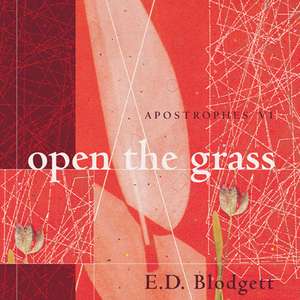
Apostrophes VI: open the grass
Autor E.D. Blodgetten Limba Engleză Paperback – 15 sep 2004
Preț: 110.29 lei
Preț vechi: 136.00 lei
-19%
Puncte Express: 165
Carte disponibilă
Livrare economică 02-16 noiembrie
Livrare prin curier în România Termenul estimat este afișat lângă disponibilitate.
Transport gratuit de la 400.00 lei Plată online sau ramburs, în funcție de opțiunile comenzii.
Retur gratuit în 14 zile Comandă securizată și suport în română.
Specificații
ISBN-13: 9780888644206
ISBN-10: 0888644205
Pagini: 80
Dimensiuni: 165 x 165 x 6 mm
Greutate: 0.11 kg
Ediția:First edition
Editura: University of Alberta Press
Colecția University of Alberta Press
Locul publicării:Edmonton, Canada
ISBN-10: 0888644205
Pagini: 80
Dimensiuni: 165 x 165 x 6 mm
Greutate: 0.11 kg
Ediția:First edition
Editura: University of Alberta Press
Colecția University of Alberta Press
Locul publicării:Edmonton, Canada
V-ar putea interesa
-
 Blue HorsesMary OliverPreț: 88.97 lei
 -
 HeavenRowan Ricardo PhillipsPreț: 81.40 lei
 -
 Words of RainJames CoburnPreț: 60.27 lei
 -
 The CircusLarry D. ThomasPreț: 56.64 lei
 -
 Continuations 2Douglas BarbourPreț: 111.13 lei
 -
 dear Hermes...Michelle SmithPreț: 110.92 lei
 -
 WellsJenna Butler-19%Preț: 110.51 lei136.12 lei
 -
 Before the CityKirby WrightPreț: 85.08 lei
 -
 Karma CrisisNathan BrownPreț: 101.90 lei
 -
 Oklahoma Poems... and Their PoetsStephen DunnPreț: 95.38 lei
 -
 Today Means AmenSierra DemulderPreț: 97.25 lei
 -
 Bedtime Stories for Grown-upsBen Holden-10%Preț: 111.48 lei123.30 lei
 -
 Splitting an OrderTed KooserPreț: 89.10 lei
 -
 JaneMaggie NelsonPreț: 91.94 lei
 -
 AchilleidStatius-24%Preț: 181.96 lei239.15 lei
 -
 When They Broke Down the Door: PoemsFatemeh Shams-19%Preț: 136.42 lei168.11 lei
Recenzii
In Apostrophes VI, E.D. Blodgett returns to his acclaimed series to invite the reader to open the grass-to open the book of creation and consider its wisdom. In 66 tightly, yet eloquently-often beautifully-structured lyric poems, Blodgett embraces the natural world as one bound to meaning by majesty and wonder. These poems are messages declared to an absence-a dialogue with the missing. Searching not only for an absent "you" but for "the absent place / of everywhere" (Flowered). Searching for "words to find you as you are and not / as I have dreamed you in these fragments" (Fragments). "The subject matter is as old as poetry itself, the formal discipline exemplary; yet this is exquisitely contemporary verse." -Susan Rudy
"Where much of contemporary formally innovative poetry unstructures conventional syntax, these poems seek an ancient, traditional, and highly rhetorical syntax in lengthy compound-complex sentences full of twists and turns of focus and desire..Where much of contemporary formally innovative poetry unstructures conventional syntax, these poems seek an ancient, traditional, and highly rhetorical syntax in lengthy compound-complex sentences full of twists and turns of focus and desire." Douglas Barbour, Canadian Book Review Annual, 2005.
"I reviewed E.D. Blodgett's An Arc of Koans last year, and have decided that it must speak well of Blodgett's versatility that the poems included in open the grass (both are part of his apostrophes series), are so different in manner. Picture broad, page-wide paragraphs (in a square-format book) threaded with long, sinewy, wistful sentences. The former volume was made up of diminutive riddle poems, evoking impressions more in what they do not say than in what they make explicit. These poems work just as interestingly from the other direction, from the side of prolix extension and operatic accumulation. The thematic furniture is outsize - stars, sky, trees, moon, sea, silence, and of course fields and fields of grass - but they are handled so lightly and dreamily that the poems seem like so many snowglobes with their two or three primary elements falling in a soft flurry of words." Jeffery Donaldson, University of Toronto Quarterly, Vol 75, No.1, Winter 2006
"Where much of contemporary formally innovative poetry unstructures conventional syntax, these poems seek an ancient, traditional, and highly rhetorical syntax in lengthy compound-complex sentences full of twists and turns of focus and desire..Where much of contemporary formally innovative poetry unstructures conventional syntax, these poems seek an ancient, traditional, and highly rhetorical syntax in lengthy compound-complex sentences full of twists and turns of focus and desire." Douglas Barbour, Canadian Book Review Annual, 2005.
"I reviewed E.D. Blodgett's An Arc of Koans last year, and have decided that it must speak well of Blodgett's versatility that the poems included in open the grass (both are part of his apostrophes series), are so different in manner. Picture broad, page-wide paragraphs (in a square-format book) threaded with long, sinewy, wistful sentences. The former volume was made up of diminutive riddle poems, evoking impressions more in what they do not say than in what they make explicit. These poems work just as interestingly from the other direction, from the side of prolix extension and operatic accumulation. The thematic furniture is outsize - stars, sky, trees, moon, sea, silence, and of course fields and fields of grass - but they are handled so lightly and dreamily that the poems seem like so many snowglobes with their two or three primary elements falling in a soft flurry of words." Jeffery Donaldson, University of Toronto Quarterly, Vol 75, No.1, Winter 2006