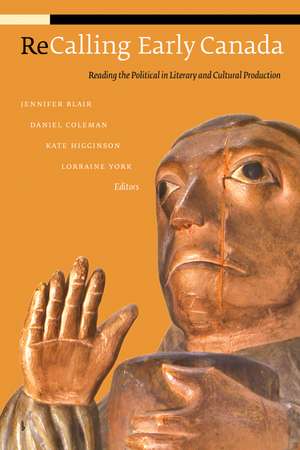
ReCalling Early Canada: Reading the Political in Literary and Cultural Production
Editat de Jennifer Blair, Daniel Coleman, Kate Higginson, Lorraine Yorken Limba Engleză Paperback – mai 2005
Preț: 202.22 lei
Puncte Express: 303
Carte disponibilă
Livrare economică 12-26 noiembrie
Livrare prin curier în România Termenul estimat este afișat lângă disponibilitate.
Transport gratuit de la 400.00 lei Plată online sau ramburs, în funcție de opțiunile comenzii.
Retur gratuit în 14 zile Comandă securizată și suport în română.
Specificații
ISBN-13: 9780888644435
ISBN-10: 0888644434
Pagini: 440
Ilustrații: b/w photos
Dimensiuni: 152 x 229 x 22 mm
Greutate: 0.55 kg
Ediția:First edition
Editura: University of Alberta Press
Colecția University of Alberta Press
Locul publicării:Edmonton, Canada
ISBN-10: 0888644434
Pagini: 440
Ilustrații: b/w photos
Dimensiuni: 152 x 229 x 22 mm
Greutate: 0.55 kg
Ediția:First edition
Editura: University of Alberta Press
Colecția University of Alberta Press
Locul publicării:Edmonton, Canada
V-ar putea interesa
-
 FocusArthur Miller-20%Preț: 72.66 lei90.93 lei
 -
 Baby Doll and Other PlaysTennessee WilliamsPreț: 92.93 lei
 -
 Julius CaesarProf. Eric Rasmussen-19%Preț: 66.89 lei82.31 lei
 -
 The Comedy of ErrorsProf. Eric Rasmussen-18%Preț: 67.28 lei82.54 lei
 -
 CoriolanusProf. Eric Rasmussen-23%Preț: 69.01 lei89.33 lei
 -
 Henry VI, Parts I, II and IIIProf. Eric Rasmussen-15%Preț: 73.43 lei86.21 lei
 -
 Preț: 316.98 lei
 -
 Modern Norwegian Literature, 1860-1918Brian W. DownsPreț: 299.73 lei
 -
 French Verse-ArtClive ScottPreț: 366.31 lei
 -
 Preț: 294.28 lei
 -
 Performance and Literature in the Commedia Dell'arteRobert HenkePreț: 344.91 lei
 -
 Preț: 41.30 lei
 -
 Preț: 260.22 lei
 -
 Raymond Chandler's Philip Marlowe: The Hard-Boiled Detective TransformedJohn Paul AthanasourelisPreț: 294.87 lei
 -
 Pearls of Persia: The Philosophical Poetry of Nasir-i KhusrawAlice C. Hunsberger-23%Preț: 398.86 lei520.57 lei
 -
 Russian PoetsPeter Washington-26%Preț: 63.30 lei85.20 lei
 -
 Shakespeare Monologues for WomenLuke DixonPreț: 92.16 lei
 -
 Sir Thomas More: Third SeriesWilliam Shakespeare-13%Preț: 124.36 lei143.72 lei
Recenzii
When we call and recall early Canada what is it that we call upon? How does the very name we give it shape in advance what it is that we set out to recall? ReCalling Early Canada is the first book-length collection of essays to focus on Canadian literary and cultural production prior to WWI. While Canadian literature is often thought to have emerged in the mid twentieth century, the essays in this volume reflect a recent critical interest in earlier generations of cultural production. Taking seriously the project of recall, the essays here not only seek to deliver certain historical documents to the light of present-day critique, they also ask important theoretical and political questions about the various methodologies involved and the assumptions that accompany them. The authors do not limit their analyses to the standards of fiction and poetry-instead they welcome photographs, captivity narratives, family letters, and journalism as part of the repertoire of early Canadian readers. These essays combine a fresh interest in this burgeoning field of study with new approaches to historical inquiry. The result is a unique and diverse investigation of more than two centuries of a relatively unknown early Canada.
"ReCalling Early Canada positions the act of recall not as simplistic retrieval but rather as a dynamic interaction between past and present. The essays collected in this book aim to look to the past not necessarily to participate in the protect of nation building, but rather to query the methodology, politics and ends of historical engagement; the processes of selection through which certain texts, objects and figures are deemed to be worthy of study; the frames through which we analyze the past; and the provisional characteristics of such frames..ReCalling Early Canada begins with a lengthy and insightful introduction that draws attention to the complexities of the 'politics of recollection' (xvi) upon which this project is based. The editors emphasize the importance of reading the non-canonical together with the canonical in order to challenge the contingencies of value upon which such a distinction is based. They foreground the limitations of the nation as an organizational category by reading Canada as a 'site of conflicting confederacies' located within, and sometimes poised against, the nation as a geopolitical entity (xxiii). The introduction also draws attention to the tendency of the archive to shape how we recall early Canada..[T]he essays collected in ReCalling Early Canada indicate a welcome shift away from the 'colony to nation' paradigm towards a more nuanced engagement with history, place and nation." Heather Milne, TOPIA 15, Spring, 2006.
"[The editors] have provided a solid body of work that can be analysed from a variety of perspectives." George Melnyk, The Canadian Historical Review, Vol. 87, No. 3, September 2006
"[T]he essays cover terrain as varied as Theresa Gowanlock's captivity narrative, the documentation of the Aboriginal 'family' by white photographers, and conflicting national identities as portrayed in French and English fiction. This collection is highly recommended for both undergraduate and graduate collections in academic libraries." Allison Sivak, Canadian Book Review Annual, 2006
"ReCalling Early Canada positions the act of recall not as simplistic retrieval but rather as a dynamic interaction between past and present. The essays collected in this book aim to look to the past not necessarily to participate in the protect of nation building, but rather to query the methodology, politics and ends of historical engagement; the processes of selection through which certain texts, objects and figures are deemed to be worthy of study; the frames through which we analyze the past; and the provisional characteristics of such frames..ReCalling Early Canada begins with a lengthy and insightful introduction that draws attention to the complexities of the 'politics of recollection' (xvi) upon which this project is based. The editors emphasize the importance of reading the non-canonical together with the canonical in order to challenge the contingencies of value upon which such a distinction is based. They foreground the limitations of the nation as an organizational category by reading Canada as a 'site of conflicting confederacies' located within, and sometimes poised against, the nation as a geopolitical entity (xxiii). The introduction also draws attention to the tendency of the archive to shape how we recall early Canada..[T]he essays collected in ReCalling Early Canada indicate a welcome shift away from the 'colony to nation' paradigm towards a more nuanced engagement with history, place and nation." Heather Milne, TOPIA 15, Spring, 2006.
"[The editors] have provided a solid body of work that can be analysed from a variety of perspectives." George Melnyk, The Canadian Historical Review, Vol. 87, No. 3, September 2006
"[T]he essays cover terrain as varied as Theresa Gowanlock's captivity narrative, the documentation of the Aboriginal 'family' by white photographers, and conflicting national identities as portrayed in French and English fiction. This collection is highly recommended for both undergraduate and graduate collections in academic libraries." Allison Sivak, Canadian Book Review Annual, 2006