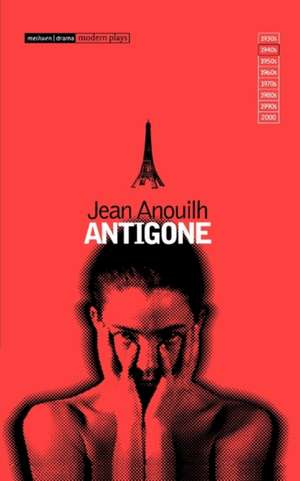
Antigone
Autor Jean Anouilh Traducere de Lewis Galantiereen Limba Engleză Paperback – sep 1960
Preț: 55.38 lei
Preț vechi: 90.42 lei
-39%
Puncte Express: 83
Carte disponibilă
Livrare economică 13-27 noiembrie
Livrare express 30 octombrie-05 noiembrie pentru 48.64 lei
Livrare prin curier în România Termenul estimat este afișat lângă disponibilitate.
Transport gratuit de la 400.00 lei Plată online sau ramburs, în funcție de opțiunile comenzii.
Retur gratuit în 14 zile Comandă securizată și suport în română.
Specificații
ISBN-13: 9780413308603
ISBN-10: 041330860X
Pagini: 80
Dimensiuni: 128 x 196 x 8 mm
Greutate: 0.08 kg
Editura: Bloomsbury Publishing
Locul publicării:United Kingdom
ISBN-10: 041330860X
Pagini: 80
Dimensiuni: 128 x 196 x 8 mm
Greutate: 0.08 kg
Editura: Bloomsbury Publishing
Locul publicării:United Kingdom
V-ar putea interesa
-
 The Theban PlaysSophocles-20%Preț: 57.13 lei71.10 lei
-
 The Oresteian TrilogyAeschylus-32%Preț: 62.94 lei92.17 lei
-
 AntigoneSophocles-39%Preț: 17.44 lei28.47 lei
-
 Tartuffe, by MolièreRichard WilburPreț: 87.07 lei
-
 Antigone: A New Adaptation of the Classic Greek TragedyHollie McNish-27%Preț: 57.13 lei78.06 lei
-
 The Resistible Rise of Arturo UiBertolt Brecht-46%Preț: 56.20 lei104.07 lei
-
 Cyrano de BergeracEdmond RostandPreț: 49.42 lei
-
 Ubu RoiAlfred JarryPreț: 28.65 lei
-
 The Burial at ThebesSeamus HeaneyPreț: 91.21 lei
-
 Medea and Other PlaysEuripidesPreț: 43.30 lei
-
 The Three Theban PlaysSophoclesPreț: 45.74 lei
-
 Antigona and MeKate ClanchyPreț: 78.13 lei
-
 -18%Preț: 71.31 lei86.98 lei
-
 An Inspector Calls: Annotation-Friendly EditionJ. B. PriestleyPreț: 86.45 lei
-
 Long Day's Journey into NightEugene O'NeillPreț: 57.13 lei
-
 Twelve Angry MenReginald RosePreț: 48.64 lei
Descriere
Descriere de la o altă ediție sau format:
'Anouilh is a poet, but not of words: he is a poet of words-acted, of scenes-set, of players-performing' Peter Brook
Jean Anouilh, one of the foremost French playwrights of the twentieth century, replaced the mundane realist works of the previous era with his innovative dramas, which exploit fantasy, tragic passion, scenic poetry and cosmic leaps in time and space. Antigone, his best-known play, was performed in 1944 in Nazi-controlled Paris and provoked fierce controversy. In defying the tyrant Creon and going to her death, Antigone conveyed to Anouilh's compatriots a covert message of heroic resistance; but the author's characterisaation of Creon also seemed to exonerate Marshal Petain and his fellow collaborators. More ambivalent than his ancient model, Sophocles, Anouilh uses Greek myth to explore the disturbing moral dilemmas of our times.
Commentary and notes by Ted Freeman.
Notă biografică
Jean Anouilh was born in Bordeaux in 1910. He studied law briefly at the Sorbonne and then became a copywriter for an advertising agency. In 1931 he became secretary to the actor-manager, Louis Jouvet, and his first play, The Ermine, was staged the following year. Antigone firmly established his popularity in France in 1944, and Peter Brook's 1950 production of Ring Round the Moon in Christopher Fry's translation made his name in England. His best-known plays are: Restless Heart (1934); Dinner with the Family, Traveller without Luggage (both 1937); Thieves' Carnival (1938); Léocadia (1939); Point of Departure (Eurydice) (1941); Romeo and Jeannette (1945); Medea (1946); Ardèle (1948); The Rehearsal (1950); Colombe (1951); The Waltz of the Toreadors (1952); The Lark (1953); Ornifle (1955); Poor Bitos (1956); Becket (1956); The Fighting Cock (1966); Dear Antoine (1971); The Director of the Opera (1973); Number One (1981). Twice married, he lived mainly in Switzerland for the last thirty years of his life. Anouilh died in 1987.