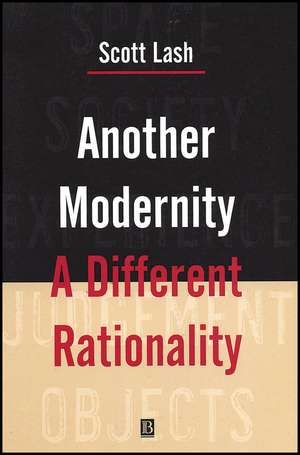
Another Modernity
Autor Lashen Limba Engleză Hardback – 6 aug 1999
The first and second modernities co-existed in a state of irresolvable tension along the history of western industrial capitalism. This is thrown into crisis, Lash argues, with the turn of the twenty-first century emergence of the global information culture. What are the implications of this explosion of first and second modernities into today's technological culture? When the previously existing third space of difference is exploded into the general indifference of information and communication flows? How might we lead our lives in an age in which difference - and indeed the ground itself - become primarily a matter for memory, for mourning?
Preț: 821.00 lei
Preț vechi: 1124.66 lei
-27%
Puncte Express: 1232
Carte tipărită la comandă
Livrare economică 28 noiembrie-12 decembrie
Livrare prin curier în România Termenul estimat este afișat lângă disponibilitate.
Transport gratuit pentru acest produs Plată online sau ramburs, în funcție de opțiunile comenzii.
Retur gratuit în 14 zile Comandă securizată și suport în română.
Specificații
ISBN-13: 9780631159391
ISBN-10: 0631159398
Pagini: 410
Dimensiuni: 157 x 235 x 27 mm
Greutate: 0.8 kg
Editura: Wiley
Locul publicării:Chichester, United Kingdom
ISBN-10: 0631159398
Pagini: 410
Dimensiuni: 157 x 235 x 27 mm
Greutate: 0.8 kg
Editura: Wiley
Locul publicării:Chichester, United Kingdom
V-ar putea interesa
-
 Peter of Spain: Summaries of Logic: Text, Translation, Introduction, and NotesBrian P. Copenhaver-32%Preț: 970.88 lei1437.53 lei
 -
 The Ten (Food) CommandmentsJay Rayner-46%Preț: 34.54 lei63.63 lei
 -
 Sociology of PostmodernismDr Scott LashPreț: 499.38 lei
 -
 Max Weber, Rationality and ModernitySam WhimsterPreț: 477.33 lei
 -
 -18%Preț: 1124.57 lei1371.44 lei
 -
 -15%Preț: 480.63 lei565.45 lei
 -
 Modernity and IdentityScott LashPreț: 431.08 lei
 -
 Preț: 482.54 lei
 -
 Pacific AsiaPreston-23%Preț: 482.41 lei626.50 lei
 -
 Blackwell Reader in ContemporaryElliottPreț: 564.40 lei
 -
 -23%Preț: 456.63 lei593.03 lei
 -
 Transgressing the ModernJohn JervisPreț: 531.00 lei
 -
 -23%Preț: 462.56 lei600.73 lei
 -
 Preț: 159.47 lei
 -
 Global Culture IndustryScott LashPreț: 209.63 lei
 -
 Popular CultureRaiford A Guins-27%Preț: 757.29 lei1037.37 lei
 -
 Food, Families and WorkRebecca O'Connell-28%Preț: 204.16 lei283.94 lei
 -
 The Handbook of Food and AnthropologyJakob A Klein-45%Preț: 894.65 lei1628.38 lei
 -
 Food and Architecture: At The TableSamantha L. Martin-McAuliffe-29%Preț: 219.74 lei307.36 lei
 -
 Food, Families and WorkRebecca O'Connell-14%Preț: 771.37 lei896.95 lei
 -
 -27%Preț: 56.19 lei77.40 lei
 -
 The Year of Living DanishlyHelen RussellPreț: 87.05 lei
 -
 Creative Chef: How to Create a Mind-Blowing Food ExperienceJasper Udink ten Cate-25%Preț: 157.04 lei209.39 lei
Public țintă
advanced students of Sociology, Cultural Studies, Philosophy, Geography, English and Modern Studies and Art and DesignNotă biografică
Scott Lash is Director of the Centre for Cultural Studies and Professor of Sociology at Goldsmiths College, University of London. He previously taught at Lancaster University for many years. He was a Humboldt Fellow in Berlin between 1988 and 1990. His previous books include The End of Organized Capitalism (co-author, 1987), Sociology of Postmodernism (1990), Modernity and Identity (co-editor, 1992), Economies of Signs and Space (co-author, 1994), Reflexive Modernization (co-author, 1994) and Detraditionalization (co-editor, 1996). His books have been translated into nine languages.
Cuprins
Acknowledgements. 1. Introduction.
Part I: Space:.
2. The First Modernity: Humans and Machines.
Garden City and Functionalism.
Structuralism.
Formalism.
Modernist Humanism?.
Conclusions.
3. Simulated Humanism: Postmodern Architecture.
Avant-gardes.
History.
Humanism.
Complexity.
Vernacular.
Conclujsions.
4. Ground the City.
Fields of Mapping: Grids and Labyrinths.
Productions of Space: Classical and Gothic.
The Other Modernity: Lived Space in Japan.
Urban Space and Allegory.
Part II: Society.
5. From System to Symbol: Durkheim and French Sociology.
Space and Society.
System.
Symbol: Durkheim and Mauss.
6. Symbol and Allegory: Simmel and German Sociology.
Values and Facts.
From Symbol to Allegory.
Conclusion.
Part III: Experience.
7. The Natural Attitude and the Reflexive Attitude.
Alfred Schutz: from Meaning to Understanding Signification and Existence.
8. Difference and Infinity: Derrida.
Kant, Husserl, Derrida.
Escape from Totality.
Time and Self-presence.
Three Modes of Signification.
Part IV: Judgement.
9. Reflexive Judgement and Aesthetic Subjectivity.
Finality of the Object, Singularity of the Subject.
Permanence and Finitude: Gadamer.
10. Discourse, Figure....Sensation.
The Body With Organs.
Greeks, Jews, Pagans.
Conclusions.
Part V: Objects.
11. Objects that Judge: Latour's Parliament of Things.
Towards a Non-Modern Constitution.
Morphisms Weavers and Object Trackers.
Ç'accuse.
Networks: Spiralling Time and Space.
12. Bad Objects: Virilio.
From Cité to War Machine.
Death: Bads, Contingency, Theodicy.
From War to Cinema.
From the Mental and the Instrumental: The End of the Gaze.
Polar Inertia: The Last Vehicle.
Time of Exposure.
13. The Symbolic in Fragments: Walter Benjamin's Talking Things.
Allegory: The Aesthetics of Destruction.
Protestant Ethic, Baroque Melancholy.
14. Conclusion.
Notes.
Index.
Part I: Space:.
2. The First Modernity: Humans and Machines.
Garden City and Functionalism.
Structuralism.
Formalism.
Modernist Humanism?.
Conclusions.
3. Simulated Humanism: Postmodern Architecture.
Avant-gardes.
History.
Humanism.
Complexity.
Vernacular.
Conclujsions.
4. Ground the City.
Fields of Mapping: Grids and Labyrinths.
Productions of Space: Classical and Gothic.
The Other Modernity: Lived Space in Japan.
Urban Space and Allegory.
Part II: Society.
5. From System to Symbol: Durkheim and French Sociology.
Space and Society.
System.
Symbol: Durkheim and Mauss.
6. Symbol and Allegory: Simmel and German Sociology.
Values and Facts.
From Symbol to Allegory.
Conclusion.
Part III: Experience.
7. The Natural Attitude and the Reflexive Attitude.
Alfred Schutz: from Meaning to Understanding Signification and Existence.
8. Difference and Infinity: Derrida.
Kant, Husserl, Derrida.
Escape from Totality.
Time and Self-presence.
Three Modes of Signification.
Part IV: Judgement.
9. Reflexive Judgement and Aesthetic Subjectivity.
Finality of the Object, Singularity of the Subject.
Permanence and Finitude: Gadamer.
10. Discourse, Figure....Sensation.
The Body With Organs.
Greeks, Jews, Pagans.
Conclusions.
Part V: Objects.
11. Objects that Judge: Latour's Parliament of Things.
Towards a Non-Modern Constitution.
Morphisms Weavers and Object Trackers.
Ç'accuse.
Networks: Spiralling Time and Space.
12. Bad Objects: Virilio.
From Cité to War Machine.
Death: Bads, Contingency, Theodicy.
From War to Cinema.
From the Mental and the Instrumental: The End of the Gaze.
Polar Inertia: The Last Vehicle.
Time of Exposure.
13. The Symbolic in Fragments: Walter Benjamin's Talking Things.
Allegory: The Aesthetics of Destruction.
Protestant Ethic, Baroque Melancholy.
14. Conclusion.
Notes.
Index.
Descriere
This volume consists of a set of explorations in the quintessentially aesthetic modernity: of architecture and the city; the emergence of classical sociological theory; the critique of phenomenology and aesthetic judgement in the techno-informational age.