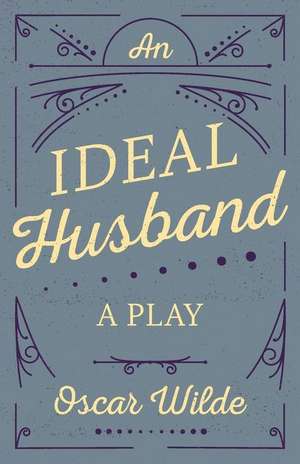
An Ideal Husband
Autor Oscar Wildeen Limba Engleză Paperback – 8 sep 2020
Preț: 110.17 lei
Puncte Express: 165
Carte tipărită la comandă
Livrare economică 30 noiembrie-14 decembrie
Livrare prin curier în România Termenul estimat este afișat lângă disponibilitate.
Transport gratuit de la 400.00 lei Plată online sau ramburs, în funcție de opțiunile comenzii.
Retur gratuit în 14 zile Comandă securizată și suport în română.
Specificații
ISBN-13: 9781528718189
ISBN-10: 1528718186
Pagini: 142
Dimensiuni: 140 x 216 x 9 mm
Greutate: 0.19 kg
Editura: Read & Co. Classics
ISBN-10: 1528718186
Pagini: 142
Dimensiuni: 140 x 216 x 9 mm
Greutate: 0.19 kg
Editura: Read & Co. Classics
V-ar putea interesa
-
 The Plays of Oscar WildeOscar WildePreț: 28.01 lei
 -
 The Inimitable JeevesP. G. Wodehouse-19%Preț: 58.55 lei71.93 lei
 -
 Very Good, JeevesP. G. Wodehouse-19%Preț: 57.64 lei71.25 lei
 -
 The Campus TrilogyDavid LodgePreț: 125.81 lei
 -
 Nineteen Eighty-Four (1984): 1984George Orwell-26%Preț: 52.87 lei71.82 lei
 -
 Preț: 71.31 lei
 -
 Oxford Student Texts: An Ideal HusbandJackie Moore-29%Preț: 80.06 lei113.13 lei
 -
 The Child In YouStefanie Stahl-25%Preț: 64.69 lei86.39 lei
 -
 The Importance of Being Earnest and Other PlaysOscar WildePreț: 35.30 lei
 -
 The Picture of Dorian GrayOscar WildePreț: 35.93 lei
 -
 Preț: 79.14 lei
 -
 The Seven Husbands of Evelyn Hugo: A NovelTaylor Jenkins ReidPreț: 98.63 lei
 -
 SalomeOscar WildePreț: 43.97 lei
 -
 Wilde, O: The Picture of Dorian GrayOscar WildePreț: 69.67 lei
 -
 -28%Preț: 87.92 lei121.87 lei
 -
 -13%Preț: 55.14 lei63.11 lei
 -
 Right Ho, JeevesP. G. Wodehouse-26%Preț: 53.15 lei72.03 lei
 -
 Carry On, JeevesP. G. Wodehouse-26%Preț: 53.27 lei72.03 lei
 -
 The Country WifeWilliam Wycherley-35%Preț: 62.69 lei96.40 lei
 -
 Selected PlaysOscar WildePreț: 58.65 lei
 -
 Great ExpectationsCharles DickensPreț: 32.43 lei
 -
 Twelfth NightWilliam ShakespearePreț: 29.27 lei
 -
 Preț: 73.35 lei
 -
 Preț: 34.20 lei
Descriere
Descriere de la o altă ediție sau format:
One of the nineteenth century's most successful and most frequently revived plays, An Ideal Husband has divided critics more than any other of Wilde's plays. Treating political intrigue, financial fraud, blackmail, scandal and spin, and the role of women in public life, it is a play which engaged with issues of vital importance to its late-Victorian audience, which continue to resonate today.
Sos Eltis, a specialist in Victorian drama and its relation to women's issues, provides a stimulating new perspective on An Ideal Husband, through an introduction that looks at its relation with contemporary social purity campaigns, women's rights, and political scandals. The introduction also gives a substantial performance history, with particular reference to the play's film versions and the influential Peter Hall theatre production.
One of the nineteenth century's most successful and most frequently revived plays, An Ideal Husband has divided critics more than any other of Wilde's plays. Treating political intrigue, financial fraud, blackmail, scandal and spin, and the role of women in public life, it is a play which engaged with issues of vital importance to its late-Victorian audience, which continue to resonate today.
Sos Eltis, a specialist in Victorian drama and its relation to women's issues, provides a stimulating new perspective on An Ideal Husband, through an introduction that looks at its relation with contemporary social purity campaigns, women's rights, and political scandals. The introduction also gives a substantial performance history, with particular reference to the play's film versions and the influential Peter Hall theatre production.
Textul de pe ultima copertă
Although Oscar Wilde (1854 1900) created a wide range of poetry, essays, and fairy tales (and one novel) in his brief, tragic life, he is perhaps best known as a dramatist. His witty, clever drama, populated by brilliant talkers skilled in the art of riposte and paradox, are still staples of the theatrical repertoire.
"An Ideal Husband" revolves around a blackmail scheme that forces a married couple to reexamine their moral standards providing, along the way, a wry commentary on the rarity of politicians who can claim to be ethically pure. A supporting cast of young lovers, society matrons, an overbearing father, and a formidable femme fatale continually exchange sparkling repartee, keeping the play moving at a lively pace.
ike most of Wilde's plays, this scintillating drawing-room comedy is wise, well-constructed, and deeply satisfying. An instant success at its 1895 debut, the play continues to delight audiences over one hundred years later. "An Ideal Husband" is a must-read for Wilde fans, students of English literature, and anyone delighted by wit, urbanity, and timeless sophistication."
"An Ideal Husband" revolves around a blackmail scheme that forces a married couple to reexamine their moral standards providing, along the way, a wry commentary on the rarity of politicians who can claim to be ethically pure. A supporting cast of young lovers, society matrons, an overbearing father, and a formidable femme fatale continually exchange sparkling repartee, keeping the play moving at a lively pace.
ike most of Wilde's plays, this scintillating drawing-room comedy is wise, well-constructed, and deeply satisfying. An instant success at its 1895 debut, the play continues to delight audiences over one hundred years later. "An Ideal Husband" is a must-read for Wilde fans, students of English literature, and anyone delighted by wit, urbanity, and timeless sophistication."
Notă biografică
IntentionsOscar Wilde Cyril (coming in through the open window from the terrace): My dear Vivian, don't coop yourself up all day in the library. It is a perfectly lovely afternoon. The air is exquisite. There is a mist upon the woods, like the purple bloom upon a plum. Let us go and lie on the grass and smoke cigarettes and enjoy Nature. Vivian: Enjoy Nature! I am glad to say that I have entirely lost that faculty. People tell us that Art makes us love Nature more than we loved her before that it reveals her secrets to us and that after a careful study of Corot and Constable we see things in her that had escaped our observation. My own experience is that the more we study Art, the less we care for Nature. What Art really reveals to us is Nature's lack of design, her curious crudities, her extraordinary monotony, her absolutely unfinished condition. Nature has good intentions, of course, but, as Aristotle once said, she cannot carry them out. When I look at a landscape I cannot help seeing all its defects. It is fortunate for us, however, that Nature is so imperfect, as otherwise we should have no art at all. Art is our spirited protest, our gallant attempt to teach Nature her proper place. As for the infinite variety of Nature, that is a pure myth. It is not to be found in Nature herself. It resides in the imagination, or fancy, or cultivated blindness of the man who looks at her. Cyril: Well, you need not look at the landscape. You can lie on the grass and smoke and talk. Vivian: But Nature is so uncomfortable. Grass is hard and lumpy and damp, and full of dreadful black insects. Why, even Morris's poorest workman could make you a more comfortable seat than the whole of Nature can. Nature pales before the furniture of 'the street which from Oxford has borrowed its name,' as the poet you love so much once vilely phrased it. I don't complain. If Nature had been comfortable, mankind would never have invented architecture, and I prefer houses to the open air. In a house we all feel of the proper proportions. Everything is subordinated to us, fashioned for our use and our pleasure. Egotism itself, which is so necessary to a proper sense of human dignity, is entirely the result of indoor life. Out of doors one becomes abstract and impersonal. One's individuality absolutely leaves one. And then Nature is so indifferent, so unappreciative.