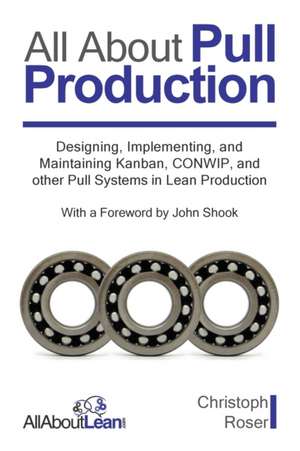
All About Pull Production: Designing, Implementing, and Maintaining Kanban, CONWIP, and other Pull Systems in Lean Production
Autor Christoph Roseren Limba Engleză Paperback – 3 apr 2021
Notăm cu interes apariția lucrării All About Pull Production, un manual tehnic riguros care propune un model de operare bazat pe eficiența fluxului, nu pe volumul stocurilor. Christoph Roser elimină ambiguitatea din jurul conceptului de „pull”, oferind o structură clară pentru proiectarea, implementarea și întreținerea sistemelor Kanban și CONWIP. Cadrul propus funcționează deoarece nu se limitează la teorie; autorul analizează relațiile fundamentale dintre cerere și capacitate, oferind soluții pentru mediile de producție unde variabilitatea este norma. Reținem că această abordare este esențială pentru reducerea inventarului și creșterea vitezei de răspuns la cerințele pieței. Descoperim aici o perspectivă mult mai aplicată decât în Production Management de Yacob Khojasteh. În timp ce lucrarea lui Khojasteh se concentrează pe controlul inventarului și analiza teoretică a costurilor, Christoph Roser adoptă o viziune de tip „mâneci suflecate”, adresându-se direct inginerului de la linia de producție. De asemenea, comparativ cu Pull Production for the Shopfloor, care oferă o introducere de bază pentru echipe, acest volum este o explorare în profunzime, fiind considerat de experți un standard de referință pentru sistemele complexe. În contextul operei sale, dacă în Faster, Better, Cheaper in the History of Manufacturing autorul explora evoluția istorică a productivității, în All About Pull Production el trece la nivelul micro, tehnic. Este o tranziție naturală de la înțelegerea contextului industrial la oferirea instrumentelor specifice necesare pentru a naviga în el. Cartea demistifică principiile Toyota și oferă clarificări asupra unor alternative mai puțin cunoscute, precum POLCA, asigurând un ghid complet pentru orice manager de producție care dorește rezultate măsurabile.
Preț: 328.52 lei
Carte tipărită la comandă
Livrare economică 24 noiembrie-08 decembrie
Specificații
ISBN-10: 3963820284
Pagini: 441
Dimensiuni: 150 x 230 x 24 mm
Greutate: 0.59 kg
Editura: AllAboutLean.com Publishing
V-ar putea interesa
-
 -12%Preț: 118.66 lei135.04 lei
 -
 The Toyota Way FieldbookJeffrey Liker-16%Preț: 226.11 lei269.66 lei
 -
 -17%Preț: 192.26 lei230.54 lei
 -
 -17%Preț: 214.01 lei256.99 lei
 -
 -41%Preț: 213.71 lei364.88 lei
 -
 Taiichi Ohnos Workplace ManagementTaiichi OhnoPreț: 190.98 lei
 -
 Implementing Lean Software Development: From Concept to CashTom PoppendieckPreț: 325.32 lei
 -
 Computational Intelligence in Design and ManufacturingAndrew Kusiak-14%Preț: 908.20 lei1056.05 lei
 -
 Lean ThinkingJames P. WomackPreț: 219.85 leiRecomandat
 -
 -25%Preț: 174.71 lei231.72 lei
 -
 Andy & Me: Crisis & Transformation on the Lean JourneyPascal DennisPreț: 317.17 lei
 -
 Preț: 399.38 lei
 -
 -15%Preț: 497.95 lei585.82 lei
 -
 5 Pillars of the Visual WorkplaceHiro-Yuki Hirano-9%Preț: 993.55 lei1091.81 lei
 -
 -15%Preț: 411.78 lei484.45 lei
 -
 Kanban in ActionJoakim Sunden-20%Preț: 346.70 lei433.38 lei
 -
 The Machine That Changed the WorldJames P. Womack-18%Preț: 76.92 lei94.24 lei
 -
 The Phoenix ProjectMike CollinsPreț: 138.20 lei
 -
 Lean & Green: Best PracticeDaniel ReichertPreț: 451.09 lei
De ce să citești această carte
Această carte este indispensabilă managerilor de producție și experților Lean care au nevoie de un ghid tehnic, nu de filozofie managerială. Cititorul câștigă acces la o metodologie validată pentru eliminarea blocajelor și optimizarea fluxului de lucru. Este un instrument practic care vă învață cum să evitați erorile costisitoare de implementare a sistemelor Kanban, oferind claritate într-un domeniu adesea dominat de jargon abstract.
Descriere
All About Pull Production is a practical guide for anyone looking to implement pull systems. It focuses on practical application and values functionality over theory, albeit it explains the underlying relations. It is not a high-level philosophical discussion of lean, but a book to help you roll up your sleeves and get the job done. It is written for the practitioner. If you are working in production or logistics and want to implement pull, then this book is for you. It also serves as a useful reference for students and researchers of lean manufacturing. With a foreword by John Shook.
Praise for All About Pull Production
“This book provides you the means to create supply systems for the rapidly evolving complexities of the twenty-first century, anywhere, in any industry.”–John Shook, Chairman, Lean Global Network
“Prof. Roser is the go-to source for anything about lean. With this comprehensive book on pull production he has written an authoritative work. Highly recommended for anyone interested in getting to the heart of Toyota’s pull principle.“–Dr. Torbjørn Netland, Professor of Production and Operations Management, ETH Zürich
“This book explains pull production very well and in an excellent style. The book definitely demystifies pull. Without doubt, the book will be the go-to guide for both beginners and experienced practitioners.“–Cheong Tsang, Bosch Plant Manager (Retired)
“Readers will definitely obtain a lot of valuable insights and new ideas from this book on pull production.“–Dr. Masaru Nakano, Professor, Keio University; Former Toyota Manager
“This is by far the best in-depth exploration of pull. It is amazingly comprehensive, including warnings, common errors, and applicability of various pull systems. I am sure that it will become THE standard reference book on pull systems.“–Dr. John Bicheno, Emeritus Professor of Lean Enterprise, University of Buckingham
“This book presents pull production control in a comprehensive and practice-oriented way for students and practitioners alike.“–Dr.-Ing. Jochen Deuse, Professor, Head of Institute of Production Systems, TU Dortmund University; Director Centre for Advanced Manufacturing, University of Technology Sydney
“The book provides well structured, in-depth insights in the application of pull systems, from Kanban to less-known but powerful alternatives. The book is a valuable source for students and practitioners in industry, from lean experts to production managers.“–Dr.-Ing. Ralph Richter, Former Head of the Bosch Production System and Plant Manager at Bosch
“With this deeply researched and considered book, Prof. Roser goes beyond the simple explanations of pull to reveal pull production in its compelling simplicity. The results provide a convincing case and trusty guide.“–Peter Willats, Professor, University of Buckingham, Co-Founder, Kaizen Institute of Europe
“Anyone considering a pull system should read this book.“–Mark Warren, Manufacturing Engineer and Production Historian
“What you have put together in this book is amazing–this may become your magnum opus in due course! It's going to be a great reference resource for practitioners and academics.“–Dr. Rajan Suri, Emeritus Professor of Industrial Engineering, University of Wisconsin-Madison, Inventor of POLCA
“This book is excellent material for understanding and using pull production. It is very informative and written in a very polite and pleasant personal style with good reflections and clarifications.“–Dr. Björn Johansson, Professor of Sustainable Production, Chalmers University of Technology, Sweden