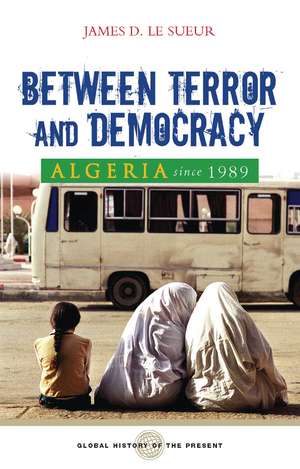
Algeria since 1989: Between Terror and Democracy: Global History of the Present
Autor James D. Le Sueuren Limba Engleză Paperback – 14 ian 2010
Le Sueur shows that Algeria is at the very heart of contemporary debates about Islam and secular democracy, arguing that the stability of Algeria is crucial for the security of the wider Middle East. Algeria Since 1989 is a lively and essential examination of how the fate of one country is entwined with much greater global issues.




Preț: 165.12 lei
Preț vechi: 199.70 lei
-17%
Puncte Express: 248
Carte tipărită la comandă
Livrare economică 06-20 iunie
Specificații
ISBN-13: 9781842777251
ISBN-10: 1842777254
Pagini: 224
Dimensiuni: 138 x 216 x 18 mm
Greutate: 0.35 kg
Editura: Bloomsbury Publishing
Colecția Zed Books
Seria Global History of the Present
Locul publicării:London, United Kingdom
ISBN-10: 1842777254
Pagini: 224
Dimensiuni: 138 x 216 x 18 mm
Greutate: 0.35 kg
Editura: Bloomsbury Publishing
Colecția Zed Books
Seria Global History of the Present
Locul publicării:London, United Kingdom
V-ar putea interesa
-
 GoebbelsPeter Longerich-17%Preț: 99.69 lei120.55 lei
 -
 The German WarNicholas Stargardt-27%Preț: 87.10 lei119.25 lei
 -
 Decolonization: A Very Short IntroductionDane Kennedy-22%Preț: 52.49 lei67.20 lei
 -
 KL: A History of the Nazi Concentration CampsNikolaus Wachsmann-25%Preț: 89.71 lei119.72 lei
 -
 The Long Sixties – America, 1955–1973CB StrainPreț: 273.03 lei
 -
 Red PlentyFrancis SpuffordPreț: 90.23 lei
 -
 Preț: 278.95 lei
 -
 The Invention of RussiaArkady Ostrovsky-30%Preț: 63.03 lei90.43 lei
 -
 -26%Preț: 164.93 lei222.93 lei
 -
 -17%Preț: 244.39 lei294.36 lei
 -
 Thabo Mbeki and the Battle for the Soul of the ANCWilliam Mervin Gumede-16%Preț: 272.45 lei323.68 lei
 -
 The Age of Transition: Trajectory of the World-System, 1945-2025Terence K. Hopkins-17%Preț: 271.92 lei327.96 lei
 -
 Berlin 1936Oliver HilmesPreț: 146.20 lei
Cuprins
Acknowledgments
Chronology
The principals
Abbreviations and acronyms
Map
Introduction: democratic reform, terrorism and reconciliation
1. Building a postcolonial state
2. The road to reform
3. The kingmakers: generals and presidents in a time of terror
4. The Bouteflika era: civil society, peace, and sidelining generals
5. Energy and the economy of terror
6. A genealogy of terror: local and global jihadis
7. The future of radical Islam: from the GSPC to AQMI
8. Killing the messengers: Algeria's Rushdie syndrome
Conclusion: a historian's reflections on amnesty in Algeria
Notes
Index
Chronology
The principals
Abbreviations and acronyms
Map
Introduction: democratic reform, terrorism and reconciliation
1. Building a postcolonial state
2. The road to reform
3. The kingmakers: generals and presidents in a time of terror
4. The Bouteflika era: civil society, peace, and sidelining generals
5. Energy and the economy of terror
6. A genealogy of terror: local and global jihadis
7. The future of radical Islam: from the GSPC to AQMI
8. Killing the messengers: Algeria's Rushdie syndrome
Conclusion: a historian's reflections on amnesty in Algeria
Notes
Index
Recenzii
Based on many years of close study of the country, the author unveils the many contradictions, complexities, and conflicts that continue to plague North Africa's most important political actor whose fate has implications for the Mediterranean region and beyond.
LeSueur makes an extremely valuable contribution to our understanding of contemporary Algerian history - placing this history into a broader geopolitical and sociological perspective, including the failure of democratic liberalism and the rise of political Islam and Islamic radicalism.
James Le Sueur provides a striking portrait of Algeria in the 1990s that is truly remarkable for presenting a fair and balanced analysis of an extremely controversial history. While Le Sueur's account provides a full account of Algerian developments, it places these experiences within broader global contexts, making this book distinctively valuable for policy makers as well as the broader public.
LeSueur makes an extremely valuable contribution to our understanding of contemporary Algerian history - placing this history into a broader geopolitical and sociological perspective, including the failure of democratic liberalism and the rise of political Islam and Islamic radicalism.
James Le Sueur provides a striking portrait of Algeria in the 1990s that is truly remarkable for presenting a fair and balanced analysis of an extremely controversial history. While Le Sueur's account provides a full account of Algerian developments, it places these experiences within broader global contexts, making this book distinctively valuable for policy makers as well as the broader public.