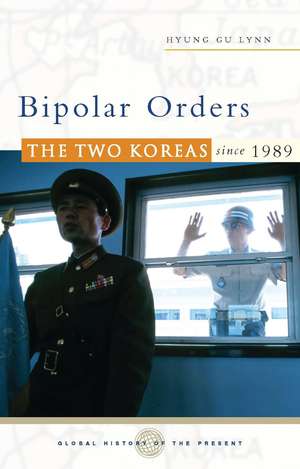
Bipolar Orders: The Two Koreas since 1989: Global History of the Present
Autor Hyung Gu Lynnen Limba Engleză Paperback – oct 2007
North Korea has experienced severe economic deterioration and increasing international isolation, while South Korea has undergone democratization and witnessed the emergence of a vibrant consumer culture. Paradoxically, this growing gap in ideologies and material standards has led to improved relations between the two countries. Why has this counterintuitive development occurred? Is North Korea really a threat, and if so, for whom? This book provides a substantive, accessible, and timely examination of the complex and compelling histories of the two Koreas.





Preț: 259.52 lei
Preț vechi: 308.42 lei
-16%
Puncte Express: 389
Carte tipărită la comandă
Livrare economică 05-19 decembrie
Livrare prin curier în România Termenul estimat este afișat lângă disponibilitate.
Transport gratuit de la 400.00 lei Plată online sau ramburs, în funcție de opțiunile comenzii.
Retur gratuit în 14 zile Comandă securizată și suport în română.
Specificații
ISBN-13: 9781842777435
ISBN-10: 1842777432
Pagini: 224
Dimensiuni: 135 x 216 x 18 mm
Greutate: 0.3 kg
Editura: Bloomsbury Publishing
Colecția Zed Books
Seria Global History of the Present
Locul publicării:London, United Kingdom
ISBN-10: 1842777432
Pagini: 224
Dimensiuni: 135 x 216 x 18 mm
Greutate: 0.3 kg
Editura: Bloomsbury Publishing
Colecția Zed Books
Seria Global History of the Present
Locul publicării:London, United Kingdom
Cuprins
Introduction
1. Democratization and Anti-Americanism in South Korea
2. Capitalism and Consumerism in South Korea
3. Political Isolation of North Korea
4. Economic Decline of North Korea
5. Representations in Popular Culture of South and North
6. North Korea and South Korea in the World
Conclusions
Notes
Suggestions for Further Reading
Index
1. Democratization and Anti-Americanism in South Korea
2. Capitalism and Consumerism in South Korea
3. Political Isolation of North Korea
4. Economic Decline of North Korea
5. Representations in Popular Culture of South and North
6. North Korea and South Korea in the World
Conclusions
Notes
Suggestions for Further Reading
Index
Recenzii
This book will serve as a good introductory analysis to the complexity of the post-1989 Korean arena for Asian studies, political science and even economics students, as well as for policy makes who strive to understand what is happening in the Korean Peninsula.
Hyung Gu Lynn has written a concise, well-judged and most useful analysis of the Korean peninsula since the fall of the Berlin Wall. South Korea's continuing democratization and development toward the 10th-ranking industrial power of the world, combined with North Korea's unexpected persistence since 1989, both raise important questions about the 'end of history' narrative.
Lynn's book is a rich and elegant tour de force that both informs and challenges conventional perspectives on the two Koreas on multiple levels, from politics to popular culture, and re-affirms the importance of understanding the present and future of the divided peninsula in the context of its deeply-textured past. Among the plethora of recent books on Korea, this is one that truly stands out-a "must-read" for anyone interested in contemporary Korea, professional and layman alike.
This book reflects the diversity of the author's long experiences on the Korean Peninsula and gives a vivid sense of the great variety of people that inhabit North and South Korea. It is an effective and dynamic work that argues that there is no "end of history" for the two Koreas.
Hyung Gu Lynn has written a concise, well-judged and most useful analysis of the Korean peninsula since the fall of the Berlin Wall. South Korea's continuing democratization and development toward the 10th-ranking industrial power of the world, combined with North Korea's unexpected persistence since 1989, both raise important questions about the 'end of history' narrative.
Lynn's book is a rich and elegant tour de force that both informs and challenges conventional perspectives on the two Koreas on multiple levels, from politics to popular culture, and re-affirms the importance of understanding the present and future of the divided peninsula in the context of its deeply-textured past. Among the plethora of recent books on Korea, this is one that truly stands out-a "must-read" for anyone interested in contemporary Korea, professional and layman alike.
This book reflects the diversity of the author's long experiences on the Korean Peninsula and gives a vivid sense of the great variety of people that inhabit North and South Korea. It is an effective and dynamic work that argues that there is no "end of history" for the two Koreas.