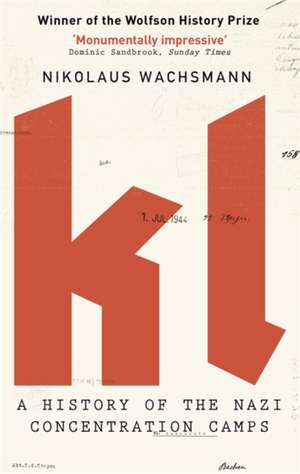
KL: A History of the Nazi Concentration Camps
Autor Nikolaus Wachsmannen Limba Engleză Paperback – 7 iul 2016
Relevanța lucrării KL pentru mediul academic și pentru cercetarea istorică este incontestabilă, reprezentând prima istorie cuprinzătoare a sistemului de lagăre de concentrare naziste care acoperă întregul arc temporal 1933–1945. Suntem de părere că acest volum, distins ca finalist al National Jewish Book Award, reușește să umple un gol imens în istoriografia Holocaustului prin integrarea unor surse primare și cercetări germane care nu au fost niciodată accesibile publicului vorbitor de limba engleză. Autorul nu se limitează la o simplă cronologie, ci construiește o imagine unificată a regimului, analizând modul în care forțele politice, juridice și economice au modelat evoluția lagărelor. Abordarea este una duală, oferind atât o perspectivă panoramică asupra mecanismelor puterii, cât și detalii intime despre viața cotidiană a deținuților. Cititorii familiarizați cu The Theory and Practice of Hell de Eugen Kogon vor aprecia modul în care Nikolaus Wachsmann extinde mărturia istorică timpurie cu o rigoare științifică modernă și o perspectivă mult mai largă asupra întregului aparat SS. Spre deosebire de lucrări care se concentrează strict pe perioada războiului, acest volum analizează și anii formativi ai sistemului, oferind un context esențial pentru înțelegerea radicalizării violenței de stat. În contextul operei sale, KL reprezintă apogeul cercetărilor începute cu Hitler's Prisons, continuând explorarea terorii legale și a represiunii în al Treilea Reich. Dacă în Rewriting German History autorul propunea noi direcții pentru bursa istorică a secolului XXI, în acest volum el aplică acele principii, livrând o lucrare de referință care balansează analiza structurală cu experiența umană din ceea ce numim generic „zona gri”.
Preț: 96.97 lei
Preț vechi: 125.69 lei
-23%
Carte disponibilă
Livrare economică 16-30 noiembrie
Livrare express 30 octombrie-05 noiembrie pentru 66.84 lei
Specificații
ISBN-10: 0349118663
Pagini: 880
Ilustrații: Section: 24, b/w
Dimensiuni: 200 x 131 x 43 mm
Greutate: 0.6 kg
Editura: Little Brown
Colecția Abacus
Locul publicării:London, United Kingdom
V-ar putea interesa
-
 A Technique for Producing IdeasJames Young-13%Preț: 55.32 lei63.40 lei
 -
 Never Have Your Dog StuffedAlan Alda-18%Preț: 64.97 lei79.46 lei
 -
 Meetings with Remarkable ManuscriptsChristopher De Hamel-26%Preț: 91.50 lei124.02 lei
 -
 Hitler’s Prisons: Legal Terror in Nazi GermanyNikolaus WachsmannPreț: 523.56 lei
 -
 -26%Preț: 68.14 lei92.60 lei
 -
 Concentration Camps in Nazi Germany: The New HistoriesNikolaus WachsmannPreț: 411.72 lei
 -
 Back From the Future: Cuba Under CastroSusan Eva Eckstein-15%Preț: 441.01 lei518.84 lei
 -
 Reagan PresidencyW. Elliot BrownleePreț: 497.58 lei
 -
 -18%Preț: 1126.71 lei1374.04 lei
 -
 The Nazi Concentration Camps, 1933-1939: A Documentary HistoryDr. Christian Goeschel-15%Preț: 459.76 lei540.89 lei
 -
 Ohio and Its PeopleKnepperPreț: 316.11 lei
 -
 Rewriting German HistoryJan Rüger-15%Preț: 735.87 lei865.73 lei
 -
 -19%Preț: 58.35 lei71.82 lei
 -
 Preț: 95.28 lei
 -
 -40%Preț: 66.60 lei110.15 lei
 -
 Bis zur letzten StundeTraudl JungePreț: 97.16 lei
 -
 KLNikolaus WachsmannPreț: 209.00 lei
De ce să citești această carte
Recomandăm această carte tuturor celor care studiază istoria secolului XX sau științele politice. Veți câștiga o înțelegere profundă și documentată a modului în care o instituție a inumanității a fost construită și menținută prin mecanisme birocratice și sociale. Este o lectură esențială pentru a înțelege nu doar ce s-a întâmplat, ci și cum a fost posibil ca sistemul lagărelor să devină centrul simbolic al regimului nazist.
Despre autor
Nikolaus Wachsmann este profesor de istorie modernă germană la Birkbeck College, University of London. Născut la München, și-a dedicat cariera academică studierii mecanismelor de represiune din Germania nazistă. Pentru cercetările sale, a fost co-câștigător al Premiului Fraenkel în Istorie Contemporană. Expertiza sa în arhivele germane i-a permis să publice lucrări fundamentale precum „Hitler's Prisons: Legal Terror in Nazi Germany”, consolidându-și reputația de autoritate mondială în istoria celui de-al Treilea Reich și a sistemelor sale punitive.
Descriere
In March of 1933, a disused factory surrounded by barbed wire held 223 prisoners in the town of Dachau. By the end of 1945, the SS concentration camp system had become an overwhelming landscape of terror. Twenty-two large camps and over one thousand satellite camps throughout Germany and Europe were at the heart of the Nazi campaign of repression and intimidation. The importance of the camps in terms of Nazi history and our modern world cannot be questioned.
Dr Nikolaus Wachsmann is the first historian to write a complete history of the camps. Combining the political and the personal, Wachsmann will examine the organisation of such an immense genocidal machine, whilst drawing a vivid picture of life inside the camps for the individual prisoner. The book gives voice to those typically forgotten in Nazi history: the 'social deviants', criminals and unwanted ethnicities that all faced the terror of the camps. Wachsmann explores the practice of institutionalised murder and inmate collaboration with the SS selectively ignored by many historians. Pulling together a wealth of in-depth research, official documents, contemporary studies and the evidence of survivors themselves, KL is a complete but accessible narrative.
Recenzii
This is the fullest and most comprehensive history of the Nazi concentration camps in any language: a magnificent feat of research, full of arresting detail and cogent analysis, readable as well as authoritative: an extraordinary achievement that will immediately take its place as the standard work on the subject
This book is a remarkable achievement. Nikolaus Wachsmann has written the first integrated history of Nazi concentration camps, unifying in a single narrative the policies and measures governing the inception and growth of the system, the context in which the monstrous KL developed and how each of its stages and facets was recorded and remembered by its victims. The study is essential for a further understanding of the Third Reich
Nikolaus Wachsmann has written an admirable historical overview of the Nazi concentration camps, effectively combining decades of recent scholarship with his own original research. He captures both the trajectory of dynamic change through which the camp system evolved as well as the experiences and agency - however limited - of the prisoner community. This is an impressive and valuable book
Telling the story of the KL means facing up to a formidable challenge: how to make the camps relatable, as places where real people lived, worked and died, rather than transcendental symbols of evil? . . . [Wachsmann] proves himself equal to this challenge . . . thanks to Wachsmann's skill as a writer, it manages to be much more than a doleful trudge through a universe of ever-increasing death and terror
Monumentally impressive . . . seems certain to become the definitive history of the Nazi concentration camps . . . his scholarship brings new life to a familiar subject
Profoundly important . . . exceptional . . . will surely become the standard work on the subject
Wachsmann has in effect united the best of the German and the British schools of grand World War II history: hugely but humbly exhaustive research with attention to character and to detailed narrative
Wachsmann's meticulous research and unwavering eye for detail is never permitted to detract from the individual human tragedies . . . so much more than another academic record of the holocaust
Hugely impressive . . . Wachsmann has produced the standard historical work on the Nazi camps . . . KL represents the acme of what the historical disciple can achieve
[A] magnificent work of scholarship . . . every page of Nikolaus Wachsmann's magisterial account is suffused with humanity
Gripping, humane, and beautifully written
A work of prodigious scholarship
Every page is suffused with humanity and anyone who wants to understand the Nazis should read it
Hugely impressive . . . Wachsmann pulls off a remarkable feat: he not only provides an account of Konzentrationslager, or KL of the books title, he does so in a readable, accessible way. KL represents an acme of what the historical discipline can achieve
It is difficult to do justice to the brilliance of Wachsmann's comprehensive history . . . engrossing as well as illuminating
Wachsmann's book is a world-making history
In devastating and undeniable detail, KL sets out the full story of the camps
A staggeringly well-informed and enormously moving record of suffering and evil . . .the terrifying lesson of Wachsmann's account is not that any of us might have been an inmate. It is that any of us might have been a guard
A truly excellent book on one of history's darkest moments
This is both a panoptic and an intimate history of the camps: we get the big picture as well as the telling detail
(the SS officer who opened doors with his elbow rather than his hand because he was worried about germs). It is a huge and very necessary contribution to our understanding of this obscene subject. It makes us think anew: about how the camps worked, what it was like in them and how they fitted into the machinery of the state