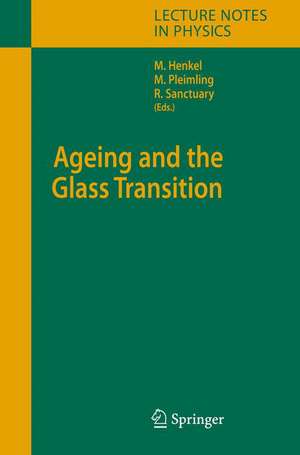
Ageing and the Glass Transition: Lecture Notes in Physics, cartea 716
Editat de Malte Henkel, Michel Pleimling, Roland Sanctuaryen Limba Engleză Hardback – 24 apr 2007
Din seria Lecture Notes in Physics
-
 Preț: 389.83 lei
 -
 Preț: 497.72 lei
 -
 Preț: 464.37 lei
 -
 Preț: 308.31 lei
 -
 Preț: 465.67 lei
 -
 Preț: 295.68 lei
 - 15%
 Preț: 568.48 lei
 -
 Preț: 392.47 lei
 - 15%
 Preț: 570.85 lei
 - 15%
 Preț: 513.02 lei
 -
 Preț: 478.20 lei
 - 15%
 Preț: 682.21 lei
 - 15%
 Preț: 411.68 lei
 -
 Preț: 156.99 lei
 -
 Preț: 379.84 lei
 - 15%
 Preț: 599.84 lei
 - 20%
 Preț: 515.72 lei
 -
 Preț: 434.49 lei
 -
 Preț: 333.50 lei
 - 15%
 Preț: 496.29 lei
 - 15%
 Preț: 564.61 lei
 -
 Preț: 296.99 lei
 - 15%
 Preț: 463.74 lei
 - 20%
 Preț: 459.08 lei
 -
 Preț: 377.01 lei
 - 15%
 Preț: 460.49 lei
 -
 Preț: 373.16 lei
 - 15%
 Preț: 456.35 lei
 -
 Preț: 409.52 lei
 - 15%
 Preț: 486.81 lei
 - 15%
 Preț: 496.41 lei
 - 15%
 Preț: 482.56 lei
 - 15%
 Preț: 484.00 lei
 - 15%
 Preț: 631.27 lei
 - 15%
 Preț: 534.35 lei
 - 15%
 Preț: 465.49 lei
 -
 Preț: 433.64 lei
 - 19%
 Preț: 439.99 lei
 -
 Preț: 296.63 lei
 - 20%
 Preț: 531.58 lei
 - 15%
 Preț: 580.06 lei
 - 15%
 Preț: 564.75 lei
 - 15%
 Preț: 464.67 lei
 - 15%
 Preț: 481.15 lei
 - 15%
 Preț: 528.89 lei
 - 15%
 Preț: 623.70 lei
 - 24%
 Preț: 741.54 lei
 - 20%
 Preț: 465.27 lei
 -
 Preț: 386.74 lei
Preț: 382.30 lei
Puncte Express: 573
Carte tipărită la comandă
Livrare economică 09-23 iunie
Specificații
ISBN-13: 9783540696834
ISBN-10: 3540696830
Pagini: 349
Ilustrații: XII, 349 p.
Dimensiuni: 155 x 235 x 29 mm
Greutate: 0.64 kg
Ediția:2007
Editura: Springer Berlin, Heidelberg
Colecția Springer
Seria Lecture Notes in Physics
Locul publicării:Berlin, Heidelberg, Germany
ISBN-10: 3540696830
Pagini: 349
Ilustrații: XII, 349 p.
Dimensiuni: 155 x 235 x 29 mm
Greutate: 0.64 kg
Ediția:2007
Editura: Springer Berlin, Heidelberg
Colecția Springer
Seria Lecture Notes in Physics
Locul publicării:Berlin, Heidelberg, Germany
V-ar putea interesa
-
 Dislocations, Mesoscale Simulations and Plastic FlowLadislas Kubin-34%Preț: 725.02 lei1091.69 lei
 -
 -21%Preț: 457.82 lei581.25 lei
 -
 -12%Preț: 311.36 lei354.42 lei
 -
 Modern Theory of ThermoelectricityVeljko Zlatic-34%Preț: 649.11 lei976.54 lei
 -
 Granular PatternsIgor Aranson-21%Preț: 372.41 lei472.72 lei
 -
 Excitations in Organic SolidsVladimir M. Agranovich-18%Preț: 487.26 lei593.69 lei
 -
 Novel Superfluids: Volume 2Karl-Heinz Bennemann-33%Preț: 971.41 lei1446.00 lei
 -
 Advances in the Casimir EffectMichael Bordag-21%Preț: 477.02 lei606.87 lei
 -
 -30%Preț: 478.67 lei681.21 lei
 -
 Non-Equilibrium Phase TransitionsMalte Henkel-18%Preț: 919.64 lei1121.51 lei
 -
 Tribology in Sheet Rolling TechnologyAkira Azushima-19%Preț: 622.16 lei768.10 lei
 -
 -15%Preț: 567.22 lei667.32 lei
 -
 Preț: 371.03 lei
 -
 -8%Preț: 556.90 lei605.33 lei
 -
 Non-Equilibrium Phase TransitionsMalte Henkel-15%Preț: 638.68 lei751.39 lei
 -
 -18%Preț: 912.69 lei1113.03 lei
 -
 Non-Equilibrium Phase TransitionsMalte Henkel-15%Preț: 633.11 lei744.83 lei
Public țintă
ResearchCuprins
Ageing, Rejuvenation and Memory: The Example of Spin-Glasses.- About the Nature of the Structural Glass Transition: An Experimental Approach.- Glassy Behaviours in A-Thermal Systems, the Case of Granular Media: A Tentative Review.- to Simulation Techniques.- From Urn Models to Zero-Range Processes: Statics and Dynamics.- Field-Theory Approaches to Nonequilibrium Dynamics.
Textul de pe ultima copertă
Understanding cooperative phenomena far from equilibrium is one of fascinating challenges of present-day many-body physics. Glassy behaviour and the physical ageing process of such materials are paradigmatic examples. The present volume, primarily intended as introduction and reference for postgraduate students and nonspecialist researchers from related fields, collects six extensive lectures addressing selected experimental and theoretical issues in the field of glassy systems.
Lecture 1 gives an introduction and overview of the time-dependent behaviour of magnetic spin glasses. Lecture 2 is devoted to an in-depth discussion on the nature of the thermal glass-transition in structural glasses. Lecture 3 examines the glassy behaviour of granular systems. Lecture 4 gives a thorough introduction to the techniques and applications of Monte-Carlo simulations and the analysis of the resulting data through scaling methods. Lecture 5 introduces the zero-range-process concept as simple but subtle model to describe a range of static and dynamic properties of glassy systems. Lecture 6 shows how familiar RG methods for equilibrium systems can be extended to systems far from equilibrium.
Lecture 1 gives an introduction and overview of the time-dependent behaviour of magnetic spin glasses. Lecture 2 is devoted to an in-depth discussion on the nature of the thermal glass-transition in structural glasses. Lecture 3 examines the glassy behaviour of granular systems. Lecture 4 gives a thorough introduction to the techniques and applications of Monte-Carlo simulations and the analysis of the resulting data through scaling methods. Lecture 5 introduces the zero-range-process concept as simple but subtle model to describe a range of static and dynamic properties of glassy systems. Lecture 6 shows how familiar RG methods for equilibrium systems can be extended to systems far from equilibrium.