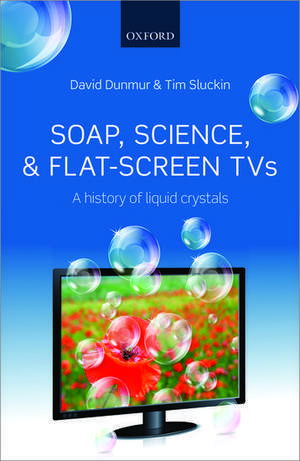
Soap, Science, and Flat-Screen TVs: A History of Liquid Crystals
Autor David Dunmur, Tim Sluckinen Limba Engleză Paperback – 29 mai 2014
Preț: 337.21 lei
Preț vechi: 383.32 lei
-12%
Puncte Express: 506
Carte tipărită la comandă
Livrare economică 04-15 decembrie
Livrare prin curier în România Termenul estimat este afișat lângă disponibilitate.
Transport gratuit de la 400.00 lei Plată online sau ramburs, în funcție de opțiunile comenzii.
Retur gratuit în 14 zile Comandă securizată și suport în română.
Specificații
ISBN-13: 9780198700838
ISBN-10: 0198700830
Pagini: 384
Ilustrații: 70 b/w line and halftone illustrations; 4pp colour plates section
Dimensiuni: 153 x 234 x 22 mm
Greutate: 0.57 kg
Editura: Oxford University Press
Colecția OUP Oxford
Locul publicării:Oxford, United Kingdom
ISBN-10: 0198700830
Pagini: 384
Ilustrații: 70 b/w line and halftone illustrations; 4pp colour plates section
Dimensiuni: 153 x 234 x 22 mm
Greutate: 0.57 kg
Editura: Oxford University Press
Colecția OUP Oxford
Locul publicării:Oxford, United Kingdom
V-ar putea interesa
-
 Introductory Statistical MechanicsRoger Bowley-20%Preț: 406.20 lei509.96 lei
 -
 Dislocations, Mesoscale Simulations and Plastic FlowLadislas Kubin-30%Preț: 819.83 lei1169.17 lei
 -
 -13%Preț: 429.85 lei493.98 lei
 -
 The Physics of SolidsJ. B. Ketterson-22%Preț: 634.94 lei812.01 lei
 -
 Elements of Phase Transitions and Critical PhenomenaHidetoshi Nishimori-21%Preț: 372.84 lei469.76 lei
 -
 Soft Matter PhysicsMasao Doi-20%Preț: 516.38 lei647.17 lei
 -
 Quasicrystals: A PrimerChristian Janot-28%Preț: 540.60 lei753.87 lei
 -
 -33%Preț: 711.29 lei1054.74 lei
 -
 Crystals That Flow: Classic Papers from the History of Liquid CrystalsTimothy J. Sluckin-14%Preț: 1120.87 lei1303.34 lei
 -
 Elements of Slow-Neutron ScatteringJ M Carpenter-14%Preț: 1264.94 lei1470.87 lei
 -
 Techniques in High Pressure Neutron ScatteringStefan Klotz-15%Preț: 600.82 lei706.85 lei
 -
 Introduction to Magnetism and Magnetic MaterialsDavid Jiles-18%Preț: 863.57 lei1053.13 lei
 -
 Memorial Volume for Y. NambuLars BrinkPreț: 198.04 lei
 -
 MANY-BODY PHYSICS, TOPOLOGY AND GEOMETRYSen SiddharthaPreț: 510.67 lei
 -
 STATISTICAL PHYSICSDiep Hung T-15%Preț: 495.95 lei583.47 lei
 -
 Preț: 383.59 lei
 -
 -18%Preț: 970.51 lei1183.55 lei
 -
 Particles and Quantum FieldsHagen KleinertPreț: 477.89 lei
 -
 -18%Preț: 1162.67 lei1417.89 lei
 -
 INTRO ELAS THEO CRYS (2ND ED)Balluffi Robert WPreț: 515.42 lei
 -
 An Introduction to Graphene PlasmonicsPaulo Andre Dias GoncalvesPreț: 470.23 lei
Recenzii
Full of charming and not widely known historical anecdotes, this book describes the drama of liquid crystals science from its early days to modern technical applications. One of the most informative and entertaining pieces of popular science history I have seen in years.
Visual communication became transportable through the discovery of that strange state of matter, the liquid crystal. This history is a fascinating account of that discovery and its development and gives considerable insight into the social mechanisms of science in general. The authors do not evade the science itself, treating it lightly but appropriately. Altogether, a detailed, informative, and enthralling account of a crucial part of techonlogical and scientific history.
Dunmur and Sluckin tell an absorbing and colourful story of an area of science that is both rich at the fundamental level and that has brought some of the major new technologies of our age. They follow the twists and turns, and the conflicts, of the science and of the people pursuing it. It is satisfying too when the authors step back from time to time to give the modern view and therefore the resolution of the difficulties of the early protagonists. Most enjoyable!
... engaging monograph ... I recommend this cultured chronicle of the people and history of a delicate state of matter that has had a profound influence on the technologies of communications and displays.
This is a truly stimulating look at the history and science of a little-understood phase of matter and a material that affects our lives every day [...] a truly useful addition to the pedagogical literature on liquid crystals.
It provides a perceptive insight into the evolution of the important area of soft matter and the development from this of an impressive display technology.
The authors delightful weaving of the influence of first individuals and then commercial companies with the advances in science pertinent to developing displays makes for fascinating and entertaining reading.
This is a readable introduction to an influential field, concentrating on personalities within political eras, and demonstrating that as complicated as the science might get, it is still a human endeavor, with all the attendant ambition, misunderstanding, dead ends and eventual enlightenment.
The liquid crystal display has changed the world and will continue to do so. 'Soap, Science, and Flat-Screen TVs' is a true and valuable history of its first 100 years, embracing as it does both the scientific literature and the history and socio-economic background of the individuals and institutions that make up the story.
Visual communication became transportable through the discovery of that strange state of matter, the liquid crystal. This history is a fascinating account of that discovery and its development and gives considerable insight into the social mechanisms of science in general. The authors do not evade the science itself, treating it lightly but appropriately. Altogether, a detailed, informative, and enthralling account of a crucial part of techonlogical and scientific history.
Dunmur and Sluckin tell an absorbing and colourful story of an area of science that is both rich at the fundamental level and that has brought some of the major new technologies of our age. They follow the twists and turns, and the conflicts, of the science and of the people pursuing it. It is satisfying too when the authors step back from time to time to give the modern view and therefore the resolution of the difficulties of the early protagonists. Most enjoyable!
... engaging monograph ... I recommend this cultured chronicle of the people and history of a delicate state of matter that has had a profound influence on the technologies of communications and displays.
This is a truly stimulating look at the history and science of a little-understood phase of matter and a material that affects our lives every day [...] a truly useful addition to the pedagogical literature on liquid crystals.
It provides a perceptive insight into the evolution of the important area of soft matter and the development from this of an impressive display technology.
The authors delightful weaving of the influence of first individuals and then commercial companies with the advances in science pertinent to developing displays makes for fascinating and entertaining reading.
This is a readable introduction to an influential field, concentrating on personalities within political eras, and demonstrating that as complicated as the science might get, it is still a human endeavor, with all the attendant ambition, misunderstanding, dead ends and eventual enlightenment.
The liquid crystal display has changed the world and will continue to do so. 'Soap, Science, and Flat-Screen TVs' is a true and valuable history of its first 100 years, embracing as it does both the scientific literature and the history and socio-economic background of the individuals and institutions that make up the story.
Notă biografică
David Dunmur received his undergraduate and postgraduate degrees from the University of Oxford. After three years as a research fellow in the newly formed Department of Theoretical Chemistry, University of Bristol, he was appointed in 1968 as a lecturer in Chemistry at the University of Sheffield, where he became Head of the Department of Chemistry from 1993 to 1996. He was a Fulbright Scholar at the University of California, Los Angeles, in 1980. In 1999 he received the George Gray Medal from the British Liquid Crystal Society. From 1996 to his retirement in 2005, he was a research Professor at the School of Chemistry, University of Southampton.Tim Sluckin was born in London in 1951, and educated in Cambridge and Nottingham, where he received his PhD in 1975 for a thesis on the theoretical physics of liquid helium. After several postdoctoral appointments in the USA and in the UK, he was appointed a lecturer in applied mathematics at the University of Southampton in 1981. Since 1995 he has been Professor of Applied Mathematical Physics at the University of Southampton. He has also spent extended periods of sabbatical leave abroad, including spells in France (Grenoble), Italy (Milan), and Israel (Haifa). His main research interests have been in mathematical and physical aspects of liquid crystals, but he also has interests in other fluid phenomena. Another of his interests is mathematical population biology, including, in particular, problems to do with human prehistory. More recently he has also published significantly in the history of science.