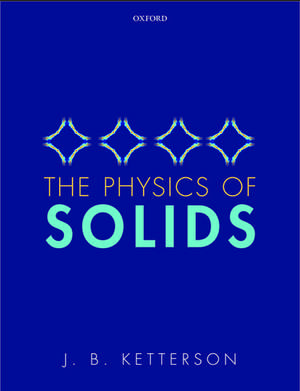
The Physics of Solids
Autor J. B. Kettersonen Limba Engleză Hardback – 8 sep 2016
Preț: 634.94 lei
Preț vechi: 812.01 lei
-22%
Puncte Express: 952
Carte tipărită la comandă
Livrare economică 04-09 decembrie
Livrare prin curier în România Termenul estimat este afișat lângă disponibilitate.
Transport gratuit pentru acest produs Plată online sau ramburs, în funcție de opțiunile comenzii.
Retur gratuit în 14 zile Comandă securizată și suport în română.
Specificații
ISBN-13: 9780198742906
ISBN-10: 0198742908
Pagini: 1054
Ilustrații: 370 black and white illustrations
Dimensiuni: 192 x 246 x 54 mm
Greutate: 2.34 kg
Editura: OUP OXFORD
Colecția OUP Oxford
Locul publicării:Oxford, United Kingdom
ISBN-10: 0198742908
Pagini: 1054
Ilustrații: 370 black and white illustrations
Dimensiuni: 192 x 246 x 54 mm
Greutate: 2.34 kg
Editura: OUP OXFORD
Colecția OUP Oxford
Locul publicării:Oxford, United Kingdom
V-ar putea interesa
-
 Quantum MechanicsLeonard Susskind-30%Preț: 65.69 lei93.77 lei
-
 Polymers and Neutron ScatteringJulia S. Higgins-31%Preț: 785.50 lei1146.21 lei
-
 Introductory Statistical MechanicsRoger Bowley-20%Preț: 406.20 lei509.96 lei
-
 The Friction and Lubrication of SolidsF. P Bowden-34%Preț: 701.82 lei1056.17 lei
-
 -33%Preț: 741.71 lei1108.97 lei
-
 The Physics of FoamsDenis Weaire-31%Preț: 562.04 lei815.94 lei
-
 -32%Preț: 801.16 lei1169.88 lei
-
 Liquid Crystal ElastomersMark Warner-30%Preț: 567.61 lei805.78 lei
-
 -30%Preț: 933.89 lei1333.93 lei
-
 Crystallography of Modular MaterialsGiovanni Ferraris-28%Preț: 480.22 lei669.61 lei
-
 Introduction to Mesoscopic PhysicsYoseph Imry-20%Preț: 493.85 lei619.14 lei
-
 Optical Properties of SolidsMark FoxPreț: 383.52 lei
-
 Optical Processes in SolidsYutaka Toyozawa-14%Preț: 789.57 lei918.10 lei
-
 Bose-Einstein Condensation in Dilute GasesC. J. Pethick-14%Preț: 774.34 lei900.39 lei
-
 Transport in NanostructuresDavid K. Ferry-14%Preț: 725.66 lei843.80 lei
Recenzii
Ketterson's book is welcomed as a valuable and fairly successful attempt to expose solid-state physics from todays perspective.
This is an outstanding book covering fundamental concepts and advanced theories explaining classical and quantum phenomena in solids. Solving the homework problems given at the end of each chapter will provide students with an in-depth understanding of the concepts... I strongly recommend it to all undergraduate, master's level, and research students interested in learning solid-state physics.
The book will be a great reference for those working in the field and for advanced physics students interested in these areas of physics... Recommended.
This new book is outstanding in its discussion of fundamental concepts and choice of topics, unlike many current texts, which vary from the too-specialized and advanced, to engineering texts which avoid fundamentals, and the older classics (Kittel, Ashcroft and Mermin, Raimes, Ziman, Omar) which omit modern topics. From elasticity to superconductivity, magnetism, phonons, graphene, DFT ( just the right level for upper level physics), glasses, dislocations, strong correlations, High Tc, quantum devices and multilayers, optical properties, electron transport, Hartree-Fock and band-structure methods, Ketterson gets the physics right, and uses more clearer language in setting up his equations than any text Ive seen. For clarity, coverage, the minimal necessary connection with experiment, and level, this is one of the very best condensed matter texts Ive come across.
Notă biografică
J.B. Ketterson received his BS, MS, and PhD degrees from the University of Chicago, USA. He worked at the Argonne National laboratory from 1962 to 1974 at which time he joined the faculty of the Physics and Astronomy Department at Northwestern University, USA. Research interests have included electronic properties of metals (particularly Fermi surface measurements); superfluid 4He, normal and superfluid 3He, and 3He - 4He solutions; superconductivity, magnetism and magnetic resonance, nonlinear optics, and excitons.
Cuprins
- Part I: Introductory Topics
- 1: Elastic behavior of solids
- 2: Electric behavior of insulators
- 3: Metals and the Drude-Lorentz model
- 4: Elementary theories of thermal properties of solids
- 5: Elementary theories of magnetism
- 6: The non-interacting Fermi gas
- 7: Elementary theories of crystal bonding
- Part II: Crystal Structure and its Determination
- 8: Lattices and crystal structures
- 9: X-ray diffraction
- Part III: Electronic Structure of Periodic Solids
- 10: Electrons in a periodic solid
- 11: The nearly-free electron, OPW, pseudopotential, and tight binding methods
- 12: The parameterization of band structures: applications to semiconductors
- 13: Augmented-plane wave and Green's function methods
- Part IV: Electron-electron interaction
- 14: The self-consistent dielectric function
- 15: Hartree-Fock and density functional theory
- Part V: Lattice Dynamics
- 16: Harmonic lattice dynamics: classical and quantum
- 17: Thermal expansion, phonon-phonon interactions, and heat transport
- Part VI: Electron Transport and Conduction Electron Dynamics
- 18: Motion of electroncs and holes in external electric and magnetic fields
- 19: Electronic transport properties governed by static scattering centers
- 20: Measuring the electronic energy spectrum on and off the Fermi surface
- 21: The interacting system of metallic-electrons and phonons
- Part VII: Semiconductors
- 22: Homogeneous semiconductors
- 23: Inhomogeneous semiconductors
- Part VIII: Electric and Magnetic Properties of Insulators
- 24: Electric and magnetic susceptibilities
- 25: Piezoelectricity, pyroelectricity, and ferroelectrcity
- Part IX: Magnetism
- 26: Ferromagnetism and antiferromagnetism
- 27: Dynamic properties of magnetic materials
- 28: Magnetic resonance
- Part X: Optical Properties
- 29: Optical responses
- 30: Polaritons, excitons, and plasmons
- 31: Behavior under intense illumination: NLO, the e-h liquid and excitonic BEC
- Part XI: Superconductivity and Superfluidity
- 32: A phenomenological theory of superconductivity: the London equations
- 33: A phenomenological theory of superconductivity: the Ginzburg-Landau theory and the Josephson effects
- 34: The microscopic theory of superconductivity: Cooper pairing and the Bardeen-Cooper-Schrieffer theory
- 35: Elementary excitations and the thermodynamic properties of superconductors
- 36: Superfluid 4HE
- 37: Landau's theory of a Fermi liquid
- 38: Superfluid 3HE
- Part XII: Disordered Materials
- 39: Alloys
- 40: Defects and diffusion in crystalline solids
- 41: Dislocations and grain boundaries
- 42: Quantum theory of electrical transport in dilute alloys
- 43: Electrical transport in highly-disordered media: localization/interaction effects
- 44: Magnetic impurities and their interactions: the Anderson model, the Kondo effect and the RKKY interaction
- Part XIII: Special Topics
- 45: Strongly correlated systems
- 46: High temperature superconductors
- 47: Artificially structures and patterned materials; surfaces and interfaces
- 48: The quantum Hall effects
- 49: Graphene, carbon nantubes and fullerenes
- Appendix A: The calculus of variations
- Appendix B: The symmetry of many-particle wave functions; the occupation number representation