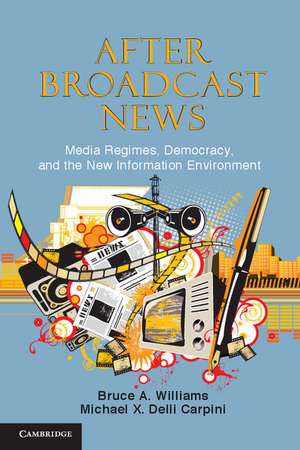
After Broadcast News: Media Regimes, Democracy, and the New Information Environment: Communication, Society and Politics
Autor Bruce A. Williams, Michael X. Delli Carpinien Limba Engleză Paperback – 9 oct 2011
În cadrul programelor de studii politice și de comunicare, After Broadcast News ocupă un loc central, adresând criza de autoritate a jurnalismului profesionist în fața noilor tehnologii. Subliniem modul în care Bruce A. Williams și Michael X. Delli Carpini refuză o abordare pur tehnologică, preferând o perspectivă istorică prin care demonstrează că relația dintre cetățeni, elite și presă a fost mereu negociată prin 'regimuri media' tranzitorii. Notăm cu interes structura cărții, care pornește de la provocarea granițelor dintre știri și divertisment — exemplificată prin comparația dintre Tina Fey și Katie Couric — pentru a ajunge la o analiză profundă a modului în care s-a dezintegrat regimul dominant al celei de-a doua jumătăți a secolului XX. Lucrarea este comparabilă cu Mediated Politics de W. Lance Bennett în rigurozitate, dar este actualizată pentru a explica vidul normativ actual, unde vechiul regim a dispărut, iar cel nou este încă în proces de formare. Autorii folosesc concepte precum 'hiperrealitate' și 'multiaxialitate' pentru a decoda momente critice, de la scandalurile administrației Clinton până la construcția spectacolului politic post-11 septembrie. Față de lucrarea anterioară a lui Williams, Democracy, Dialogue, and Environmental Disputes, care se concentra pe limbajul reglementărilor sociale, acest volum extinde aria de cercetare către întregul ecosistem informațional, oferind un cadru teoretic esențial pentru înțelegerea democrației în era post-televiziune.
Din seria Communication, Society and Politics
-
 Preț: 276.67 lei
 -
 Preț: 272.95 lei
 -
 Preț: 319.46 lei
 -
 Preț: 229.89 lei
 -
 Preț: 278.18 lei
 -
 Preț: 314.39 lei
 - 11%
 Preț: 534.49 lei
 -
 Preț: 178.33 lei
 - 11%
 Preț: 557.60 lei
 -
 Preț: 273.68 lei
 -
 Preț: 274.79 lei
 -
 Preț: 232.83 lei
 -
 Preț: 274.79 lei
 -
 Preț: 213.64 lei
 -
 Preț: 208.57 lei
 -
 Preț: 201.55 lei
 -
 Preț: 210.30 lei
 -
 Preț: 254.23 lei
 -
 Preț: 295.37 lei
 -
 Preț: 196.53 lei
 -
 Preț: 391.56 lei
 - 11%
 Preț: 579.15 lei
 -
 Preț: 276.29 lei
 -
 Preț: 207.61 lei
 -
 Preț: 233.56 lei
 -
 Preț: 273.88 lei
Preț: 280.81 lei
Carte tipărită la comandă
Livrare economică 03-17 iunie
Specificații
ISBN-10: 0521279836
Pagini: 376
Ilustrații: 7 b/w illus. 6 tables
Dimensiuni: 152 x 226 x 23 mm
Greutate: 0.54 kg
Ediția:New.
Editura: Cambridge University Press
Colecția Cambridge University Press
Seria Communication, Society and Politics
Locul publicării:New York, United States
V-ar putea interesa
-
 Preț: 151.42 lei
 -
 -6%Preț: 323.64 lei345.95 lei
 -
 Intercultural PragmaticsIstvan Kecskes-14%Preț: 675.98 lei786.02 lei
 -
 Humanity's LawRuti TeitelPreț: 279.23 lei
 -
 The Practice of Public DiplomacyW. RughPreț: 376.51 lei
 -
 Freedom's BattleGary J. BassPreț: 146.95 lei
 -
 Advocacy and Social Work PracticeTom Wilks-22%Preț: 187.11 lei240.19 lei
 -
 Branding Cities: Cosmopolitanism, Parochialism, and Social ChangeStephanie Hemelryk DonaldPreț: 453.04 lei
 -
 Preț: 295.57 lei
 -
 The Nature and Origins of Mass OpinionJohn R. ZallerPreț: 213.90 lei
 -
 -37%Preț: 250.76 lei398.75 lei
 -
 The Ethics of Armed Humanitarian InterventionDon E. ScheidPreț: 216.43 lei
 -
 International Law and International RelationsDavid ArmstrongPreț: 272.33 lei
 -
 International Public Relations and Public DiplomacyGuy J. GolanPreț: 415.54 lei
 -
 Managing the Public's Trust in Non-profit OrganizationsChristopher D.B. BurtPreț: 361.78 lei
De ce să citești această carte
Recomandăm această carte cercetătorilor și studenților la științe politice care doresc să înțeleagă de ce jurnalismul tradițional și-a pierdut monopolul asupra adevărului politic. Cititorul câștigă o perspectivă critică asupra modului în care mediul digital reconfigurează puterea politică, primind instrumentele necesare pentru a evalua dacă viitorul regim media va mai putea susține valorile democratice fundamentale.
Despre autor
Bruce A. Williams este profesor în cadrul Departamentului de Studii Media de la University of Virginia, având un doctorat în științe politice la University of Minnesota. Cu o carieră academică vastă, acesta a predat la instituții de prestigiu precum London School of Economics și University of Michigan. Expertiza sa în intersecția dintre democrație și comunicare a fost recunoscută prin premiul Caldwell pentru cea mai bună carte în 1996, distincție primită pentru volumul Democracy, Dialogue, and Environmental Disputes. Opera sa academică include peste patruzeci de articole care analizează reglementările sociale și discursul public.
Descriere scurtă
Cuprins
Recenzii
– Rodney Benson, New York University
“An insightful, well written and thoroughly researched analysis of what the rise of entertainment, the internet and digital media mean for the quality of journalism and democracy. While being firmly anchored to the US experience, it is highly relevant for Europe, Asia and elsewhere since we are all engulfed in a similar process of change.”
– James Curran, Goldsmiths, University of London
“Political communication took place for most of the late twentieth century in a media environment dominated by professional journalistic gatekeepers, dedicated to norms of social responsibility, largely insulated from commercial pressures, and at the same time closely tied to established political elites. Over the past couple of decades, this ‘media regime,’ as Williams and Delli Carpini put it, has broken down, and a multitude of hybrid genres and competing gatekeepers with divergent motivations and ideologies have replaced the bounded, unified system of the previous era. We are still sorting out how to understand political communication in this new era, and Williams and Delli Carpini make a sophisticated, lively contribution to accomplishing this. It makes a big difference that they bring to this task a good sense of history, and put the most recent transformation of American political communication in the context of along and complex history of contention over the rules of the game for determining who gets to speak about politics and how.”
– Daniel Hallin, University of California, San Diego