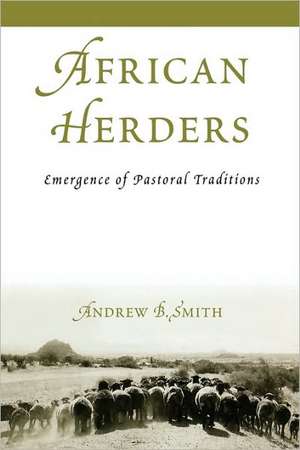
African Herders: Emergence of Pastoral Traditions: African Archaeology Series
Autor Andrew B. Smithen Limba Engleză Paperback – 24 ian 2005



Preț: 364.21 lei
Preț vechi: 462.89 lei
-21%
Puncte Express: 546
Carte tipărită la comandă
Livrare economică 17 noiembrie-01 decembrie
Livrare prin curier în România Termenul estimat este afișat lângă disponibilitate.
Transport gratuit de la 400.00 lei Plată online sau ramburs, în funcție de opțiunile comenzii.
Retur gratuit în 14 zile Comandă securizată și suport în română.
Specificații
ISBN-13: 9780759107489
ISBN-10: 0759107483
Pagini: 256
Dimensiuni: 149 x 228 x 17 mm
Greutate: 0.42 kg
Ediția:New.
Editura: Bloomsbury Publishing
Colecția AltaMira Press
Seria African Archaeology Series
Locul publicării:New York, United States
ISBN-10: 0759107483
Pagini: 256
Dimensiuni: 149 x 228 x 17 mm
Greutate: 0.42 kg
Ediția:New.
Editura: Bloomsbury Publishing
Colecția AltaMira Press
Seria African Archaeology Series
Locul publicării:New York, United States
Cuprins
Chapter 1 1. African Herders: An Introduction
Chapter 2 2. The Material Culture of Nomadic Pastoralists
Chapter 3 3. The Advent of Domestication in the Old World
Chapter 4 4. Early Domesticated Animals in North Africa
Chapter 5 5. Toward a Prehistory of Modern Saharan Pastoralists
Chapter 6 6. Domestic Animals Spread to East and Southern Africa
Chapter 7 7. Cattle in Ritual
Chapter 8 8. The Future for African Pastoralists?
Chapter 2 2. The Material Culture of Nomadic Pastoralists
Chapter 3 3. The Advent of Domestication in the Old World
Chapter 4 4. Early Domesticated Animals in North Africa
Chapter 5 5. Toward a Prehistory of Modern Saharan Pastoralists
Chapter 6 6. Domestic Animals Spread to East and Southern Africa
Chapter 7 7. Cattle in Ritual
Chapter 8 8. The Future for African Pastoralists?
Recenzii
Professor Andrew Smith has through the last thirty years provided researchers interested in African history with incisive analysis on a wide variety of topics, from southern Saharan archaeology to the colonial history of Khoikhoi herders at the Cape of Good Hope. In this book, he returns to one of his earliest interests, the comparative study of African herding populations through time. African Herders is a sweeping survey of the origins and development of pastoralist traditions in Africa, effectively blending archaeological, ethnographic, historical and other evidence in order to best interpret this extremely complex topic. Two of the particular strengths of the book are its attention to the modern contexts of herding lifeways on the continent, andto the central roles that women play in pastoralist communities. This attention is an effective antidote to some traditional reviews of the topic, which have treated pastoralist societies as moored in a timeless - and partiarchal - past. In the courseof African Herders, Professor Smith also points out intriguing relationships between herding populations in the Shara and East Africa, and between the cultural practices of ancient and modern pastoralists across the continent. In addition, he places
Andrew's publication fills a gap which was crying out in need. The synthesis is broad-ranging and insightful, an dhis writing is brilliantly clear. I can only reiterate the words of Scott MacEachern in sating this is 'essential reading for specialists in African prehistory', an dadd that it should be compulsory for any layperson or student with a passing interest in the subject.
Nomadic pastoralists have occupied a significant place in African history for nearly 10,000 years. Andrew Smith's wide-ranging investigation of their archaeology is an indispensable introduction to these fascinating African cultures, their origins, spread, development and future in a changing world.
Andrew Smith has captured the richness of African pastoralism, in all its geographic variability and chronological depth. His portrayal reflects his immersion in this wealth of material, and the African materials provide an important and necessary complement to the comparative study of pastoral adaptations, one which often confounds ideas developed in other parts of the world. African Herders: Emergence of Pastoral Traditions is a fine introduction to this complex and fascinating phenomenon.
Recommended. All levels/libraries.
Professor Andrew Smith has through the last thirty years provided researchers interested in African history with incisive analysis on a wide variety of topics, from southern Saharan archaeology to the colonial history of Khoikhoi herders at the Cape of Good Hope. In this book, he returns to one of his earliest interests, the comparative study of African herding populations through time. African Herders is a sweeping survey of the origins and development of pastoralist traditions in Africa, effectively blending archaeological, ethnographic, historical and other evidence in order to best interpret this extremely complex topic. Two of the particular strengths of the book are its attention to the modern contexts of herding lifeways on the continent, and to the central roles that women play in pastoralist communities. This attention is an effective antidote to some traditional reviews of the topic, which have treated pastoralist societies as moored in a timeless - and partiarchal - past. In the course of African Herders, Professor Smith also points out intriguing relationships between herding populations in the Shara and East Africa, and between the cultural practices of ancient and modern pastoralists across the continent. In addition, he places the development of pastoralism in Africa firmly in the context of parallel processes in neighboring areas of the Old World, instead of - as is all too often the case - treating the continent in isloation. African Herders: Emergence of Pastoral Traditions is well written and well illustrated. It is accessible to a general audience, including university students and members of the public who have an interest in archaeology and/or African topics. However, the breadth of synthesis and care in scholarship that have gone into this book will make it essential reading for specialists in African prehistory as well. I highly recommend it.
Using a concise and clearly-written style, Andrew Smith provides us with a masterful summary, not just of the debates concerning the emergence and spread of African pastoralism but, especially, of the core processes that make this phenomenon so unique. This book succeeds in dispelling the multiple myths surrounding early pastoralism, namely, that herding began simply as a miniority afterthought to agriculture, always late in time, always dependent, to some degree, on their farming neighbors. This is one of the best expositions on the differences between Near Eastern and African pastoralism - in the former, herding clearly follows farming in time and, most critically, the social values brought to food production emphasize ownership of land. In Africa, herding precedes farming by 3,000 or more years and the herder's view of the landscape is much more opportunistic, more ambulatory, migratory and subtle. Smith drives home the point that, in order to understand pastoralism's appearance and subsequent rapid and highly innovative spread, we must understand the essential differences between the hunter's and the herder's values. Hunters speak often of the metaphysical "trust" between themselves and their prey; the many facets of African pastoralists' value of "domination" over animals was pre-conditioned by an early Saharan practice of controlling wild animals - to an extent that we simply have not yet found in other parts of the world. Smith provides the classic argument for African pastoralism - its origins, its maturation and its spectacular innovations as it spread throughout the continent - as one of the world's most original forms of food production.
The strength of the book is exactly in its wide perspective, covering a large series of issues, an impressive series of contexts, and a robus quantity of disciplines-over an enormous area and over an incredible time depth. . . I have to say that the African Archaeology Series, directed by Joseph Vogel, is becoming part of our reference material: it is a wonderful example, in my view, of high-standard scientific production, elegantly produced and efficiently distributed.
African Herders tells the complete story of what in pre-industrial times had been a major subsistence form; it is a precious introduction to professionalists and students of a broad range of disciplines in the humanities.
...useful...
Andrew's publication fills a gap which was crying out in need. The synthesis is broad-ranging and insightful, an dhis writing is brilliantly clear. I can only reiterate the words of Scott MacEachern in sating this is 'essential reading for specialists in African prehistory', an dadd that it should be compulsory for any layperson or student with a passing interest in the subject.
Nomadic pastoralists have occupied a significant place in African history for nearly 10,000 years. Andrew Smith's wide-ranging investigation of their archaeology is an indispensable introduction to these fascinating African cultures, their origins, spread, development and future in a changing world.
Andrew Smith has captured the richness of African pastoralism, in all its geographic variability and chronological depth. His portrayal reflects his immersion in this wealth of material, and the African materials provide an important and necessary complement to the comparative study of pastoral adaptations, one which often confounds ideas developed in other parts of the world. African Herders: Emergence of Pastoral Traditions is a fine introduction to this complex and fascinating phenomenon.
Recommended. All levels/libraries.
Professor Andrew Smith has through the last thirty years provided researchers interested in African history with incisive analysis on a wide variety of topics, from southern Saharan archaeology to the colonial history of Khoikhoi herders at the Cape of Good Hope. In this book, he returns to one of his earliest interests, the comparative study of African herding populations through time. African Herders is a sweeping survey of the origins and development of pastoralist traditions in Africa, effectively blending archaeological, ethnographic, historical and other evidence in order to best interpret this extremely complex topic. Two of the particular strengths of the book are its attention to the modern contexts of herding lifeways on the continent, and to the central roles that women play in pastoralist communities. This attention is an effective antidote to some traditional reviews of the topic, which have treated pastoralist societies as moored in a timeless - and partiarchal - past. In the course of African Herders, Professor Smith also points out intriguing relationships between herding populations in the Shara and East Africa, and between the cultural practices of ancient and modern pastoralists across the continent. In addition, he places the development of pastoralism in Africa firmly in the context of parallel processes in neighboring areas of the Old World, instead of - as is all too often the case - treating the continent in isloation. African Herders: Emergence of Pastoral Traditions is well written and well illustrated. It is accessible to a general audience, including university students and members of the public who have an interest in archaeology and/or African topics. However, the breadth of synthesis and care in scholarship that have gone into this book will make it essential reading for specialists in African prehistory as well. I highly recommend it.
Using a concise and clearly-written style, Andrew Smith provides us with a masterful summary, not just of the debates concerning the emergence and spread of African pastoralism but, especially, of the core processes that make this phenomenon so unique. This book succeeds in dispelling the multiple myths surrounding early pastoralism, namely, that herding began simply as a miniority afterthought to agriculture, always late in time, always dependent, to some degree, on their farming neighbors. This is one of the best expositions on the differences between Near Eastern and African pastoralism - in the former, herding clearly follows farming in time and, most critically, the social values brought to food production emphasize ownership of land. In Africa, herding precedes farming by 3,000 or more years and the herder's view of the landscape is much more opportunistic, more ambulatory, migratory and subtle. Smith drives home the point that, in order to understand pastoralism's appearance and subsequent rapid and highly innovative spread, we must understand the essential differences between the hunter's and the herder's values. Hunters speak often of the metaphysical "trust" between themselves and their prey; the many facets of African pastoralists' value of "domination" over animals was pre-conditioned by an early Saharan practice of controlling wild animals - to an extent that we simply have not yet found in other parts of the world. Smith provides the classic argument for African pastoralism - its origins, its maturation and its spectacular innovations as it spread throughout the continent - as one of the world's most original forms of food production.
The strength of the book is exactly in its wide perspective, covering a large series of issues, an impressive series of contexts, and a robus quantity of disciplines-over an enormous area and over an incredible time depth. . . I have to say that the African Archaeology Series, directed by Joseph Vogel, is becoming part of our reference material: it is a wonderful example, in my view, of high-standard scientific production, elegantly produced and efficiently distributed.
African Herders tells the complete story of what in pre-industrial times had been a major subsistence form; it is a precious introduction to professionalists and students of a broad range of disciplines in the humanities.
...useful...