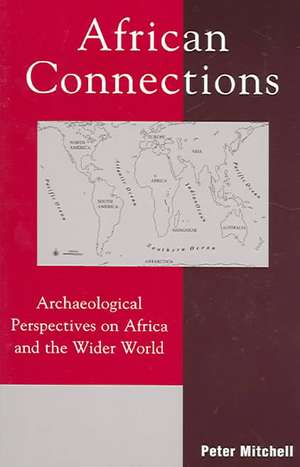
African Connections: Archaeological Perspectives on Africa and the Wider World: African Archaeology Series
Autor Peter Mitchellen Limba Engleză Paperback – 24 ian 2005

Preț: 367.49 lei
Preț vechi: 462.08 lei
-20%
Puncte Express: 551
Carte tipărită la comandă
Livrare economică 17 noiembrie-01 decembrie
Livrare prin curier în România Termenul estimat este afișat lângă disponibilitate.
Transport gratuit de la 400.00 lei Plată online sau ramburs, în funcție de opțiunile comenzii.
Retur gratuit în 14 zile Comandă securizată și suport în română.
Specificații
ISBN-13: 9780759102590
ISBN-10: 0759102597
Pagini: 334
Dimensiuni: 136 x 214 x 22 mm
Greutate: 0.42 kg
Ediția:New.
Editura: Bloomsbury Publishing
Colecția AltaMira Press
Seria African Archaeology Series
Locul publicării:New York, United States
ISBN-10: 0759102597
Pagini: 334
Dimensiuni: 136 x 214 x 22 mm
Greutate: 0.42 kg
Ediția:New.
Editura: Bloomsbury Publishing
Colecția AltaMira Press
Seria African Archaeology Series
Locul publicării:New York, United States
Cuprins
1 Foreword by J. O. Vogel
2 Preface
3 1. Introducing Africa: Definitions, Routes, Resources and Interactions
4 2. The Development and Spread of African Farming Systems
5 3. The Nile and Red Sea Corridors
6 4. Africa in the Indian Ocean World System
7 5. Africa's Other Sea: The Sahara and its Shores
8 6. Africa's Opening to the Atlantic
9 7. Out-of-Africa III: The Archaeology of the African Diaspora
10 8. Reconnecting Africa: Patterns, Problems and Potentials
11 References
12 Index
13 About the Author
2 Preface
3 1. Introducing Africa: Definitions, Routes, Resources and Interactions
4 2. The Development and Spread of African Farming Systems
5 3. The Nile and Red Sea Corridors
6 4. Africa in the Indian Ocean World System
7 5. Africa's Other Sea: The Sahara and its Shores
8 6. Africa's Opening to the Atlantic
9 7. Out-of-Africa III: The Archaeology of the African Diaspora
10 8. Reconnecting Africa: Patterns, Problems and Potentials
11 References
12 Index
13 About the Author
Recenzii
I was quite delighted to come across Peter Mitchell's African Connections as a potential text. . . Mitchell is an archaeologist with a breadth of vision and who sees the material record less as a record of discreet cultures than as a foundation of historical patterns of interaction. His narrative is, in fact, far more lively and comprehensive than one might fear from an archaeologist since he often uses the first person and allows the reader a sense of the interpretive subjectivity that pre-modern history often requires.
Highly recommended.
[Mitchell] does succeed, without fanfare, in destroying entirely the useless boundary between prehistoric and historic archaeology. This success if founded upon an ability to keep the archaeology front and center while niether ignoring nor being overwhelmed by documentary sources. He also manages to steer well away from the tyranny of the ethnographic present and the analogies that lurk therein. Overall, a job well done.
The book is richly complemented by extensive maps, charts, illustrations, and tables. It is required reading for Africanists and world historians, while other archaeologists, historians, and social scientists will find the wealth of information, approach, conclusions and insights richly rewarding.
Having compressed an amazing amount of information into 241 pages of text, this tour-de-force will be a welcome addition to any Africanist's library, and is highly recommended for graduate student use. I hope that African historians get to know about it, as archaeology is too often seen by them as a Cinderella discipline.
A most welcome effort. . . . Mitchell's command of the literature, sources, theoretical debates in the field and areas of contention is sweeping, and backed up by an extensive familiarity with work in such related fields as historical linguistic reconstruction, botany, and palynology which have played important roles in enriching our knowledge of the African past. His approach is measured and evenhanded in its assessment of the evidence. . . . An immense amount of reading and a great deal of thought and care went into the writing of this book. . . . Mitchell succeeds in bringing to light many specifics of African innovation and independent agency across a variety of areas of culture and history.
Mitchell. . . presents an impressively wide-ranging synthesis around his chosen theme of Africa's centrality to human development.
In short African Connections is a worthy attempt to synthesize a tremendous amount of information about a continent that is incredibly diverse-both culturally and ecologically.
Peter Mitchell's book must be read by anyone with any interest not only in Africa, but also in archaeology and history. As the world shrinks through telecommunication and mass transportation, Mitchell's book reminds us that we have always been connected and that Africa was always part of the world. To deny or underestimate the role of Africa in the future of humankind would be a grave mistake.
Highly recommended.
[Mitchell] does succeed, without fanfare, in destroying entirely the useless boundary between prehistoric and historic archaeology. This success if founded upon an ability to keep the archaeology front and center while niether ignoring nor being overwhelmed by documentary sources. He also manages to steer well away from the tyranny of the ethnographic present and the analogies that lurk therein. Overall, a job well done.
The book is richly complemented by extensive maps, charts, illustrations, and tables. It is required reading for Africanists and world historians, while other archaeologists, historians, and social scientists will find the wealth of information, approach, conclusions and insights richly rewarding.
Having compressed an amazing amount of information into 241 pages of text, this tour-de-force will be a welcome addition to any Africanist's library, and is highly recommended for graduate student use. I hope that African historians get to know about it, as archaeology is too often seen by them as a Cinderella discipline.
A most welcome effort. . . . Mitchell's command of the literature, sources, theoretical debates in the field and areas of contention is sweeping, and backed up by an extensive familiarity with work in such related fields as historical linguistic reconstruction, botany, and palynology which have played important roles in enriching our knowledge of the African past. His approach is measured and evenhanded in its assessment of the evidence. . . . An immense amount of reading and a great deal of thought and care went into the writing of this book. . . . Mitchell succeeds in bringing to light many specifics of African innovation and independent agency across a variety of areas of culture and history.
Mitchell. . . presents an impressively wide-ranging synthesis around his chosen theme of Africa's centrality to human development.
In short African Connections is a worthy attempt to synthesize a tremendous amount of information about a continent that is incredibly diverse-both culturally and ecologically.
Peter Mitchell's book must be read by anyone with any interest not only in Africa, but also in archaeology and history. As the world shrinks through telecommunication and mass transportation, Mitchell's book reminds us that we have always been connected and that Africa was always part of the world. To deny or underestimate the role of Africa in the future of humankind would be a grave mistake.