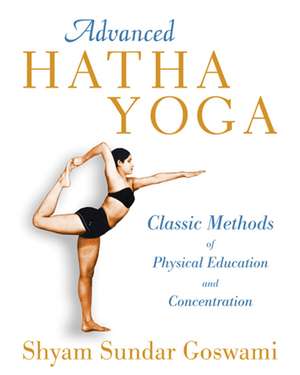
Advanced Hatha Yoga: Classic Methods of Physical Education and Concentration
Autor Shyam Sundar Goswamien Limba Engleză Paperback – 12 aug 2012
• Includes instructions for many advanced Hatha yoga exercises to build strength, stamina, and good posture, the necessary basis for spiritual development
• Provides detailed exercise plans to help you develop your personal weekly practice
• Explains traditional yogic methods of fasting and internal cleansing, practices to strengthen the endocrine system, methods for advanced sexual control, breath control practices, and concentration exercises to improve mind power
Based upon ancient Sanskrit works on yoga as well as thousands of years of oral teachings, this Hatha yoga classic moves beyond the introductory level of yoga and provides illustrated instructions for many advanced asanas and other yogic techniques to build strength, stamina, and good posture--a necessary prerequisite for spiritual development.
Offering detailed exercise plans to help you develop your personal weekly yoga practice as well as techniques to target specific areas of the body, such as the abdominal muscles, this book also contains detailed instructions on many forms of prânâyâma (breath control), including alternate nostril breathing, kapâlabhâti, and sahita, as well as meditative methods for developing your powers of concentration and mental discipline. With instructions on diet, fasting, internal cleansing, advanced sexual control, and strengthening the endocrine system, Sri S. S. Goswami’s classic text presents the complete picture of an advanced Hatha yoga lifestyle for a strong, vital, beautiful body and a balanced, harmonious, happy mind.
Preț: 211.21 lei
Puncte Express: 317
Carte disponibilă
Livrare economică 10-16 septembrie
Livrare express 29 august-04 septembrie pentru 28.29 lei
Livrare prin curier în România Termenul estimat este afișat lângă disponibilitate.
Transport gratuit de la 400.00 lei Plată online sau ramburs, în funcție de opțiunile comenzii.
Retur gratuit în 14 zile Comandă securizată și suport în română.
Specificații
ISBN-13: 9781594774539
ISBN-10: 1594774536
Pagini: 304
Ilustrații: Black-and-white photographs throughout
Dimensiuni: 203 x 254 x 18 mm
Greutate: 0.55 kg
Editura: Inner Traditions/Bear & Company
Colecția Inner Traditions
ISBN-10: 1594774536
Pagini: 304
Ilustrații: Black-and-white photographs throughout
Dimensiuni: 203 x 254 x 18 mm
Greutate: 0.55 kg
Editura: Inner Traditions/Bear & Company
Colecția Inner Traditions
V-ar putea interesa
-
 Sweet PoisonDavid GillespiePreț: 91.48 lei
 -
 Layayoga: The Definitive Guide to the Chakras and KundaliniShyam Sundar Goswami-29%Preț: 144.24 lei202.96 lei
 -
 Nom Nom Paleo: Food for HumansMichelle Tam-19%Preț: 174.24 lei216.31 lei
 -
 -24%Preț: 109.30 lei144.66 lei
 -
 Dental Herbalism: Natural Therapies for the MouthLeslie M. Alexander Ph.D., RH(AHG)-30%Preț: 103.05 lei147.49 lei
 -
 Natural Treatments for Lyme Coinfections: Anaplasma, Babesia, and EhrlichiaStephen Harrod Buhner-23%Preț: 107.77 lei139.29 lei
 -
 Natural Remedies for InflammationChristopher Vasey N.D.-25%Preț: 74.31 lei98.68 lei
 -
 -24%Preț: 86.54 lei114.34 lei
 -
 Freedom from Constipation: Natural Remedies for Digestive HealthChristopher Vasey N.D.-42%Preț: 73.12 lei125.66 lei
 -
 -28%Preț: 55.77 lei77.15 lei
Notă biografică
Shyam
Sundar
Goswami
(1891-1978)
was
the
founder
of
the
Goswami
Yoga
Institute
in
Sweden,
which
opened
in
1949
and
was
the
first
yoga
school
in
Scandinavia.
A
disciple
of
the
great
yoga
master
Balak
Bharati,
he
toured
the
world
giving
lectures
and
yoga
demonstrations
as
well
as
participating
in
scientific
studies
on
the
physical
benefits
of
yoga
practice.
He
also
wroteLayayoga:
The
Definitive
Guide
to
the
Chakras
and
Kundalini.
Extras
Chapter
2
Fundamentals of Yoga Exercise
In Yoga the meaning of exercise has been extended and its application broadened, as the body is looked upon in a more comprehensive manner. It is based on the broader conception of man--his goals, his activities, his meaning in this world, everything. According to Yoga the material body, which is a compound of tissues, is the last stage of the body--an elaboration of the internal body necessary for the full expression of man while on the earth plane.
Static-Dynamic Aspects of Man
From the history of the body we understand that two fundamental factors are related to man. Sakti (consciousness in the form of radiant energy) remaining static, becomes dynamic. In all stages of the dynamic existence of man there is always the static background. We can, therefore, say that man is a center of static-dynamic powers. In the dynamic aspect are all his changes, motions, limits, world consciousness, world experiences. At the back of all this is something more positive. It is his static aspect. In that lies his eternal, nonmoving, indestructible principle, conscious radiant energy in a quiescent state. Conscious radiant energy in the nonmanifested state is one and the same as Supreme Consciousness. There is no separate entity. Only when a stress comes, when the radiant energy is about to manifest it appears as something else. Something dynamic is forced on this static state.
The dynamic aspect of man is expressed in action and the static one is realizable through contemplation. In the lowest order of mental life the contemplative side is almost completely hidden and the active side is either semiparalyzed or uncontrolled. In the higher order, the contemplative side is well developed and the dynamic side is fully controlled. Exercise from the Yogic point of view is intimately related to both aspects of man, contemplative and motional.
Exercise Defined
When exercise is considered in relation to the physical body, it is a systematized method of movements of muscles done purposefully for the development of the material body. But in Yoga, exercise has been used in a broader sense. Exercise as it is understood in Yoga aims not merely at the body (material) isolated from the rest nor the mind similarly isolated, but at the whole man for his full development, which culminates in the attainment of the spiritual goal. It is a means leading straight to his goal. This is why it is called Sadhana.
The exercise is sevenfold. By the application of the sevenfold exercise the whole man is influenced. It consists of purificatory exercise, posture exercise, control exercise, breath-control exercise, sensory-control exercise, and Dhyana and Samadhi (concentration exercise). To these may be added contraction exercise and Dharana (the first stage of concentration exercise). To make the exercise most successful all these factors should be applied simultaneously and harmoniously. This, in short, is the whole picture of exercise in Yoga.
13 Spinal Posture Exercise
Posture exercise is of two types: dynamic and static. It is not necessary to consider each type of exercise separately except for a few folded-leg postures. It is more convenient to consider each exercise from both standpoints.
Spinal Posture Exercise Defined and Classified
Spinal posture exercise consists of four forms of exercise: posterior trunk-bend posture exercise, anterior trunk-bend posture exercise, lateral trunk-bend posture exercise, and trunk-twist posture exercise. The thoracic and the lumbar regions of the spine are principally involved in these exercises. The cervical spine needs special exercise, which is termed neck posture exercise.
Anterior Trunk-bend Posture Exercise
The exercises listed in this section cause contraction of the abdominal muscles and stretching of the spinal muscles. The mind should be concentrated upon the abdominal muscles during these exercises.
Head-knee Posture
1. Sit with the right heel pressed against the perineum, the left leg fully extended forward, the arms bent at the elbows and held at the level of the shoulders, the forearms and fingers extended forward, and the body erect.
2. Bend the body forward and downward and simultaneously extend the arms forward and grasp with both hands the big toe or all the toes of the left foot. Finally, bend the head until the forehead touches the left knee. The extended leg should be kept perfectly straight throughout the exercise. Maintain the final attitude for a few seconds.
3. Return to step 1.
Breathing: Exhale during step 2 and inhale during step 3.
Concentration: Concentrate on the abdominal muscles.
Dynamic Application: Execute steps 2 and 3 alternately.
Static Application: Maintain the final attitude (step 2) as per instruction.
Relaxation: After completion of the exercise, dynamic or static, relax in the sitting position with the legs extended forward and the arms by the sides.
Points of Note: This exercise relaxes and stretches the hamstring muscles and helps in securing full flexion at the hip joints. The exercise should also be performed with the right leg extended.
Forward Body-bend Posture
1. Sit with the legs extended sideward, the body erect, the arms stretched overhead.
2. Bend the body forward and downward until the trunk, head, and arms touch the ground.
Maintain the final attitude for a few seconds.
3. Return to stage 1.
Breathing: Exhale during step 2 and inhale during step 3.
Concentration: Concentrate on the abdominal muscles.
Dynamic Application: Execute steps 2 and 3 alternately.
Static Application: Maintain the final attitude (step 2) as per instruction.
Relaxation: After completion of the exercise, dynamic or static, relax in the sitting position with the legs extended forward and the arms by the sides.
Points of Note: This is an advanced exercise. It requires extraordinary relaxation of the hamstring muscles and full flexibility at the hip joints to be able to extend the legs sideward. The beginner should try to go as far as possible.
Fundamentals of Yoga Exercise
In Yoga the meaning of exercise has been extended and its application broadened, as the body is looked upon in a more comprehensive manner. It is based on the broader conception of man--his goals, his activities, his meaning in this world, everything. According to Yoga the material body, which is a compound of tissues, is the last stage of the body--an elaboration of the internal body necessary for the full expression of man while on the earth plane.
Static-Dynamic Aspects of Man
From the history of the body we understand that two fundamental factors are related to man. Sakti (consciousness in the form of radiant energy) remaining static, becomes dynamic. In all stages of the dynamic existence of man there is always the static background. We can, therefore, say that man is a center of static-dynamic powers. In the dynamic aspect are all his changes, motions, limits, world consciousness, world experiences. At the back of all this is something more positive. It is his static aspect. In that lies his eternal, nonmoving, indestructible principle, conscious radiant energy in a quiescent state. Conscious radiant energy in the nonmanifested state is one and the same as Supreme Consciousness. There is no separate entity. Only when a stress comes, when the radiant energy is about to manifest it appears as something else. Something dynamic is forced on this static state.
The dynamic aspect of man is expressed in action and the static one is realizable through contemplation. In the lowest order of mental life the contemplative side is almost completely hidden and the active side is either semiparalyzed or uncontrolled. In the higher order, the contemplative side is well developed and the dynamic side is fully controlled. Exercise from the Yogic point of view is intimately related to both aspects of man, contemplative and motional.
Exercise Defined
When exercise is considered in relation to the physical body, it is a systematized method of movements of muscles done purposefully for the development of the material body. But in Yoga, exercise has been used in a broader sense. Exercise as it is understood in Yoga aims not merely at the body (material) isolated from the rest nor the mind similarly isolated, but at the whole man for his full development, which culminates in the attainment of the spiritual goal. It is a means leading straight to his goal. This is why it is called Sadhana.
The exercise is sevenfold. By the application of the sevenfold exercise the whole man is influenced. It consists of purificatory exercise, posture exercise, control exercise, breath-control exercise, sensory-control exercise, and Dhyana and Samadhi (concentration exercise). To these may be added contraction exercise and Dharana (the first stage of concentration exercise). To make the exercise most successful all these factors should be applied simultaneously and harmoniously. This, in short, is the whole picture of exercise in Yoga.
13 Spinal Posture Exercise
Posture exercise is of two types: dynamic and static. It is not necessary to consider each type of exercise separately except for a few folded-leg postures. It is more convenient to consider each exercise from both standpoints.
Spinal Posture Exercise Defined and Classified
Spinal posture exercise consists of four forms of exercise: posterior trunk-bend posture exercise, anterior trunk-bend posture exercise, lateral trunk-bend posture exercise, and trunk-twist posture exercise. The thoracic and the lumbar regions of the spine are principally involved in these exercises. The cervical spine needs special exercise, which is termed neck posture exercise.
Anterior Trunk-bend Posture Exercise
The exercises listed in this section cause contraction of the abdominal muscles and stretching of the spinal muscles. The mind should be concentrated upon the abdominal muscles during these exercises.
Head-knee Posture
1. Sit with the right heel pressed against the perineum, the left leg fully extended forward, the arms bent at the elbows and held at the level of the shoulders, the forearms and fingers extended forward, and the body erect.
2. Bend the body forward and downward and simultaneously extend the arms forward and grasp with both hands the big toe or all the toes of the left foot. Finally, bend the head until the forehead touches the left knee. The extended leg should be kept perfectly straight throughout the exercise. Maintain the final attitude for a few seconds.
3. Return to step 1.
Breathing: Exhale during step 2 and inhale during step 3.
Concentration: Concentrate on the abdominal muscles.
Dynamic Application: Execute steps 2 and 3 alternately.
Static Application: Maintain the final attitude (step 2) as per instruction.
Relaxation: After completion of the exercise, dynamic or static, relax in the sitting position with the legs extended forward and the arms by the sides.
Points of Note: This exercise relaxes and stretches the hamstring muscles and helps in securing full flexion at the hip joints. The exercise should also be performed with the right leg extended.
Forward Body-bend Posture
1. Sit with the legs extended sideward, the body erect, the arms stretched overhead.
2. Bend the body forward and downward until the trunk, head, and arms touch the ground.
Maintain the final attitude for a few seconds.
3. Return to stage 1.
Breathing: Exhale during step 2 and inhale during step 3.
Concentration: Concentrate on the abdominal muscles.
Dynamic Application: Execute steps 2 and 3 alternately.
Static Application: Maintain the final attitude (step 2) as per instruction.
Relaxation: After completion of the exercise, dynamic or static, relax in the sitting position with the legs extended forward and the arms by the sides.
Points of Note: This is an advanced exercise. It requires extraordinary relaxation of the hamstring muscles and full flexibility at the hip joints to be able to extend the legs sideward. The beginner should try to go as far as possible.
Cuprins
Foreword
to
the
Third
Edition
by
Basile
P.
Catoméris
Foreword by Elis Berven
Preface
Acknowledgments
Introduction
Part One
Yoga Exercise and Associated Factors
1The Emergence of Yoga
2Fundamentals of Yoga Exercise
3Developmental Aspects of Yoga Exercise
4Practical Application of Yoga Exercise
5Dynamic Application of Posture Exercise
6Static Application of Posture Exercise
7Diet
8Fasting and Special Diets
9The Yoga Method of Internal Cleansing
10The Yoga Method of Endocrine Development
11Sexual Efficiency and Control
Part Two
Technical Aspects of Yoga Exercise
12Spinal Posture Exercise
13Neck Posture Exercise
14Abdominal Posture Exercise
15Pelvic Posture and Control Exercise
16Pectoral Limb Posture Exercise
17Pelvic Limb Posture Exercise
18Balance Posture Exercise
19Inverse Body Posture Exercise
20Folded-Leg Postures
21Pranayama--Breath-Control Exercise
22Concentration Exercise
Part Three
Exercise Plans
23General Exercise Plans
24Specific Dynamic Exercise Plans and Daily Schedules
25Static Exercise Plans and Daily Schedules
Yoga Demonstrations
Note on the Pronunciation of Transliterated
Sanskrit Words
Bibliography
Glossary
Index
Foreword by Elis Berven
Preface
Acknowledgments
Introduction
Part One
Yoga Exercise and Associated Factors
1The Emergence of Yoga
2Fundamentals of Yoga Exercise
3Developmental Aspects of Yoga Exercise
4Practical Application of Yoga Exercise
5Dynamic Application of Posture Exercise
6Static Application of Posture Exercise
7Diet
8Fasting and Special Diets
9The Yoga Method of Internal Cleansing
10The Yoga Method of Endocrine Development
11Sexual Efficiency and Control
Part Two
Technical Aspects of Yoga Exercise
12Spinal Posture Exercise
13Neck Posture Exercise
14Abdominal Posture Exercise
15Pelvic Posture and Control Exercise
16Pectoral Limb Posture Exercise
17Pelvic Limb Posture Exercise
18Balance Posture Exercise
19Inverse Body Posture Exercise
20Folded-Leg Postures
21Pranayama--Breath-Control Exercise
22Concentration Exercise
Part Three
Exercise Plans
23General Exercise Plans
24Specific Dynamic Exercise Plans and Daily Schedules
25Static Exercise Plans and Daily Schedules
Yoga Demonstrations
Note on the Pronunciation of Transliterated
Sanskrit Words
Bibliography
Glossary
Index
Recenzii
“Modern,
cogent,
and
the
most
comprehensive,
definitive
treatment
of
Ha?ha
Yoga
to
be
found
in
the
Western
world
today.
It
is
also
the
most
completely
illustrated
book.”
“Scientifically presented as a valuable bridge between India’s ancestral spiritual legacy and searching Western civilization, Sri S. S. Goswami’s methodically elaboratedAdvanced Hatha Yogahas been for many years, and will surely continue to be, an exclusive reference for future generations.”
“This plainly–written and well–organized journal of classic Hatha yoga poses and lifestyle is sure to heighten the reader’s practice both on the mat and off.”
“Scientifically presented as a valuable bridge between India’s ancestral spiritual legacy and searching Western civilization, Sri S. S. Goswami’s methodically elaboratedAdvanced Hatha Yogahas been for many years, and will surely continue to be, an exclusive reference for future generations.”
“This plainly–written and well–organized journal of classic Hatha yoga poses and lifestyle is sure to heighten the reader’s practice both on the mat and off.”
Descriere
The
classic
Hatha
yoga
manual
for
a
strong,
vital,
beautiful
body
and
a
balanced,
harmonious,
happy
mind.