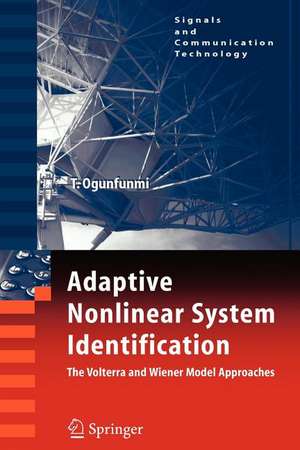
Adaptive Nonlinear System Identification: Signals and Communication Technology
Autor Tokunbo Ogunfunmien Limba Engleză Paperback – 23 noi 2010
After a brief introduction to nonlinear systems and to adaptive system identification, the author presents the discrete Volterra model approach. This is followed by an explanation of the Wiener model approach. Adaptive algorithms using both models are developed. The performance of the two methods are then compared to determine which model performs better for system identification applications.
Adaptive Nonlinear System Identification: The Volterra and Wiener Model Approaches is useful to graduates students, engineers and researchers in the areas of nonlinear systems, control, biomedical systems and in adaptive signal processing.
Din seria Signals and Communication Technology
- 20%
 Preț: 404.53 lei
 - 18%
 Preț: 702.89 lei
 - 20%
 Preț: 1407.27 lei
 - 15%
 Preț: 666.92 lei
 - 18%
 Preț: 1584.26 lei
 -
 Preț: 404.65 lei
 - 15%
 Preț: 605.90 lei
 - 18%
 Preț: 954.17 lei
 - 15%
 Preț: 645.30 lei
 - 18%
 Preț: 1564.35 lei
 - 18%
 Preț: 929.85 lei
 - 18%
 Preț: 939.37 lei
 - 15%
 Preț: 390.21 lei
 - 18%
 Preț: 754.93 lei
 - 15%
 Preț: 669.89 lei
 - 20%
 Preț: 680.21 lei
 - 18%
 Preț: 914.22 lei
 - 18%
 Preț: 1282.39 lei
 - 18%
 Preț: 919.51 lei
 - 15%
 Preț: 628.68 lei
 - 15%
 Preț: 727.22 lei
 - 15%
 Preț: 660.83 lei
 - 18%
 Preț: 1006.84 lei
 - 18%
 Preț: 1277.90 lei
 - 18%
 Preț: 1238.52 lei
 - 18%
 Preț: 1280.80 lei
 - 15%
 Preț: 677.63 lei
 - 20%
 Preț: 670.82 lei
 - 18%
 Preț: 813.90 lei
 - 15%
 Preț: 621.34 lei
 - 15%
 Preț: 662.87 lei
 - 20%
 Preț: 1036.41 lei
 - 18%
 Preț: 995.58 lei
 - 20%
 Preț: 681.58 lei
 - 18%
 Preț: 958.76 lei
 - 15%
 Preț: 714.83 lei
 - 15%
 Preț: 722.57 lei
 - 20%
 Preț: 674.94 lei
 - 18%
 Preț: 915.89 lei
 - 18%
 Preț: 1116.47 lei
 - 15%
 Preț: 650.40 lei
 - 18%
 Preț: 944.71 lei
 - 15%
 Preț: 659.99 lei
Preț: 616.24 lei
Preț vechi: 724.99 lei
-15%
Puncte Express: 924
Carte tipărită la comandă
Livrare economică 27 noiembrie-11 decembrie
Livrare prin curier în România Termenul estimat este afișat lângă disponibilitate.
Transport gratuit pentru acest produs Plată online sau ramburs, în funcție de opțiunile comenzii.
Retur gratuit în 14 zile Comandă securizată și suport în română.
Specificații
ISBN-13: 9781441938831
ISBN-10: 1441938834
Pagini: 248
Ilustrații: XVI, 232 p.
Dimensiuni: 152 x 229 x 14 mm
Greutate: 0.37 kg
Ediția:Softcover reprint of hardcover 1st edition 2007
Editura: Springer
Colecția Signals and Communication Technology
Seria Signals and Communication Technology
Locul publicării:New York, NY, United States
ISBN-10: 1441938834
Pagini: 248
Ilustrații: XVI, 232 p.
Dimensiuni: 152 x 229 x 14 mm
Greutate: 0.37 kg
Ediția:Softcover reprint of hardcover 1st edition 2007
Editura: Springer
Colecția Signals and Communication Technology
Seria Signals and Communication Technology
Locul publicării:New York, NY, United States
V-ar putea interesa
-
 -18%Preț: 977.93 lei1192.61 lei
 -
 Models of the Visual SystemGeorge K Hung-18%Preț: 1299.11 lei1584.28 lei
 -
 Generalized Principal Component AnalysisRené Vidal-19%Preț: 492.56 lei608.10 lei
 -
 -18%Preț: 983.42 lei1199.29 lei
 -
 Mapping CyberspaceMartin Dodge-15%Preț: 474.70 lei558.47 lei
 -
 -14%Preț: 127.43 lei148.92 lei
 -
 Decentralized Control of Large-Scale SystemsEdward J. Davison-18%Preț: 922.45 lei1124.94 lei
 -
 Power, Autonomy, UtopiaR. TrapplPreț: 386.68 lei
 -
 -18%Preț: 908.61 lei1108.06 lei
 -
 Perspectives on Software RequirementsJulio Cesar Sampaio do Prado Leite-15%Preț: 615.84 lei724.52 lei
 -
 Robust Modal Control with a Toolbox for Use with MATLAB®Jean-François Magni-15%Preț: 588.97 lei692.91 lei
 -
 Discrete Event SystemsR. Boel-15%Preț: 645.12 lei758.96 lei
 -
 Synergy Matters: Working with Systems in the 21st CenturyAdrian M. CastellPreț: 403.36 lei
 -
 Speech and Audio Processing for Coding, Enhancement and RecognitionTokunbo Ogunfunmi-15%Preț: 672.92 lei791.66 lei
 -
 Methoden der Mathematischen Physik IIR. CourantPreț: 501.84 lei
 -
 SystemtheorieDezsö VarjuPreț: 486.10 lei
 -
 Optimization Techniques IIJ. StoerPreț: 401.62 lei
 -
 Informatik für IngenieureF. L. Nicolet-15%Preț: 470.58 lei553.62 lei
 -
 Extensions of Linear-Quadratic Control TheoryD. H. JacobsonPreț: 379.38 lei
 -
 Methods and Applications in Adaptive ControlH. UnbehauenPreț: 386.97 lei
 -
 -15%Preț: 473.18 lei556.69 lei
 -
 Invariance and System TheoryAllen TannenbaumPreț: 277.58 lei
 -
 Preț: 322.73 lei
 -
 Linear Stochastic SystemsAnders Lindquist-18%Preț: 1067.99 lei1302.42 lei
 -
 Preț: 401.27 lei
Public țintă
ResearchCuprins
to Nonlinear Systems.- Polynomial Models of Nonlinear Systems.- Volterra and Wiener Nonlinear Models.- Nonlinear System Identification Methods.- to Adaptive Signal Processing.- Nonlinear Adaptive System Identification Based on Volterra Models.- Nonlinear Adaptive System Identification Based on Wiener Models (Part 1).- Nonlinear Adaptive System Identification Based on Wiener Models (Part 2).- Nonlinear Adaptive System Identification Based on Wiener Models (Part 3).- Nonlinear Adaptive System Identification Based on Wiener Models (Part 4).- Conclusions, Recent Results, and New Directions.
Recenzii
From the reviews:
"In this book, the author presents simple, concise, easy-to-understand methods for identifying nonlinear systems using adaptive filter algorithms well known for linear systems identification. The book focuses on the Volterra and Wiener models for nonlinear systems … . It is another contribution to the current literature on the subject. The book will be useful for graduate students, engineers and researchers in the area of the nonlinear systems identification and adaptive signal processing." (George S. Stavrakakis, Zentralblatt MATH, Vol. 1130 (8), 2008)
"In this book, the author presents simple, concise, easy-to-understand methods for identifying nonlinear systems using adaptive filter algorithms well known for linear systems identification. The book focuses on the Volterra and Wiener models for nonlinear systems … . It is another contribution to the current literature on the subject. The book will be useful for graduate students, engineers and researchers in the area of the nonlinear systems identification and adaptive signal processing." (George S. Stavrakakis, Zentralblatt MATH, Vol. 1130 (8), 2008)
Textul de pe ultima copertă
Adaptive Nonlinear System Identification: The Volterra and Wiener Model Approaches introduces engineers and researchers to the field of nonlinear adaptive system identification. The book includes recent research results in the area of adaptive nonlinear system identification and presents simple, concise, easy-to-understand methods for identifying nonlinear systems. These methods use adaptive filter algorithms that are well known for linear systems identification. They are applicable for nonlinear systems that can be efficiently modeled by polynomials.
After a brief introduction to nonlinear systems and to adaptive system identification, the author presents the discrete Volterra model approach. This is followed by an explanation of the Wiener model approach. Adaptive algorithms using both models are developed. The performance of the two methods are then compared to determine which model performs better for system identification applications.
Adaptive Nonlinear System Identification: The Volterra and Wiener Model Approaches is useful to graduates students, engineers and researchers in the areas of nonlinear systems, control, biomedical systems and in adaptive signal processing.
After a brief introduction to nonlinear systems and to adaptive system identification, the author presents the discrete Volterra model approach. This is followed by an explanation of the Wiener model approach. Adaptive algorithms using both models are developed. The performance of the two methods are then compared to determine which model performs better for system identification applications.
Adaptive Nonlinear System Identification: The Volterra and Wiener Model Approaches is useful to graduates students, engineers and researchers in the areas of nonlinear systems, control, biomedical systems and in adaptive signal processing.
Caracteristici
The focus is on the Volterra and Wiener modeling approaches, which have become very popular in signal processing circles
Notă biografică
Thomas K. Paul has worked in signal communications since 1996. Most recently, he has worked at ICR Inc. and Northrop Grumman Corp, in support of government defense contracts. Prior to that, at Ralink Technology, he worked on development of a cost-reduced version of the 802.11b WLAN chipset. And earlier, at PC-TEL Inc., he worked on the maintenance and improvement of their V.92 software modem product. He also holds a U.S. Patent regarding dynamic block processing in soft-ware modems. He earned the B.A.Sc. degree at the University of Toronto, Canada in 1996, and M.S.E.E. and Ph.D. degrees at Santa Clara University, Santa Clara, California in 2007 and 2013, respectively. His research interests are in communica-tions system design and digital signal processing.
Tokunbo Ogunfunmi received the B.S. (first class honors) degree from Obafemi Awolowo University, Nigeria, and the M.S. and Ph.D. degrees from Stanford University, Stanford, California, all in Electrical Engineering. He is currently a Professor of Electrical and Computer Engineering and Director of the Information Processing and Machine Learning Research Laboratory at Santa Clara University (SCU), Santa Clara, California. From 2010-2014, he served as the Associate Dean for Research and Faculty Development for the SCU School of Engineering. At SCU, he teaches a variety of courses in circuits, systems, signal processing and related areas. His current research interests include machine learning, deep learning, speech and multimedia (audio, video) compression, digital and adaptive signal processing and applications and nonlinear signal processing. He has published three books and over 250 refereed journal and conference papers in these areas.