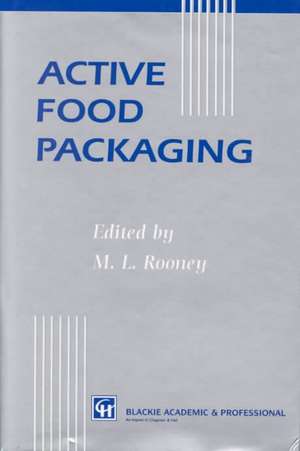
Active Food Packaging
Autor M. L. Rooneyen Limba Engleză Hardback – 31 dec 1995
Preț: 665.10 lei
Preț vechi: 782.47 lei
-15%
Puncte Express: 998
Carte tipărită la comandă
Livrare economică 18 noiembrie-02 decembrie
Livrare prin curier în România Termenul estimat este afișat lângă disponibilitate.
Transport gratuit pentru acest produs Plată online sau ramburs, în funcție de opțiunile comenzii.
Retur gratuit în 14 zile Comandă securizată și suport în română.
Specificații
ISBN-13: 9780751401912
ISBN-10: 0751401919
Pagini: 276
Ilustrații: XI, 260 p.
Dimensiuni: 160 x 241 x 20 mm
Greutate: 0.53 kg
Ediția:1995
Editura: Springer
Locul publicării:New York, NY, United States
ISBN-10: 0751401919
Pagini: 276
Ilustrații: XI, 260 p.
Dimensiuni: 160 x 241 x 20 mm
Greutate: 0.53 kg
Ediția:1995
Editura: Springer
Locul publicării:New York, NY, United States
V-ar putea interesa
-
 Advanced Dairy Chemistry: Volume 3: Lactose, Water, Salts and Minor ConstituentsPaul L. H. McSweeney-18%Preț: 1508.81 lei1840.01 lei
 -
 Terroir and Other Myths of WinegrowingMark A MatthewsPreț: 256.67 lei
 -
 Preț: 252.91 lei
 -
 -18%Preț: 914.66 lei1115.44 lei
 -
 Current Topics in Flavours and FragrancesK. A. Swift-15%Preț: 637.88 lei750.45 lei
 -
 Quantitative Microbiology in Food ProcessingAnderson De Souza Sant'Ana-23%Preț: 1274.01 lei1654.57 lei
 -
 Advances in Food BiotechnologyRavishankar Rai V-9%Preț: 1614.99 lei1774.72 lei
 -
 Biotechnology of Lactic Acid BacteriaFernanda Mozzi-9%Preț: 1250.03 lei1373.66 lei
 -
 Chocolate Science and TechnoloEmmanuel Ohene Afoakwa-9%Preț: 1227.78 lei1349.21 lei
 -
 -14%Preț: 964.86 lei1121.92 lei
 -
 Pseudocereals and Less Common CerealsPeter S. Belton-15%Preț: 667.96 lei785.85 lei
Public țintă
ResearchCuprins
1 Overview of active food packaging.- 1.1 Active, intelligent and modified atmosphere packaging.- 1.2 Origins of active packaging.- 1.3 Literature review.- 1.4 Scope for application of active packaging.- 1.5 Physical and chemical principles applied.- 1.6 Implications for other packaging.- 1.7 Limitations of current approaches.- 1.8 Future potential.- 1.9 Regulatory considerations.- References.- 2 Ethylene-removing packaging.- 2.1 The chemistry of ethylene.- 2.2 Deleterious effects of ethylene.- 2.3 Interactions of ethylene and other gases.- 2.4 Ethylene sources in the environment.- 2.5 Commercial applications in packaging.- Acknowledgements.- References.- 3 Design of modified atmosphere packaging for fresh produce.- 3.1 Introduction.- 3.2 Literature review.- 3.3 Feasibility study.- 3.4 Respiration rates.- 3.5 Measurement of respiration rates.- 3.6 Model equations and package requirements.- 3.7 Polymeric films for MAP applications.- 3.8 Concluding remarks.- Nomenclature.- References.- 4Active packaging in polymer films.- 4.1 Introduction.- 4.2 Oxygen scavenging.- 4.3 Moisture control films.- 4.4 Removal of taints and food constituents.- 4.5 Ingredient release.- 4.6 Permeability modification.- 4.7 Current use commercially.- 4.8 Regulatory and environmental impacts.- References.- 5 Edible films and coatings as active layers.- 5.1 Introduction.- 5.2 Use of edible active layers to control water vapor transfer.- 5.3 Use of edible active layers to control gas exchange.- 5.4 Modification of surface conditions with edible active layers.- 5.5 Conclusion.- Acknowledgements.- References.- 6 Interactive packaging involving sachet technology.- 6.1 Introduction.- 6.2 Oxygen absorbents.- 6.3 Ethanol vapor.- 6.4 Conclusion.- References.- 7 Enzymes as active packaging agents.- 7.1 Enzymes.- 7.2 Potential roles of enzymes in active packaging.- 7.3 History.- 7.4 Oxygen removal.- 7.5 Antimicrobial effects.- 7.6 Time—temperature integrator—indicators.- 7.7 Lactose removal.- 7.8 Cholesterol removal.- References.- 8 The history of oxygen scavenger bottle closures.- 8.1 Background.- 8.2 Oxygen measurements.- 8.3 Oxygen scavenger liners.- 8.4 The effect of scavenging closures on beer flavor.- 8.5 The advantages of oxygen control bottles.- 8.6 The future of oxygen scavenging closures.- References.- 9 Commercial applications in North America.- 9.1 Packaging overview.- 9.2 Marketplace susceptors.- 9.3 Application of temperature indicator to microwaveable packaging.- 9.4 Active packaging — produce.- 9.5 Oxygen absorber food applications.- 9.6 Other applications.- References.- 10 Time—temperature indicators.- 10.1 Introduction.- 10.2 Indicator systems.- 10.3 Indicator application issues and consumer interests.- 10.4 Chemical indicators for thermal process validation.- 10.5 Conclusions.- References.- 11 Safety considerations in active packaging.- 11.1 Introduction.- 11.2 Packaging and food safety.- 11.3 Passive safety interactions.- 11.4 Active safety interactions.- 11.5 Conclusions.- References.