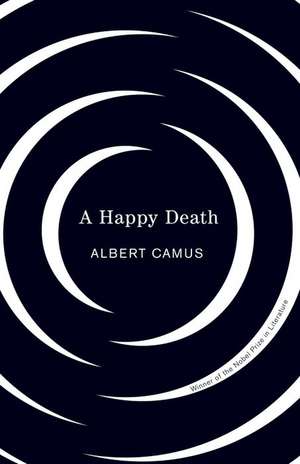
A Happy Death
Autor Albert Camusen Limba Engleză Paperback – 29 aug 1995
Observăm, încă din primele pagini, o imagine de o brutalitate calmă: Patrice Mersault pășește spre casa victimei sale, un act care nu pare să fie sfârșitul unei povești, ci începutul unei căutări febrile a fericirii. Scris în tinerețea autorului și recuperat din arhivele sale personale abia după moartea sa în 1960, A Happy Death ne oferă o perspectivă rară și nefiltrată asupra minții unui viitor laureat al Premiului Nobel. Considerăm acest text nu doar o schiță, ci o confesiune lirică în care Albert Camus se dezvăluie mult mai direct decât în proza sa ulterioară. Imaginați-vă tensiunea morală și alienarea din The Outsider, mutată într-un decor de o senzualitate debordantă, unde marea și soarele Algeriei nu sunt doar fundaluri, ci forțe vii care dictează ritmul existenței. Dacă în lucrările sale de maturitate, precum The Plague sau The Fall, autorul adoptă o rigoare filosofică și o distanțare calculată, aici regăsim un Camus tânăr, îndrăgostit de viață și în același timp disprețuitor față de convențiile dragostei romantice. Stilul alternează între introspecție și descrieri vibrante ale stărilor de exil sau hedonism, capturând tranziția de la un om supus regulilor la unul care își asumă responsabilitatea propriei libertăți, indiferent de preț. În contextul operei sale, A Happy Death ocupă un loc singular. Este puntea de legătură între experiențele biografice regăsite în The First Man și rigoarea absurdului din eseurile sale. Recomandăm lectura acestui roman ca pe un exercițiu de arheologie literară: este momentul în care Camus începe să formuleze întrebările esențiale despre viață și moarte care vor defini gândirea secolului XX.
Preț: 92.83 lei
Carte disponibilă
Livrare economică 16-30 noiembrie
Specificații
ISBN-10: 0679764003
Pagini: 208
Dimensiuni: 198 x 128 x 16 mm
Greutate: 0.2 kg
Ediția:Vintage Intl.
Editura: Knopf Doubleday Publishing Group
V-ar putea interesa
-
 Eat SmartNiomi SmartPreț: 148.66 lei
 -
 The Gambler and Other StoriesFyodor DostoyevskyPreț: 94.27 lei
 -
 Counting the StarsHelen DunmorePreț: 115.32 lei
 -
 The Forgotten LiesKerry JamiesonPreț: 116.98 lei
 -
 The Elephanta SuitePaul TherouxPreț: 115.32 lei
 -
 Things I Want My Daughters to KnowElizabeth NoblePreț: 92.61 lei
 -
 The New ConfessionsWilliam Boyd-29%Preț: 62.74 lei87.96 lei
 -
 Stars and BarsWilliam Boyd-25%Preț: 59.55 lei79.49 lei
 -
 According to MarkPenelope LivelyPreț: 79.72 lei
 -
 The OutsiderAlbert Camus-27%Preț: 51.35 lei70.72 lei
 -
 London Belongs to MeNorman CollinsPreț: 110.46 lei
 -
 #GirlbossSophia Amoruso-18%Preț: 64.81 lei79.00 lei
 -
 Create DangerouslyAlbert Camus-38%Preț: 17.49 lei28.38 lei
 -
 What Is Sport?Roland BarthesPreț: 130.62 lei
 -
 The StrangerAlbert CamusPreț: 95.64 lei
 -
 RepetitionAlain Robbe-GrilletPreț: 97.79 lei
 -
 The Tao Te ChingNathan CoppedgePreț: 121.62 lei
 -
 Lilac Cigarette in a Wish CathedralRobin MagowanPreț: 137.18 lei
 -
 The MetamorphosisFranz KafkaPreț: 32.88 lei
 -
 Preț: 57.46 lei
 -
 Preț: 57.56 lei
 -
 Preț: 55.79 lei
 -
 Preț: 143.67 lei
 -
 Preț: 144.41 lei
De ce să citești această carte
Recomandăm această carte cititorilor care doresc să descopere geneza geniului lui Albert Camus. Este o lectură esențială pentru cei care au fost marcați de The Outsider și vor să înțeleagă rădăcinile filosofiei absurdului. Cititorul câștigă acces la o latură mai intimă și poetică a autorului, explorând dualitatea dintre crimă și căutarea unei „morți fericite” prin prisma libertății absolute.
Despre autor
Albert Camus (1913–1960) a fost un filosof, scriitor și jurnalist francez, născut în Algeria, a cărui operă a avut un impact profund asupra gândirii contemporane. Laureat al Premiului Nobel pentru Literatură în 1957, el este asociat frecvent cu existențialismul, deși a preferat să își definească viziunea prin conceptul de absurd. De la copilăria marcată de sărăcie în Alger până la rolul de redactor-șef al ziarului de rezistență Combat, viața sa a fost o căutare constantă a integrității morale. Lucrările sale emblematice, precum The Stranger și The Plague, explorează condiția umană în fața unui univers indiferent.
Descriere scurtă
As the novel follows the protagonist, Patrice Mersault, to his victim's house -- and then, fleeing, in a journey that takes him through stages of exile, hedonism, privation, and death -it gives us a glimpse into the imagination of one of the great writers of the twentieth century. For here is the young Camus himself, in love with the sea and sun, enraptured by women yet disdainful of romantic love, and already formulating the philosophy of action and moral responsibility that would make him central to the thought of our time.
Translated from the French by Richard Howard
Notă biografică
His early essays were collected in L'Envers et l'endroit (The Wrong Side and the Right Side) and Noces (Nuptials). He went to Paris, where he worked on the newspaper Paris Soir before returning to Algeria. His play, Caligula, appeared in 1939. His first two important books, L'Etranger (The Outsider) and the long essay Le Mythe de Sisyphe (The Myth of Sisyphus), were published when he returned to Paris.
After the occupation of France by the Germans in 1941, Camus became one of the intellectual leaders of the Resistance movement. He edited and contributed to the underground newspaper Combat, which he had helped to found. After the war he devoted himself to writing and established an international reputation with such books as La Peste (The Plague 1947), Les Justes (The Just 1949) and La Chute (The Fall; 1956). During the late 1950s Camus renewed his active interest in the theatre, writing and directing stage adaptations of William Faulkner's Requiem for a Nun and Dostoyevsky's The Possessed. He was awarded the Nobel Prize for Literature in 1957. He was killed in a road accident in 1960.