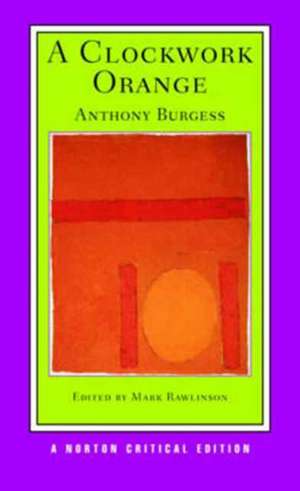
A Clockwork Orange
Autor Anthony Burgess Editat de Mark Rawlinsonen Limba Engleză Paperback – 20 dec 2010
Ritmul este unul alert, sacadat și de o intensitate viscerală. Remarcăm cum A Clockwork Orange se impune nu doar ca un text literar, ci ca un experiment lingvistic brutal. Narațiunea este condusă de Alex, un adolescent sociopat a cărui voce, redată în argoul „Nadsat”, forțează cititorul să învețe o limbă nouă pentru a înțelege ororile descrise. Structura fragmentară a experiențelor sale — de la „ultraviolența” nocturnă la terapia de reeducare — subliniază o progresie dură spre dezumanizare. Ne-a atras atenția modul în care autorul folosește muzica clasică drept contrapunct pentru cruzime, o tehnică ce oferă profunzime filozofică unei premise altfel terifiante. Această ediție de studiu este esențială, oferind un glosar pentru termenii rusești și note textuale care clarifică procesul creativ al lui Anthony Burgess. Merită menționat că volumul include capitolul final, adesea omis în edițiile americane, care schimbă fundamental rezoluția morală a poveștii. Cartea amintește de A Clockwork Orange. Restored Edition prin fidelitatea față de textul original, dar se diferențiază prin bogăția aparatului critic și a eseurilor care analizează impactul adaptării cinematografice a lui Stanley Kubrick. Față de alte lucrări ale autorului, precum The Complete Enderby, unde satira este mai pregnantă, aici Anthony Burgess adoptă un ton mult mai sumbru, explorând limitele controlului statal asupra individului.
Preț: 217.29 lei
Carte disponibilă
Livrare economică 05-19 noiembrie
Specificații
ISBN-10: 0393928098
Pagini: 368
Dimensiuni: 131 x 212 x 22 mm
Greutate: 0.35 kg
Ediția:Critică
Editura: W. W. Norton & Company
V-ar putea interesa
-
 Time BitesDoris LessingPreț: 57.68 lei
 -
 On CatsDoris LessingPreț: 69.97 lei
 -
 The Children of HúrinJ. R. R. TolkienPreț: 64.64 lei
 -
 Brave New WorldAldous HuxleyPreț: 63.49 lei
 -
 Briefing for a Descent Into HellDoris LessingPreț: 118.36 lei
 -
 The Summer Before the DarkDoris LessingPreț: 121.32 lei
 -
 Origami Card CraftKaren Elaine ThomasPreț: 140.45 lei
 -
 The SilmarillionJ. R. R. TolkienPreț: 65.00 lei
 -
 WonderR. J. Palacio-17%Preț: 49.06 lei58.90 leiRecomandat
 -
 -15%Preț: 491.34 lei578.05 lei
 -
 Bob Dylan Chronicles Volume 1Bob Dylan-19%Preț: 64.45 lei79.19 lei
 -
 The Cuckoo's Calling: Cormoran Strike Book 1Robert Galbraith-24%Preț: 61.93 lei81.22 lei
 -
 Cloud Atlas (Movie Tie-In Edition)David MitchellPreț: 94.68 lei
 -
 One Ball Knits: PursesF KhadijaPreț: 126.96 lei
 -
 Candle MakingBob ShermanPreț: 97.06 lei
 -
 Paul McCartney: A LifePeter Ames CarlinPreț: 133.13 lei
 -
 Neuromancer: The groundbreaking cyberpunk thrillerWilliam Gibson-25%Preț: 59.80 lei79.95 lei
 -
 Conversations with Anthony BurgessEarl G IngersollPreț: 237.21 lei
 -
 -26%Preț: 58.20 lei79.00 lei
 -
 Introduction to Calculus and Analysis IRichard CourantPreț: 448.65 lei
De ce să citești această carte
Pentru cititorul care dorește să exploreze dileme etice profunde despre natura binelui și a răului. Această ediție oferă instrumentele lingvistice necesare pentru a descifra argoul Nadsat, transformând lectura într-o experiență intelectuală provocatoare. Câștigi o perspectivă critică asupra modului în care limbajul și condiționarea pot fi folosite ca mecanisme de control social, totul într-un format compact și riguros documentat.
Despre autor
John Anthony Burgess Wilson (1917–1993), cunoscut sub numele de Anthony Burgess, a fost un scriitor, compozitor și lingvist englez de o versatilitate remarcabilă. Deși se considera în egală măsură muzician, având peste 250 de compoziții, succesul său major a venit din beletristică. Experiența sa ca ofițer de educație în Malaezia și diagnosticul medical sever din 1959 l-au impulsionat să devină un autor extrem de prolific. Specialist în fonetică și admirator al lui James Joyce, Burgess a creat pentru acest roman un limbaj hibrid unic, demonstrându-și geniul lingvistic în contextul unei distopii care a definit secolul XX.
Descriere scurtă
The Norton Critical Edition of A Clockwork Orange is based on the first British edition and includes Burgess's original final chapter. It is accompanied by Mark Rawlinson's preface, explanatory annotations, and textual notes. A glossary of the Russian-origin terms that inspired Alex's dialect is provided to illustrate the process by which Burgess arrived at the distinctive style of this novel.
"Backgrounds and Contexts" presents a wealth of materials chosen by the editor to enrich the reader's understanding of this unforgettable work, many of them by Burgess himself. Burgess's views on writing A Clockwork Orange, its philosophical issues, and the debates over the British edition versus the American edition and the novel versus the film adaptation are all included. Related writings that speak to some of the novel's central issues--youthful style, behavior modification, and art versus morality--are provided by Paul Rock and Stanley Cohen, B. F. Skinner, John R. Platt, Joost A. M. Meerloo, William Sargent, and George Steiner.
"Criticism" is divided into two sections, one addressing the novel and the other Stanley Kubrick's film version. Five major reviews of the novel are reprinted along with a wide range of scholarly commentary, including, among others, David Lodge on the American reader; Julie Carson on linguistic invention; Zinovy Zinik on Burgess and the Russian language; Geoffrey Sharpless on education, masculinity, and violence; Shirley Chew on circularity; Patrick Parrinder on dystopias; Robbie B. H. Goh on language and social control; and Steven M. Cahn on freedom. A thorough analysis of the film adaptation of A Clockwork Orange is provided in reviews by Vincent Canby, Pauline Kael, and Christopher Ricks; in Philip Strick and Penelope Houston's interview with Stanley Kubrick; and in interpretive essays by Don Daniels, Alexander Walker, Philip French, Thomas Elsaesser, Tom Dewe Mathews, and Julian Petley.
A Selected Bibliography is also included.
Descriere
Notă biografică
He became a full-time writer in 1959 and achieved a worldwide reputation as one of the most versatile novelists of his day. His writings include biographies of Shakespeare and Hemingway, critical studies of James Joyce, stage plays, and two volumes of autobiography. His work as a composer and librettist includes the Broadway musical, Cyrano, and Blooms of Dublin, an operetta based on Joyce's Ulysses.
His 33 novels continue to be published all over the world. They include A Clockwork Orange, Nothing Like the Sun, The Complete Enderby, Earthly Powers, Napoleon Symphony, and Beard's Roman Women, a collaboration with the photographer David Robinson.
Anthony Burgess died in London in 1993.
Recenzii
A piece that, in its focus on youthful disaffection and the state's attempts to control antisocial behaviour, is as pertinent as it was 50 years ago. Maybe even more so ... This "right nasty little shocker", as Burgess put it, still has the power to disturb.
This high-octane adaptation of Anthony Burgess's Clockwork Orange has lost none of its impact ... It's not an easy watch - but then, with Burgess's urgent commentary on the mechanisation of human society and its inevitably violent consequences seeming just as relevant now as it was in 1962, it never should be.
It seems even more relevant as a commentary on the "disaffected youth" ... high art constantly pushes up against ultraviolence
It sizzles with energy but also leaves the audience deeply unsettled.