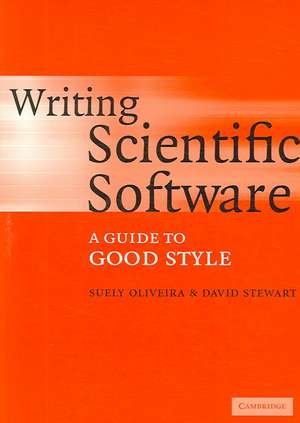
Writing Scientific Software
Autor Suely Oliveira, David E. Stewarten Limba Engleză Paperback – 26 iul 2017
Preț: 417.95 lei
Preț vechi: 522.43 lei
-20%
Puncte Express: 627
Carte tipărită la comandă
Livrare economică 08-22 decembrie
Livrare prin curier în România Termenul estimat este afișat lângă disponibilitate.
Transport gratuit pentru acest produs Plată online sau ramburs, în funcție de opțiunile comenzii.
Retur gratuit în 14 zile Comandă securizată și suport în română.
Specificații
ISBN-13: 9780521675956
ISBN-10: 0521675952
Pagini: 316
Ilustrații: illustrations
Dimensiuni: 170 x 244 x 18 mm
Greutate: 0.55 kg
Editura: Cambridge University Press
Locul publicării:Cambridge, United Kingdom
ISBN-10: 0521675952
Pagini: 316
Ilustrații: illustrations
Dimensiuni: 170 x 244 x 18 mm
Greutate: 0.55 kg
Editura: Cambridge University Press
Locul publicării:Cambridge, United Kingdom
V-ar putea interesa
-
 High Performance Computing: Modern Systems and PracticesThomas Sterling-40%Preț: 437.18 lei729.97 lei
 -
 Smalltalk Best Practice PatternsKent Beck-20%Preț: 408.65 lei510.81 lei
 -
 -20%Preț: 209.98 lei262.47 lei
 -
 Clean Code: A Handbook of Agile Software CraftsmanshipRobert Martin-20%Preț: 367.00 lei458.75 lei
 -
 Modern Software EngineeringDavid Farley-20%Preț: 223.44 lei279.30 lei
 -
 The Practice of ProgrammingBrian Kernighan-20%Preț: 304.16 lei380.20 lei
 -
 Software Design DecodedAndre van der Hoek-20%Preț: 85.23 lei106.54 lei
 -
 Lessons Learned in Software Testing - A Context- Driven ApproachBret Pettichord-20%Preț: 259.60 lei324.50 lei
 -
 Numerical RecipesWilliam H. Press-14%Preț: 872.22 lei1014.21 lei
 -
 Code Complete: A practical handbook of software constructionSteve McConnell-20%Preț: 287.39 lei359.24 lei
 -
 Practical Computing for BiologistsSteven H. D. Haddock-27%Preț: 797.38 lei1092.30 lei
 -
 R-ticulateMartin Bader-23%Preț: 653.46 lei848.65 lei
 -
 Coding For Dummies, All New EditionPaul McFedries-20%Preț: 116.94 lei146.18 lei
 -
 The Art of R ProgrammingNorman Matloff-35%Preț: 256.15 lei392.87 lei
 -
 Street CoderSedat Kapanoglu-20%Preț: 285.56 lei356.95 lei
 -
 Modern C, Third EditionJens Gustedt-20%Preț: 350.34 lei437.92 lei
 -
 Math for ProgrammingRonald T. Kneusel-35%Preț: 244.36 lei373.43 lei
 -
 Statistics for ScientistsUmberto Michelucci-20%Preț: 279.62 lei349.53 lei
 -
 A Primer on Scientific Programming with PythonHans Petter Langtangen-20%Preț: 651.64 lei814.55 lei
Cuprins
Part I. Numerical Software: 1. Why numerical software?; 2. Scientific computation and numerical analysis; 3. Priorities; 4. Famous disasters; 5. Exercises; Part II. Developing Software: 6. Basics of computer organization; 7. Software design; 8. Modularity and all that; 9. Data structures; 10. Design for testing and debugging; 11. Exercises; Part III. Efficiency in Time, Efficiency in Memory: 12. Be algorithm aware; 13. Computer architecture and efficiency; 14. Global vs. local optimization; 15. Grabbing memory when you need it; 16. Memory bugs and leaks; Part IV. Tools: 17. Sources of scientific software; 18. Unix tools; 19. Cubic spline function library; 20. Multigrid algorithms; Appendix A: review of vectors and matrices; Appendix B: trademarks; Bibliography; Index.
Recenzii
'Writing Scientific Software bridges the chasm that too often separates numerical analysis from real scientific computing. It is full of tips, tricks, and just plain interesting information. The reader will learn how to write code that takes advantage of many hidden features in modern computer architectures, programming languages, and compilers. This is a book that is full of good sense.' William H. Press, author of Numerical Recipes
'The book is a useful tool working in the filed of scientific computations…' Zentralblatt MATH
'The book is a useful tool working in the filed of scientific computations…' Zentralblatt MATH
Descriere
A manual and guide to good scientific computing style, explaining how to write good software and how to test it for bugs, accuracy and performance.