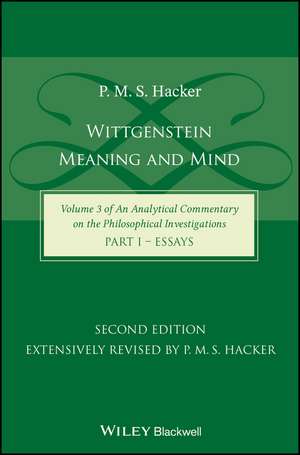
Wittgenstein
Autor P. M. S. Hackeren Limba Engleză Hardback – 26 apr 2019
--ADRIAN MOORE, University of Oxford
"The Baker/Hacker commentary remains by far the most important and most impressive scholarly work on Wittgenstein's Philosophical Investigations. This revised edition of Hacker's Volume 3 incorporates some illuminating new material in the exegetical part and contains four excellent new essays on the private language argument. Required reading for anyone seriously interested in Wittgenstein's philosophy of mind."
--SEVERIN SCHROEDER, University of Reading
Preț: 669.72 lei
Preț vechi: 727.95 lei
-8%
Puncte Express: 1005
Carte tipărită la comandă
Livrare economică 06-20 august
Livrare prin curier în România Termenul estimat este afișat lângă disponibilitate.
Transport gratuit pentru acest produs Plată online sau ramburs, în funcție de opțiunile comenzii.
Retur gratuit în 14 zile Comandă securizată și suport în română.
Specificații
ISBN-13: 9781118951804
ISBN-10: 1118951808
Pagini: 352
Dimensiuni: 156 x 287 x 30 mm
Greutate: 0.62 kg
Ediția:2nd edition
Editura: Wiley
Locul publicării:Chichester, United Kingdom
ISBN-10: 1118951808
Pagini: 352
Dimensiuni: 156 x 287 x 30 mm
Greutate: 0.62 kg
Ediția:2nd edition
Editura: Wiley
Locul publicării:Chichester, United Kingdom
Notă biografică
P. M. S. Hacker is the leading authority on the philosophy of Wittgenstein. He is author of the four-volume Analytical Commentary on the Philosophical Investigations (1980-96), the first two volumes co-authored with G.P. Baker, and of the epilogue Wittgenstein's Place in Twentieth Century Analytic Philosophy (Blackwell, 1996). He has written extensively on philosophy and neuroscience--Philosophical Foundations of Neuroscience (Blackwell, 2003) and History of Cognitive Neuroscience (Wiley Blackwell, 2008), both co-authored with M.R. Bennett. He has published three volumes of a tetralogy on human nature: Human Nature: The Categorial Framework (Blackwell, 2007), The Intellectual Powers: A Study of Human Nature (Wiley Blackwell, 2013), and The Passions: A Study of Human Nature (Wiley Blackwell, 2018). He is currently completing the final volume - The Moral Powers: A Study of Human Nature (forthcoming). Together with Joachim Schulte, he has produced the fourth edition and extensively revised translation of Wittgenstein's Philosophical Investigations (Wiley Blackwell, 2009). They are currently working on a new edition and translation of Wittgenstein's On Certainty.
Descriere
Descriere de la o altă ediție sau format:
Wittgenstein: Connections and Controversies consists of thirteen thematically linked essays on different aspects of the philosophy of Wittgenstein, by one of the leading commentators on his work. After an opening overview of Wittgenstein's philosophy the following essays fall into two classes: those that investigate connections between the philosophy of Wittgenstein and other philosophers and philosophical trends, and those which enter into some of the controversies that, over the last two decades, have raged over the interpretation of one aspect or another of Wittgenstein's writings. The connections that are explored include the relationship between Wittgenstein's philosophy and the humanistic and hermeneutic traditions in European philosophy, Wittgenstein's response to Frazer's Golden Bough and the interpretation of ritual actions, his attitude towards and criticisms of Frege (both in the Tractatus and in the later philosophy), the relationship between his ideas and those of members of the Vienna Circle on the matter of ostensive definition, and a comparison of Carnap's conception of the elimination of metaphysics and of Strawson's rehabilitation of metaphysics with Wittgenstein's later criticisms of metaphysics. The controversies into which Hacker enters include the Diamond-Conant interpretation of the Tractatus (which is shown to be inconsistent with the text of the Tractatus and with Wittgenstein's explanations of and comments on his book), Winch's interpretation of the Tractatus conception of names, Kripke's interpretation of Wittgenstein's discussion of following a rule (which is demonstrated to be remote from Wittgenstein's intentions), and Malcolm's defence of the idea that Wittgenstein claimed that mastery of a language logically requires that the language be shared with other speakers. These far-ranging essays, several of them previously unpublished or difficult to find, shed much light upon different aspects of Wittgenstein's thought, and upon the controversies which it has stimulated.
Recenzii
Review from previous edition the standard interpretation of Wittgenstein ... can be attributed to a large extent to the interpretive work of P.M.S. Hacker.