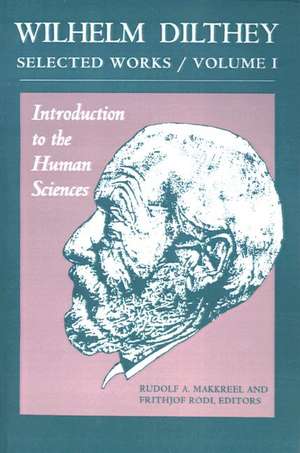
Wilhelm Dilthey
Autor Wilhelm Dilthey Editat de Rudolf A. Makkreel, Frithjof Rodien Limba Engleză Paperback – sep 1991
Preț: 660.98 lei
Preț vechi: 816.03 lei
-19%
Puncte Express: 991
Carte tipărită la comandă
Livrare economică 28 noiembrie-12 decembrie
Livrare prin curier în România Termenul estimat este afișat lângă disponibilitate.
Transport gratuit pentru acest produs Plată online sau ramburs, în funcție de opțiunile comenzii.
Retur gratuit în 14 zile Comandă securizată și suport în română.
Specificații
ISBN-13: 9780691020747
ISBN-10: 0691020744
Pagini: 546
Dimensiuni: 152 x 229 x 32 mm
Greutate: 0.88 kg
Editura: Princeton University Press
Locul publicării:Princeton, United States
ISBN-10: 0691020744
Pagini: 546
Dimensiuni: 152 x 229 x 32 mm
Greutate: 0.88 kg
Editura: Princeton University Press
Locul publicării:Princeton, United States
V-ar putea interesa
-
 Chechen JihadYossef BodanskyPreț: 120.30 lei
 -
 Ghost WarsSteve Coll-22%Preț: 111.34 lei143.37 lei
 -
 Preț: 127.59 lei
 -
 -28%Preț: 468.78 lei652.04 lei
 -
 -22%Preț: 510.57 lei650.57 lei
 -
 -21%Preț: 450.58 lei569.54 lei
 -
 They Must Be StoppedBrigitte GabrielPreț: 122.59 lei
 -
 -23%Preț: 311.93 lei406.00 lei
 -
 Fighting Terror: Ethical DilemmasAlex Bellamy-17%Preț: 215.11 lei259.51 lei
 -
 -33%Preț: 848.47 lei1262.37 lei
 -
 -21%Preț: 138.25 lei174.05 lei
 -
 British Muslims & the Call to Global JihadKylie Baxter-18%Preț: 92.39 lei112.92 lei
Notă biografică
Rudolf A. Makkreel is Charles Howard Conder professor of Philosophy at Emory University and editor of the Journal of the History of Philosophy. His books include Dilthey, Philosopher of the Human Studies (Princeton). Frithjof Rodi is Professor of Philosophy at Ruhr-Universität Bochum and one of the editors of dilthey's Gesammelte Schiften.
Descriere
Descriere de la o altă ediție sau format:
Presents Wilhelm Dilthey's principal writings on aesthetics and the philosophical understanding of poetry, as well as representative essays of literary criticism. This book includes the essay, "The Imagination of the Poet" which is his attempt to examine the philosophical bearings of literature in relation to psychological and historical theory.
Presents Wilhelm Dilthey's principal writings on aesthetics and the philosophical understanding of poetry, as well as representative essays of literary criticism. This book includes the essay, "The Imagination of the Poet" which is his attempt to examine the philosophical bearings of literature in relation to psychological and historical theory.