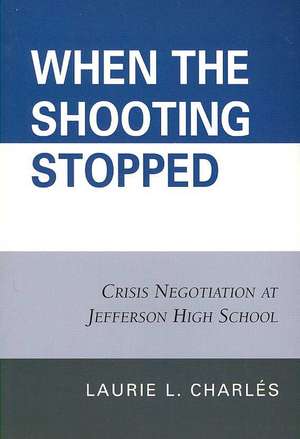
When the Shooting Stopped: Crisis Negotiation and Critical Incident Change
Autor Laurie L. Charlésen Limba Engleză Paperback – 28 dec 2007
În contextul programelor de formare pentru forțele de ordine și al certificărilor în intervenția la criză, When the Shooting Stopped oferă un cadru metodologic riguros pentru gestionarea incidentelor critice. Observăm o tranziție necesară de la simpla relatare anecdotică spre o analiză științifică a discursului, volumul fiind esențial pentru cei care urmăresc profesionalizarea în negocierea de ostatici și gestionarea crizelor. Prin integrarea unei perspective sistemice, Laurie L. Charlés transformă înțelegerea procesului de comunicare dintr-o abilitate intuitivă într-o disciplină structurată.
Structura cărții urmărește o progresie logică, pornind de la originile istorice ale unităților de negociere din anii '70 și ajungând la cerințele psihologice contemporane ale unui negociator ideal. Descoperim o secțiune valoroasă dedicată categorisirii subiecților în funcție de caracteristicile individuale și contextuale, dar și o analiză a elementelor tactice precum implicarea echipelor SWAT și rolul consultanților de sănătate mintală. Cititorii familiarizați cu Dynamic Processes of Crisis Negotiation de Randall G. Rogan vor aprecia modul în care volumul de față aduce nou o analiză lingvistică aplicată pe un studiu de caz specific — o negociere într-o instituție de învățământ — oferind o profunzime micro-analitică asupra modului în care se construiește colaborarea sub presiune.
Apreciem modul în care această lucrare se ancorează în opera anterioară a autoarei, precum Family Therapy in Global Humanitarian Contexts sau Family Systems and Global Humanitarian Mental Health. Dacă în acele volume Laurie L. Charlés explora sistemele familiale în zone de conflict, aici ea aplică aceeași rigoare sistemică pentru a diseca interacțiunea dintre negociator și agresor. Este o resursă care depășește granițele forțelor de ordine, fiind relevantă și pentru psihologii care activează în medii cu risc ridicat.
Preț: 311.93 lei
Preț vechi: 406.00 lei
-23%
Carte tipărită la comandă
Livrare economică 28 noiembrie-12 decembrie
Specificații
ISBN-10: 0742560880
Pagini: 141
Dimensiuni: 150 x 226 x 16 mm
Greutate: 0.24 kg
Editura: Bloomsbury Publishing
Colecția Rowman & Littlefield
Locul publicării:New York, United States
V-ar putea interesa
-
 The Oxford Handbook of U.S. Women's Social Movement ActivismHolly J. McCammon-35%Preț: 935.31 lei1444.68 lei
 -
 They Must Be StoppedBrigitte GabrielPreț: 122.59 lei
 -
 -18%Preț: 1342.62 lei1637.35 lei
 -
 9/11 and Collective Memory in US Classrooms: Teaching About TerrorCheryl Lynn Duckworth-18%Preț: 1299.64 lei1584.94 lei
 -
 Transatlantic DefianceGavin Wilk-23%Preț: 694.07 lei901.40 lei
 -
 -25%Preț: 307.26 lei407.39 lei
 -
 The 2001 Anthrax DeceptionGraeme MacqueenPreț: 135.98 lei
 -
 -15%Preț: 465.33 lei547.45 lei
 -
 Preț: 454.35 lei
 -
 -19%Preț: 315.83 lei389.78 lei
 -
 -24%Preț: 274.11 lei361.73 lei
 -
 Terror Crime Prevention with CommunitiesDr. Basia Spalek-16%Preț: 276.10 lei329.73 lei
 -
 State of Recovery: The Quest to Restore American Security After 9/11Dr. Barry Scott Zellen-24%Preț: 280.05 lei370.64 lei
 -
 Boko Haram: The Emerging Nigerian Terrorist ThreatSamuel T Whitlock-27%Preț: 998.60 lei1361.83 lei
 -
 Rising Terror Groups in the Middle East & North AfricaAlexandria Stafford-27%Preț: 1023.92 lei1396.04 lei
 -
 Small-Unit Leaders' Guide to CounterinsurgencyU. S. Marine CorpsPreț: 116.85 lei
De ce să citești această carte
Recomandăm această carte profesioniștilor din structurile de siguranță publică și psihologilor care doresc să înțeleagă mecanica fină a negocierii sub stres. Veți câștiga o metodologie clară pentru utilizarea limbajului ca instrument tactic și o perspectivă sistemică asupra modului în care echipele de intervenție pot lucra eficient pentru a preveni violența. Este un ghid concis care transformă teoria comunicării în practică salvatoare de vieți.
Descriere
CharlZs outlines a fundamental methodology for crisis negotiation, as it occurs for law-enforcement officers trained in crisis intervention. When the Shooting Stopped systematically examines the process of negotiation, dissecting the conduct of meaningful discourse, use of language, and use of the collaborative team process. Using case data on a school hostage negotiation, CharlZs reveals the underlying communication processes at work in crisis negotiation. When the Shooting Stopped is a key resource for criminal justice professionals, law enforcement personnel, and family counseling psychologists alike.
Cuprins
Chapter 2 Origins in the Field, Police Standoffs in the 1970s, First Hostage Negotiation Unit, Hostage Negotiation as a Professional Responsibility
Chapter 3 Necessary Requirements of Effective Crisis Negotiation Reconceptualizing, Who Makes an Ideal Crisis Negotiator, Rethinking the Relationship with the Hostage Taker, Utilizing Psychological Theory, Creating a Climate for Conversation, Approaching the Conver
Chapter 4 Categorizing Hostage Takers according to Individual Characteristics, Appreciating the Limits of Categories, Considering the Contextual Circumstances of an Incident, Valuing Communication Skills, Using Active Listening with Hostage Takers
Chapter 5 Elements of a Typical Crisis Negotiation Incident, First Response at the Scene, Making Contact, Coordination the Negotiation Team, SWAT involvement, Mental Health Consultation, Third Party Intermediaries, Dynamic Inactivity, The Stockholm Syndrome, Discus
Chapter 6 Research on Crisis Negotiation, The Potential for Paradox, Studying Aspects of "Face", Uncovering Emotion and Affect, Exploring the Developing Relationship, Discourse Analysis of a Successful Crisis Negotiation, Combining Methods (Discourse Analysis, Ethn
Recenzii
When the Shooting Stopped is a thoroughly researched and uniquely perceptive examination of a real life-and-death negotiation. Charlés' work is an engaging must read for anyone interested in the human drama of crisis negotiation.
When the Shooting Stopped is of a growing field of scholarly research on crisis and hostage negotiation. Charlés' case study of the language of negotiation builds upon nearly three decades of discourse and analytic research. Her work provides fellow researchers and negotiators with an in-depth analysis of negotiation in action as critiqued from extant crisis negotiation guidelines and from which practical insights can be gleaned.