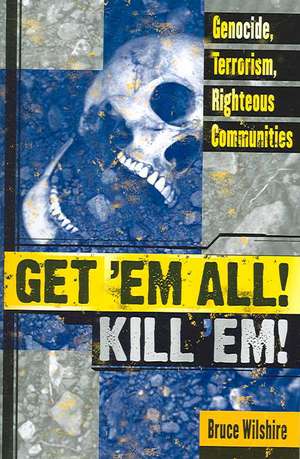
Get 'Em All! Kill 'Em!: Genocide, Terrorism, Righteous Communities
Autor Bruce Wilshireen Limba Engleză Paperback – 2 oct 2006
Preț: 307.26 lei
Preț vechi: 407.39 lei
-25%
Puncte Express: 461
Carte tipărită la comandă
Livrare economică 19 noiembrie-03 decembrie
Livrare prin curier în România Termenul estimat este afișat lângă disponibilitate.
Transport gratuit de la 400.00 lei Plată online sau ramburs, în funcție de opțiunile comenzii.
Retur gratuit în 14 zile Comandă securizată și suport în română.
Specificații
ISBN-13: 9780739112793
ISBN-10: 0739112791
Pagini: 199
Dimensiuni: 154 x 230 x 18 mm
Greutate: 0.35 kg
Editura: Bloomsbury Publishing
Colecția Lexington Books
Locul publicării:New York, United States
ISBN-10: 0739112791
Pagini: 199
Dimensiuni: 154 x 230 x 18 mm
Greutate: 0.35 kg
Editura: Bloomsbury Publishing
Colecția Lexington Books
Locul publicării:New York, United States
V-ar putea interesa
-
 End of DaysJames L SwansonPreț: 114.00 lei
 -
 -31%Preț: 786.95 lei1145.13 lei
 -
 Ethics for Enemies: Terror, Torture, and WarF. M. Kamm-11%Preț: 241.36 lei272.67 lei
 -
 The Special Tribunal for Lebanon: Law and PracticeAmal Alamuddin-31%Preț: 1028.13 lei1495.00 lei
 -
 Crossfire: The Plot That Killed KennedyJim Marrs-24%Preț: 121.39 lei159.26 lei
 -
 -23%Preț: 311.93 lei406.00 lei
 -
 The Assassination of the ArchdukeGreg King-24%Preț: 85.27 lei112.27 lei
 -
 Killing KennedyBill O' Reilly-19%Preț: 97.71 lei121.26 lei
 -
 Dirty Wars: The world is a battlefieldJeremy ScahillPreț: 94.85 lei
Cuprins
Chapter 1 Genocide and Terrorism
Chapter 2 Initial Cases of Genocide: Nazi Germany, California Indians
Chapter 3 The Everyday Illusion of Immortality and its Disruption
Chapter 4 Further Cases of Genocide: Bosnia, Cambodia, Rwanda
Chapter 5 A Theory of Genocide and Terrorism
Chapter 6 Centering-Down Into the Immediate: Variations on the Theme of Genocide
Chapter 7 Thinking the Unthinkable? A Religious Retardant to Genocide and Terrorism?
Chapter 2 Initial Cases of Genocide: Nazi Germany, California Indians
Chapter 3 The Everyday Illusion of Immortality and its Disruption
Chapter 4 Further Cases of Genocide: Bosnia, Cambodia, Rwanda
Chapter 5 A Theory of Genocide and Terrorism
Chapter 6 Centering-Down Into the Immediate: Variations on the Theme of Genocide
Chapter 7 Thinking the Unthinkable? A Religious Retardant to Genocide and Terrorism?
Recenzii
Wilshire has taken what most people feel is unfathomable-genocide and terrorism-and illuminated the web of dark forces that can explode forth into such heinous acts. He allows us to see how the cycles of suffering and anxiety work through our collective bodies and group symbolism to trap us all within a nightmare of violence and further suffering. Yet, he doesn't stop there, as he also shows how we can awake from this nightmare through an unconventional sense of the sacred, a way of boundary crossing found within nature, and a different attunement to the universe. Bravo for thinking through "the unthinkable!"
This is a provocative, stimulating read. Highly recommended.
Bruce Wilshire's book Get 'Em All! Kill 'Em! is a fascinating and important study of issues that could not be more crucial to our perilous times. . . . I know of no other study that looks to these utterly concrete, yet very elusive, roots of the major destructive actions of the last one hundred years, continuing to this day. It should stand by itself as a book that will draw a lot of attention from the reading public as well as from academics who know WIlshire's previously published distinguished work.
Already well on his way with Wild Hunger; in Get 'Em All! Kill 'Em! we find the distinctively original discursive style and thematic substance of Bruce Wilshire. The engaging entwinement of style and provocative, thought-provoking content just carried me along to the end. A remarkable achievement!
It is not only the deceptively simple and lucid theory of genocide that we must honor here, but the way in which Wilshire gradually densifies and intensifies the theory, drawing us inexorably into the dark heart of the world's polarized present, at the sharp tooth-edge of history and of our own possible extinction.
This is philosophy that matters: soaring thought on a vital topic expressed in an accessible, elegant style. Not everyone will agree with Wilshire's understanding of genocide, but everyone needs to be familiar with it. Wilshire is one of a vanishing breed of public intellectuals who addresses the mind of our community and appeals to its conscience. Must reading.
Wilshire is a prophet of disaster and a child with saving news. We find deep insight in this book - from the Qur'an and the Gospels, from Tolstoy, Dostoevsky and William James. We learn from Emerson, that great "optimist," that along side a human hope is a persisting, sudden, strange-uncanny - say the bare existence of rats and lizards, who are no less a part of our surround than its more noted inhabitants, and alien enough to challenge our grip on those basal human comforts - hope, understanding, health: for what are these to crawling things...? Of course, this is a book, as the title says, on genocide and terror. But it's also about compassion, crucifixion, King Lear, "poor forked creatures," Black Elk; it lives with that ancient epigraph on our lives: "many are the wonders and terrors, but none more wonderful (and terrible) than we. " It delivers an embodied human spirit, high and low and mediocre, in the flow and out of it, getting ice cream and wrestling with the unspeakable (which Wilshire so ably bespeaks). He is a philosopher in the spirit of Emerson and James, on the go, rushing at us like a Lion on the plain - then turning like a Greek Chorus to reflect soberly on our plight - then turning lightly to play in the curling surf for the moment numinous, enchanted.
Wilshire's book is not only a good essay on genocide and terrorism, but also an invitation to be intellectually prepared for countering fundamentalism.
This is an epic study of genocide and terrorism. Congratulations on a superb achievement and hopes for the widest dissemination and discussion of the urgent issues it involves.
The prose is forceful, clear, and engaging. The examples are rich, provocative, and far-reaching. Instead of lecturing at his readers. . . . Wilshire invites them to join him in a journey of intellectual exploration. It is philosophical in the admirable tradition of William James. It is an excellent book.
Deep within our souls there is an archetype of genocide that emerges in times of crisis and sears our historical understanding so we no longer acknowledge moral tenets. Wilshire brings together the diverse strands of genocidal events to demonstrate that at our worst we are an embarrassment to the universe.
Bruce Wilshire's interpretation of the genocidal impulse as a response to the threat of the annihilation of an organized group's whole cultural world is compelling and profound. Get 'Em All! Kill 'Em! will be of enormous interest to all those who are committed to understanding the experience of being human.
This is a provocative, stimulating read. Highly recommended.
Bruce Wilshire's book Get 'Em All! Kill 'Em! is a fascinating and important study of issues that could not be more crucial to our perilous times. . . . I know of no other study that looks to these utterly concrete, yet very elusive, roots of the major destructive actions of the last one hundred years, continuing to this day. It should stand by itself as a book that will draw a lot of attention from the reading public as well as from academics who know WIlshire's previously published distinguished work.
Already well on his way with Wild Hunger; in Get 'Em All! Kill 'Em! we find the distinctively original discursive style and thematic substance of Bruce Wilshire. The engaging entwinement of style and provocative, thought-provoking content just carried me along to the end. A remarkable achievement!
It is not only the deceptively simple and lucid theory of genocide that we must honor here, but the way in which Wilshire gradually densifies and intensifies the theory, drawing us inexorably into the dark heart of the world's polarized present, at the sharp tooth-edge of history and of our own possible extinction.
This is philosophy that matters: soaring thought on a vital topic expressed in an accessible, elegant style. Not everyone will agree with Wilshire's understanding of genocide, but everyone needs to be familiar with it. Wilshire is one of a vanishing breed of public intellectuals who addresses the mind of our community and appeals to its conscience. Must reading.
Wilshire is a prophet of disaster and a child with saving news. We find deep insight in this book - from the Qur'an and the Gospels, from Tolstoy, Dostoevsky and William James. We learn from Emerson, that great "optimist," that along side a human hope is a persisting, sudden, strange-uncanny - say the bare existence of rats and lizards, who are no less a part of our surround than its more noted inhabitants, and alien enough to challenge our grip on those basal human comforts - hope, understanding, health: for what are these to crawling things...? Of course, this is a book, as the title says, on genocide and terror. But it's also about compassion, crucifixion, King Lear, "poor forked creatures," Black Elk; it lives with that ancient epigraph on our lives: "many are the wonders and terrors, but none more wonderful (and terrible) than we. " It delivers an embodied human spirit, high and low and mediocre, in the flow and out of it, getting ice cream and wrestling with the unspeakable (which Wilshire so ably bespeaks). He is a philosopher in the spirit of Emerson and James, on the go, rushing at us like a Lion on the plain - then turning like a Greek Chorus to reflect soberly on our plight - then turning lightly to play in the curling surf for the moment numinous, enchanted.
Wilshire's book is not only a good essay on genocide and terrorism, but also an invitation to be intellectually prepared for countering fundamentalism.
This is an epic study of genocide and terrorism. Congratulations on a superb achievement and hopes for the widest dissemination and discussion of the urgent issues it involves.
The prose is forceful, clear, and engaging. The examples are rich, provocative, and far-reaching. Instead of lecturing at his readers. . . . Wilshire invites them to join him in a journey of intellectual exploration. It is philosophical in the admirable tradition of William James. It is an excellent book.
Deep within our souls there is an archetype of genocide that emerges in times of crisis and sears our historical understanding so we no longer acknowledge moral tenets. Wilshire brings together the diverse strands of genocidal events to demonstrate that at our worst we are an embarrassment to the universe.
Bruce Wilshire's interpretation of the genocidal impulse as a response to the threat of the annihilation of an organized group's whole cultural world is compelling and profound. Get 'Em All! Kill 'Em! will be of enormous interest to all those who are committed to understanding the experience of being human.