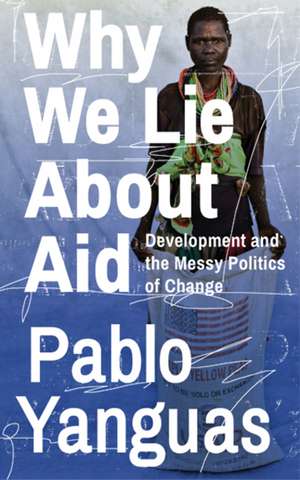
Why We Lie About Aid: Development and the Messy Politics of Change
Autor Pablo Yanguasen Limba Engleză Hardback – 15 feb 2018
The reality, as Yanguas argues in this highly provocative book, is that aid isn't - or at least shouldn't be - about levels of spending, nor interventions shackled to vague notions of 'accountability' and 'ownership'. Instead, a different approach is possible, one that acknowledges aid as being about struggle, about taking sides, about politics. It is an approach that has been quietly applied by innovative development practitioners around the world, providing political coverage for local reformers to open up spaces for change. Drawing on a variety of convention-defying stories from a variety of countries - from Britain to the US, Sierra Leone to Honduras - Yanguas provides an eye-opening account of what we really mean when we talk about aid.
Preț: 524.21 lei
Preț vechi: 703.91 lei
-26%
Puncte Express: 786
Carte tipărită la comandă
Livrare economică 23 noiembrie-07 decembrie
Livrare prin curier în România Termenul estimat este afișat lângă disponibilitate.
Transport gratuit pentru acest produs Plată online sau ramburs, în funcție de opțiunile comenzii.
Retur gratuit în 14 zile Comandă securizată și suport în română.
Specificații
ISBN-13: 9781783609345
ISBN-10: 1783609346
Pagini: 282
Dimensiuni: 140 x 222 x 20 mm
Greutate: 0.44 kg
Ediția:1
Editura: Bloomsbury Publishing
Colecția Zed Books
Locul publicării:London, United Kingdom
ISBN-10: 1783609346
Pagini: 282
Dimensiuni: 140 x 222 x 20 mm
Greutate: 0.44 kg
Ediția:1
Editura: Bloomsbury Publishing
Colecția Zed Books
Locul publicării:London, United Kingdom
V-ar putea interesa
-
 Emergency Sex (And Other Desperate Measures)Andrew Thomson-25%Preț: 83.61 lei111.94 lei
 -
 Dead AidDambisa Moyo-20%Preț: 63.04 lei78.35 lei
 -
 The PersuadersAnand Giridharadas-19%Preț: 63.70 lei78.26 lei
 -
 Aiding Empowerment: Democracy Promotion and Gender Equality in PoliticsSaskia Brechenmacher-20%Preț: 160.88 lei202.20 lei
 -
 -33%Preț: 558.90 lei829.70 lei
 -
 How Change HappensDuncan Green-17%Preț: 60.93 lei73.38 lei
 -
 The Ills of Aid: An Analysis of Third World Development PoliciesEberhard ReussePreț: 240.91 lei
 -
 Preț: 351.54 lei
 -
 Dead AidDambisa MoyoPreț: 102.95 lei
 -
 Poor ReliefHeath HendersonPreț: 227.02 lei
 -
 Hunger Inc.: Building Solidarity Beyond the Food BankKayleigh GarthwaitePreț: 122.16 lei
 -
 Friends in Common: Radical Friendship and Everyday SolidaritiesLaura C. ForsterPreț: 134.23 lei
 -
 Don't Talk About Politics: How to Change 21st-Century MindsSarah Stein LubranoPreț: 155.60 lei
 -
 International DevelopmentMichael WoolcockPreț: 138.89 lei
 -
 Preț: 63.69 lei
 -
 Preț: 405.21 lei
 -
 No More Heroes: Grassroots Challenges to the Savior MentalityJordan FlahertyPreț: 86.61 lei
 -
 The Nationalisation of UK Aid and DevelopmentMelita Lazell-18%Preț: 785.95 lei958.47 lei
 -
 -23%Preț: 166.00 lei215.38 lei
Cuprins
Introduction
1. The Theatrics of Aid Debates
2. The Banality of Certainty
3. The Ugly Politics of Change
4. The Limits of Donor Influence
5. The Paradoxes of Development Diplomacy
6. The Struggle of Thinking Politically
7. Understanding the Messy Politics of Change
Conclusion
1. The Theatrics of Aid Debates
2. The Banality of Certainty
3. The Ugly Politics of Change
4. The Limits of Donor Influence
5. The Paradoxes of Development Diplomacy
6. The Struggle of Thinking Politically
7. Understanding the Messy Politics of Change
Conclusion
Recenzii
Why we lie about aid plays an important role in showing where we are in terms of the debates around how to do aid and development better, and to more effectively tackle those stickiest of problems like weak governance and corruption.'
Well written, informative, and entertaining.'
Full of pithy quotes, punchy anecdotes and insightful case studies . you should leave this book everywhere, from your friend's bedside table, to DFID's tea-room and the doorsteps of the Daily Mail.
Yanguas entertainingly and persuasively argues that a move away from current aid systems - as institutions too fixated on short-term results - is vital.
A bold effort to reframe global engagement with development. Yanguas is a leading exemplar of a new, committed and pragmatic generation of scholars and practitioners. His voice deserves to be widely heard.
One of the most exciting books about development aid in many years: original and timely, closely argued and evidenced, and beautifully written.
Elegantly written and passionately argued, Yanguas has provided us with an authoritative guide to current debates within the aid business, and, more importantly, to the crucial political struggles that have always defined the development process.
Incisive case studies, a strong command of recent currents in development studies, and a passionate belief in the necessity of development aid, despite all its flaws, bolster this probing inquiry into the politics of aid.
Well written, informative, and entertaining.'
Full of pithy quotes, punchy anecdotes and insightful case studies . you should leave this book everywhere, from your friend's bedside table, to DFID's tea-room and the doorsteps of the Daily Mail.
Yanguas entertainingly and persuasively argues that a move away from current aid systems - as institutions too fixated on short-term results - is vital.
A bold effort to reframe global engagement with development. Yanguas is a leading exemplar of a new, committed and pragmatic generation of scholars and practitioners. His voice deserves to be widely heard.
One of the most exciting books about development aid in many years: original and timely, closely argued and evidenced, and beautifully written.
Elegantly written and passionately argued, Yanguas has provided us with an authoritative guide to current debates within the aid business, and, more importantly, to the crucial political struggles that have always defined the development process.
Incisive case studies, a strong command of recent currents in development studies, and a passionate belief in the necessity of development aid, despite all its flaws, bolster this probing inquiry into the politics of aid.