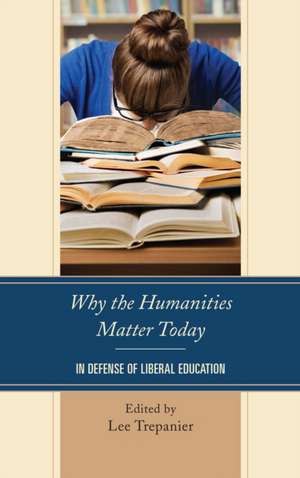
Why the Humanities Matter Today: In Defense of Liberal Education
Editat de Lee Trepanier Contribuţii de Kirk Fitzpatrick, James W. Harrison, Nozomi Irei, David Lunt, Kristopher G. Phillipsen Limba Engleză Hardback – 8 mar 2017
Preț: 576.70 lei
Preț vechi: 864.14 lei
-33%
Puncte Express: 865
Carte tipărită la comandă
Livrare economică 03-17 decembrie
Livrare prin curier în România Termenul estimat este afișat lângă disponibilitate.
Transport gratuit pentru acest produs Plată online sau ramburs, în funcție de opțiunile comenzii.
Retur gratuit în 14 zile Comandă securizată și suport în română.
Specificații
ISBN-13: 9781498538602
ISBN-10: 1498538606
Pagini: 192
Ilustrații: 5 tables
Dimensiuni: 158 x 232 x 18 mm
Greutate: 0.4 kg
Editura: Bloomsbury Publishing
Colecția Lexington Books
Locul publicării:New York, United States
ISBN-10: 1498538606
Pagini: 192
Ilustrații: 5 tables
Dimensiuni: 158 x 232 x 18 mm
Greutate: 0.4 kg
Editura: Bloomsbury Publishing
Colecția Lexington Books
Locul publicării:New York, United States
V-ar putea interesa
-
 Reaching the Unreached: ICTs and Adult Education for the Empowerment of Rural WomenOlivia Adwoa Tiwaah Frimpong Kwapong-23%Preț: 320.61 lei416.17 lei
 -
 Peer Coaching for EducatorsBarbara L. Gottesman-22%Preț: 360.87 lei460.88 lei
 -
 Practical Training TechniquesLyndon Pugh-34%Preț: 409.69 lei624.63 lei
 -
 -26%Preț: 176.22 lei237.06 lei
 -
 -23%Preț: 256.91 lei335.05 lei
 -
 -32%Preț: 583.67 lei864.29 lei
 -
 -27%Preț: 338.02 lei460.26 lei
 -
 -33%Preț: 729.31 lei1095.47 lei
 -
 Leading the Campaign: Advancing Colleges and UniversitiesMichael J. Worth-24%Preț: 482.56 lei637.54 lei
 -
 Taal vitaal op school 1. ArbeitsbuchStephen FoxPreț: 130.06 lei
Cuprins
Contents
Introduction: Why the Humanities Matter
Lee Trepanier
Chapter 1: The Third Era of Education
Kirk Fitzpatrick
Chapter 2: Is Philosophy Impractical? Yes and No, but that's Precisely Why We Need It
Kristopher G. Phillips
Chapter 3: Comparative Literature: From "Crossroads" of the Humanities to "Rhizome"
Nozomi Irei
Chapter 4: The Limits of Language as a Liberal Art and Hugo von Hofmannsthal's "Letter to Lord Chandos"
James W. Harrison
Chapter 5: Ancient History's Contribution to Liberal Education
David Lunt
Chapter 6: The Relevance of Political Philosophy and Political Science
Lee Trepanier
About the Contributors
Introduction: Why the Humanities Matter
Lee Trepanier
Chapter 1: The Third Era of Education
Kirk Fitzpatrick
Chapter 2: Is Philosophy Impractical? Yes and No, but that's Precisely Why We Need It
Kristopher G. Phillips
Chapter 3: Comparative Literature: From "Crossroads" of the Humanities to "Rhizome"
Nozomi Irei
Chapter 4: The Limits of Language as a Liberal Art and Hugo von Hofmannsthal's "Letter to Lord Chandos"
James W. Harrison
Chapter 5: Ancient History's Contribution to Liberal Education
David Lunt
Chapter 6: The Relevance of Political Philosophy and Political Science
Lee Trepanier
About the Contributors
Recenzii
The book will appeal not only to those who may be teaching in what have become traditional departments within the humanities, but also to political scientists in the social sciences.
Essential reading for faculty in these and other disciplines and students deciding on a course of study. It should also be read by policymakers and parents and anyone in need of a crash course on the value of the humanities and liberal arts education.
In a world of increasing complexity and danger, the need for the humanities has never been greater, and yet liberal arts education is in rapid decline everywhere. This excellent collection of essays is an important contribution to this pressing issue. Instead of regurgitating platitudes about the inherent value of the humanities-that they make students more well-rounded, better communicators, and critical thinkers-the authors attempt to defend the humanities by considering new approaches and formulating ground-breaking arguments. This volume is essential reading for anyone concerned about the future of liberal arts education, and looking for fresh ways to articulate the necessity and worth of the humanities.
Essential reading for faculty in these and other disciplines and students deciding on a course of study. It should also be read by policymakers and parents and anyone in need of a crash course on the value of the humanities and liberal arts education.
In a world of increasing complexity and danger, the need for the humanities has never been greater, and yet liberal arts education is in rapid decline everywhere. This excellent collection of essays is an important contribution to this pressing issue. Instead of regurgitating platitudes about the inherent value of the humanities-that they make students more well-rounded, better communicators, and critical thinkers-the authors attempt to defend the humanities by considering new approaches and formulating ground-breaking arguments. This volume is essential reading for anyone concerned about the future of liberal arts education, and looking for fresh ways to articulate the necessity and worth of the humanities.