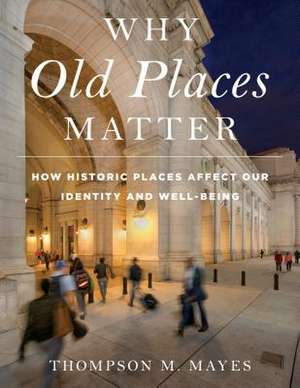
Why Old Places Matter: How Historic Places Affect Our Identity and Well-Being: American Association for State and Local History
Autor Thompson M. Mayesen Limba Engleză Hardback – sep 2018
The book reveals the fundamentally important yet under-recognized role old places play in our lives. While many people feel a deep-seated connection to old places -- from those who love old houses, to the millions of tourists who are drawn to historic cities, to the pilgrims who flock to ancient sites throughout the world -- few can articulate why. The book explores these deep attachments people have with old places -the feelings of belonging, continuity, stability, identity and memory, as well as the more traditional reasons that old places have been deemed by society to be important, such as history, national identity, and architecture.
This book will be appealing to anyone who has ever loved an old place. But more importantly, it will be an useful resource to articulate why old places are meaningful to people and their communities. This book will help people understand that the feeling many have for old places is supported by a wide variety of fields, and that the continued existence of these old places is good. It will give people the words and phrases to understand and express why old places matter.
Din seria American Association for State and Local History
- 32%
 Preț: 832.56 lei
 - 21%
 Preț: 214.67 lei
 - 22%
 Preț: 322.44 lei
 - 19%
 Preț: 316.09 lei
 - 11%
 Preț: 398.39 lei
 - 30%
 Preț: 355.61 lei
 - 19%
 Preț: 331.43 lei
 - 23%
 Preț: 286.27 lei
 - 24%
 Preț: 255.41 lei
 - 27%
 Preț: 501.00 lei
 - 25%
 Preț: 216.46 lei
 - 24%
 Preț: 254.02 lei
 - 19%
 Preț: 320.78 lei
 - 34%
 Preț: 951.06 lei
 - 19%
 Preț: 322.24 lei
 - 24%
 Preț: 391.91 lei
 - 31%
 Preț: 569.03 lei
 - 18%
 Preț: 334.84 lei
 - 24%
 Preț: 222.59 lei
 - 24%
 Preț: 283.12 lei
 -
 Preț: 421.53 lei
 - 21%
 Preț: 312.33 lei
 - 20%
 Preț: 373.68 lei
 - 30%
 Preț: 576.05 lei
 - 19%
 Preț: 323.58 lei
 - 25%
 Preț: 286.61 lei
 - 21%
 Preț: 365.17 lei
 - 23%
 Preț: 276.66 lei
 - 35%
 Preț: 633.94 lei
 - 31%
 Preț: 534.98 lei
 - 24%
 Preț: 255.02 lei
 - 31%
 Preț: 569.81 lei
 - 29%
 Preț: 522.70 lei
 - 19%
 Preț: 322.03 lei
 - 19%
 Preț: 322.16 lei
Preț: 338.01 lei
Preț vechi: 421.36 lei
-20%
Puncte Express: 507
Carte disponibilă
Livrare economică 04-18 noiembrie
Livrare prin curier în România Termenul estimat este afișat lângă disponibilitate.
Transport gratuit de la 400.00 lei Plată online sau ramburs, în funcție de opțiunile comenzii.
Retur gratuit în 14 zile Comandă securizată și suport în română.
Specificații
ISBN-13: 9781538117682
ISBN-10: 1538117681
Pagini: 168
Ilustrații: 74 colour photos
Dimensiuni: 222 x 286 x 18 mm
Greutate: 0.74 kg
Editura: Bloomsbury Publishing
Colecția Rowman & Littlefield
Seria American Association for State and Local History
Locul publicării:New York, United States
ISBN-10: 1538117681
Pagini: 168
Ilustrații: 74 colour photos
Dimensiuni: 222 x 286 x 18 mm
Greutate: 0.74 kg
Editura: Bloomsbury Publishing
Colecția Rowman & Littlefield
Seria American Association for State and Local History
Locul publicării:New York, United States
Cuprins
Acknowledgements
Foreword, by Stephanie K. Meeks
Prologue
Introduction
Chapter 1: Continuity
Chapter 2: Memory
Chapter 3: Individual Identity
Chapter 4: Civic, State, National, and Universal Identity
Chapter 5: Beauty
Chapter 6: History
Chapter 7: Architecture
Chapter 8: Sacred
Chapter 9: Creativity
Chapter 10: Learning
Chapter 11: Sustainability
Chapter 12: Ancestors
Chapter 13: Community
Chapter 14: Economics
Epilogue
Bibliography
Foreword, by Stephanie K. Meeks
Prologue
Introduction
Chapter 1: Continuity
Chapter 2: Memory
Chapter 3: Individual Identity
Chapter 4: Civic, State, National, and Universal Identity
Chapter 5: Beauty
Chapter 6: History
Chapter 7: Architecture
Chapter 8: Sacred
Chapter 9: Creativity
Chapter 10: Learning
Chapter 11: Sustainability
Chapter 12: Ancestors
Chapter 13: Community
Chapter 14: Economics
Epilogue
Bibliography
Recenzii
Thompson Mayes presents the case for being loyal to places we love. Actually, he makes the case for falling in love and remaining true through a series of thoughtful and stimulating essays. Rome is Mayes' muse. One of the world's oldest and most significant cities, Rome provides the inspiration for his clarion call for preservation. The interdisciplinary community of the American Academy in Rome, where Mayes was a Fellow, enriches his deep grounding in the historic preservation institutions built heritage of the United States. Mayes' essays are lively and full of insight and hope. Why Old Places Matter is essential reading for anyone engaged in the design or planning of the built environment.
Mayes has framed the context of historic preservation for the next generation. Whether you're a student, an activist, a professional in the field, or just care about your community, there is no better way to understand the 'why' of historic preservation than by reading this superb book.
[Mayes] has summarized his years of work - and six months in Rome - devoted to answering that most basic question about the importance of places commonly perceived as 'old.' The book is a great read for built environment professionals, elected officials, and others who work with urban issues. . . . He tells stories of continuity of building use, and changed attitudes about Confederate statues, including those in his own hometown. On a practical level, Mayes equates "old places" with today's fascination with DNA tests, and ancestry websites . . . what I like best is the author's voice as a fireside storyteller, providing accessibility to otherwise heady concepts.
Mayes has framed the context of historic preservation for the next generation. Whether you're a student, an activist, a professional in the field, or just care about your community, there is no better way to understand the 'why' of historic preservation than by reading this superb book.
[Mayes] has summarized his years of work - and six months in Rome - devoted to answering that most basic question about the importance of places commonly perceived as 'old.' The book is a great read for built environment professionals, elected officials, and others who work with urban issues. . . . He tells stories of continuity of building use, and changed attitudes about Confederate statues, including those in his own hometown. On a practical level, Mayes equates "old places" with today's fascination with DNA tests, and ancestry websites . . . what I like best is the author's voice as a fireside storyteller, providing accessibility to otherwise heady concepts.