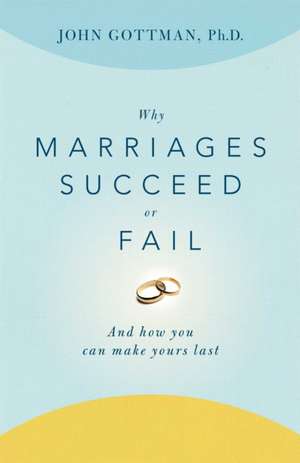
Why Marriages Succeed or Fail
Autor John Gottmanen Limba Engleză Paperback – iun 1995
Notăm cu interes cum Why Marriages Succeed or Fail reușește să transforme cercetarea academică riguroasă într-un ghid de supraviețuire pentru cuplul modern. Volumul conține o metodologie testată, extrasă din observarea directă a mii de parteneri, oferind cititorului instrumente concrete pentru a evalua dacă relația sa se află pe o traiectorie ascendentă sau spre un declin inevitabil. Structura cărții este una progresivă: începe prin definirea stilurilor de căsnicie — de la cele volatile la cele validate — și continuă cu celebrul concept al lui John Gottman, „Cei patru călăreți ai Apocalipsei”, acele atitudini toxice care pot prezice separarea cu o acuratețe surprinzătoare. Suntem de părere că abordarea lui Gottman este revoluționară deoarece nu se bazează pe intuiție, ci pe date. Cine a studiat The Seven Principles for Making Marriage Work va aprecia aici profunzimea analizei mecanismelor de conflict; în timp ce volumul menționat oferă reguli de aur pentru funcționare, Why Marriages Succeed or Fail se concentrează pe diagnosticarea timpurie a semnelor de alarmă și pe restructurarea dialogului interior al partenerilor. Cartea dedică spațiu generos diferențelor de perspectivă dintre „versiunea lui” și „versiunea ei”, oferind chei practice pentru consolidarea fundației relaționale. Această lucrare se poziționează ca un pilon central în opera autorului, făcând puntea între studiul teoretic What Predicts Divorce? și ghidurile aplicate precum The Seven-Day Love Prescription. Cititorul este invitat nu doar să lectureze, ci să participe activ prin chestionare care dezvăluie punctele slabe ale comunicării, învățând că secretul unei căsnicii durabile nu stă în absența conflictului, ci în modul în care acesta este gestionat și reparat.
Preț: 100.38 lei
Carte disponibilă
Livrare economică 13-27 noiembrie
Specificații
ISBN-10: 0684802414
Pagini: 240
Dimensiuni: 141 x 219 x 27 mm
Greutate: 0.2 kg
Editura: Simon&Schuster
V-ar putea interesa
-
 Stumbling on HappinessDaniel GilbertPreț: 79.45 lei
 -
 Predictably IrrationalDan ArielyPreț: 79.92 lei
 -
 The (Honest) Truth About DishonestyDan Ariely-22%Preț: 50.45 lei64.87 lei
 -
 Thinking, Fast and SlowDaniel Kahneman-27%Preț: 90.79 lei123.57 leiRecomandat
 -
 Positive Discipline A-ZJane NelsenPreț: 118.24 lei
 -
 Preț: 111.95 lei
 -
 Preț: 133.67 lei
 -
 The Best American Travel Writing 2016Bill BrysonPreț: 93.53 lei
 -
 The Relationship CureJohn GottmanPreț: 110.15 lei
 -
 Optimistic ChildMartin E P SeligmanPreț: 103.27 lei
 -
 Raising An Emotionally Intelligent ChildDaniel GolemanPreț: 103.10 lei
 -
 NoDavid WalshPreț: 99.88 lei
 -
 -26%Preț: 89.82 lei122.02 lei
 -
 101 Favorite Play Therapy Techniques: Volume 1Heidi Kaduson-31%Preț: 415.88 lei599.98 lei
 -
 The 5 Love LanguagesGary ChapmanPreț: 93.21 lei
 -
 Preț: 89.13 lei
 -
 -27%Preț: 74.89 lei103.02 lei
 -
 Preț: 117.96 lei
 -
 What Makes Love Last?John GottmanPreț: 105.03 lei
 -
 Intervention & Strategies in Counseling and PsychotherapyRichard E. Watts-5%Preț: 506.07 lei532.71 lei
 -
 Notes from a Small IslandBill Bryson-18%Preț: 65.33 lei79.72 lei
 -
 Why Him? Why Her?Helen FisherPreț: 79.95 lei
De ce să citești această carte
Recomandăm această carte oricărui cuplu care dorește să înlocuiască presupunerile cu certitudini științifice. Veți câștiga capacitatea de a identifica tiparele distructive înainte ca acestea să devină iremediabile și veți învăța tehnici de comunicare care pot salva o relație aflată în impas. Este o lectură esențială pentru cei care vor să înțeleagă dinamica psihologică a partenerului și să construiască o legătură bazată pe respect reciproc, nu pe defensivă.
Despre autor
John Gottman este un psiholog american renumit, profesor emerit la Universitatea din Washington, recunoscut la nivel mondial pentru munca sa de peste patru decenii în analiza stabilității maritale și predicția divorțului. Co-fondator al Institutului Gottman, el a fost inclus în topul celor mai influenți terapeuți ai ultimului sfert de secol. Metodologia sa, bazată pe observația științifică directă în „Laboratorul de Iubire”, a revoluționat consilierea de cuplu, punând accent pe importanța reconcilierii și a inteligenței emoționale în menținerea unei relații sănătoase.
Descriere scurtă
You'll also learn:
* More sex doesn't necessarily improve a marriage
* Frequent arguing will not lead to divorce
* Financial problems do not always spell trouble in a relationship
* Wives who make sour facial expressions when their husbands talk are likely to be separated within four years
* There is a reason husbands withdraw from arguments -- and there's a way around it
Dr. Gottman tells you how to recognize attitudes that doom a marriage -- contempt, criticism, defensiveness, and stonewalling -- and provides practical exercises, quizzes, tips, and techniques that will help you understand and make the most of your relationship. You can avoid patterns that lead to divorce, and -- Why Marriages Succeed or Fail will show you how.
Notă biografică
Descriere
Cuprins
CONTENTS
Preface
ONE What Makes Marriage Work?
TWO Marriage Styles: The Good, The Bad, and the Volatile
THREE The Four Horsemen of the Apocalypse: Warning Signs
FOUR Your Private Thoughts Become Cast in Stone
FIVE The Two Marriages: His and Hers
SIX Your Marriage: The Diagnosis
SEVEN The Four Keys to Improving Your Marriage
EIGHT Strengthening the Foundations
Acknowledgments