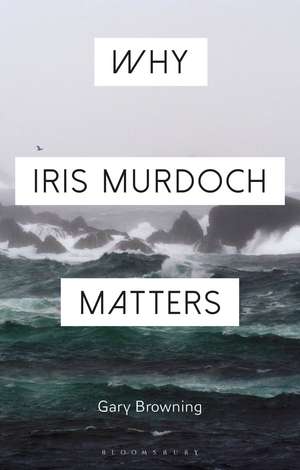
Why Iris Murdoch Matters: Why Philosophy Matters
Autor Professor Gary Browningen Limba Engleză Paperback – 23 aug 2018
Browning lucidly illustrates that through both her thought and fiction we can grasp the significance of issues that remain of paramount importance today: the possibilities of a moral life without foundations, the meaning of philosophy in a post-metaphysical age, the prospects of politics without ideological certainties and the significance of art after realism.
A totally original work arguing persuasively that Iris Murdoch not only matters but is absolutely central to how we think through the contemporary age.

Preț: 186.11 lei
Preț vechi: 231.80 lei
-20%
Puncte Express: 279
Carte tipărită la comandă
Livrare economică 23 noiembrie-07 decembrie
Livrare prin curier în România Termenul estimat este afișat lângă disponibilitate.
Transport gratuit de la 400.00 lei Plată online sau ramburs, în funcție de opțiunile comenzii.
Retur gratuit în 14 zile Comandă securizată și suport în română.
Specificații
ISBN-13: 9781472574473
ISBN-10: 1472574478
Pagini: 248
Dimensiuni: 138 x 214 x 16 mm
Greutate: 0.34 kg
Editura: Bloomsbury Publishing
Colecția Bloomsbury Academic
Seria Why Philosophy Matters
Locul publicării:London, United Kingdom
ISBN-10: 1472574478
Pagini: 248
Dimensiuni: 138 x 214 x 16 mm
Greutate: 0.34 kg
Editura: Bloomsbury Publishing
Colecția Bloomsbury Academic
Seria Why Philosophy Matters
Locul publicării:London, United Kingdom
Cuprins
Introduction
1. Murdoch and Modernity
2. Philosophy: Plato and the Good
3. The Modern Self in Search of Itself
4. The Good
5. The Time of the Angels: Religion After the Death of God
6. Politics in a Post-ideological World
7. Art After Realism
8. The Life and Times of Murdoch
Bibliography
Index
1. Murdoch and Modernity
2. Philosophy: Plato and the Good
3. The Modern Self in Search of Itself
4. The Good
5. The Time of the Angels: Religion After the Death of God
6. Politics in a Post-ideological World
7. Art After Realism
8. The Life and Times of Murdoch
Bibliography
Index
Recenzii
The complex relationships Murdoch so carefully lays bare in her novels show the misery that people inflict on themselves and others by failing to attend properly to the reality at hand. Her philosophical works on metaphysics and ethics display her unique reaction to the dryness and radical individualism of the overly abstract philosophies of existentialist and analytic philosophers, who depict moral agents as freely choosing wills unencumbered, and undefined by, personal relations, detached from the communities in which they live. Murdoch attempts to recover traditional values lost in these philosophies by intimations in experience of the unifying presence of goodness that transcends subjective satisfaction. Good art and literature enable people to see and become more sensitive to the experience of others. Summing Up: Highly recommended. Upper-division undergraduates through faculty.
She had a significant impact on some brilliant philosophers: Cora Diamond, John McDowell, Martha Nussbaum, and Charles Taylor. But she is not widely read . Her work may be more visible now, but progress is slow. Browning's accessible, wide-ranging book will help accelerate it.
A stunning account of the philosophical and, to a lesser degree, political, underpinning of Murdoch's novel writing ... written in precise, rich prose, this is an important contribution to the growing sphere of Iris Murdoch studies but should also prove to be of immense interest to the general reader alike.
Browning has succeeded in casting Murdoch's legacy in a new light by showing that her work is historical and political. He has made a convincing case that her unique combination of metaphysics, moral philosophy, art and personal life offer something which has been missing in the dominant trends of Anglo-American moral and political philosophy, and that she should be studied not only by literary scholars and philosophers but also by political theorists and historians of ideas.
Browning has achieved a unity in the diversity of her thought and readers will likely be convinced that Iris Murdoch indeed matters.
An original introduction for both the student and the lay reader alike.
Gary Browning places Murdoch in her age and in ours: she is a profoundly historical and dialectical thinker from a very particular historical moment, whose influence and importance have only grown in recent years. He sees her in the round: this is Murdoch as first, the philosopher who refused to be either 'analytic' or 'continental': but then also and, very vividly, the novelist, the playwright, the political thinker and the letter-writer. An exciting and much-needed book.
She had a significant impact on some brilliant philosophers: Cora Diamond, John McDowell, Martha Nussbaum, and Charles Taylor. But she is not widely read . Her work may be more visible now, but progress is slow. Browning's accessible, wide-ranging book will help accelerate it.
A stunning account of the philosophical and, to a lesser degree, political, underpinning of Murdoch's novel writing ... written in precise, rich prose, this is an important contribution to the growing sphere of Iris Murdoch studies but should also prove to be of immense interest to the general reader alike.
Browning has succeeded in casting Murdoch's legacy in a new light by showing that her work is historical and political. He has made a convincing case that her unique combination of metaphysics, moral philosophy, art and personal life offer something which has been missing in the dominant trends of Anglo-American moral and political philosophy, and that she should be studied not only by literary scholars and philosophers but also by political theorists and historians of ideas.
Browning has achieved a unity in the diversity of her thought and readers will likely be convinced that Iris Murdoch indeed matters.
An original introduction for both the student and the lay reader alike.
Gary Browning places Murdoch in her age and in ours: she is a profoundly historical and dialectical thinker from a very particular historical moment, whose influence and importance have only grown in recent years. He sees her in the round: this is Murdoch as first, the philosopher who refused to be either 'analytic' or 'continental': but then also and, very vividly, the novelist, the playwright, the political thinker and the letter-writer. An exciting and much-needed book.