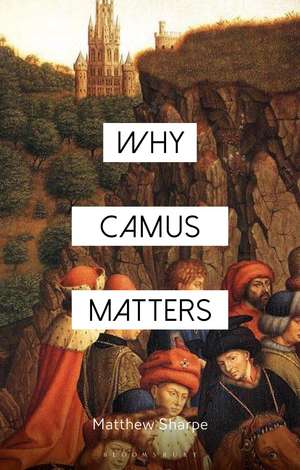
Why Camus Matters: Why Philosophy Matters
Autor Matthew Sharpeen Limba Engleză Paperback – 30 apr 2026
Camus was a man of the Left, without believing in inevitable progress; he wrestled with nihilism but only in order to seek paths beyond it; he repudiated belief in God yet wrestled profoundly with religious questions; he defended "Western civilization" and adored the ancient Greeks, whilst denouncing reactionary politics; he explored the darkest human experiences, yet defended moderation, love and dialogue.
He matters today, firstly, because the problems he addressed remain ours: widespread cynicism and despair, democratic collapse, the rise of authoritarianisms, alienation from nature and a fascination with extremes. Secondly, because the solutions he explored to these problems were so highly original and balanced, relative to more widely-credited schools of thought: whether liberalism, Marxism, or fascism, or existentialism, postmodernism, or postcolonialism.
This book, written by an established expert on Camus' work, can serve for new readers as an introduction to Camus' philosophical ideas. More than another critical commentary. Why Camus Matters engages Camus in our contemporary debates, seeking in his thinking a thread out of the labyrinth of the global culture wars, and sources of democratic renewal.



Preț: 160.34 lei
Preț vechi: 192.43 lei
-17%
Puncte Express: 241
Carte disponibilă
Livrare economică 31 octombrie-14 noiembrie
Livrare express 20-24 octombrie pentru 53.59 lei
Livrare prin curier în România Termenul estimat este afișat lângă disponibilitate.
Transport gratuit de la 400.00 lei Plată online sau ramburs, în funcție de opțiunile comenzii.
Retur gratuit în 14 zile Comandă securizată și suport în română.
Specificații
ISBN-13: 9781350512481
ISBN-10: 1350512486
Pagini: 232
Dimensiuni: 156 x 232 x 20 mm
Greutate: 0.25 kg
Editura: Bloomsbury Publishing
Colecția Bloomsbury Academic
Seria Why Philosophy Matters
Locul publicării:London, United Kingdom
ISBN-10: 1350512486
Pagini: 232
Dimensiuni: 156 x 232 x 20 mm
Greutate: 0.25 kg
Editura: Bloomsbury Publishing
Colecția Bloomsbury Academic
Seria Why Philosophy Matters
Locul publicării:London, United Kingdom
Cuprins
Introduction: why Camus matters now
a. Then and now: contrasts and comparisons of Camus' times and ours
b. Camus as engaged thinker
1. Against nihilism: Camus' task
a. Alienation and anomie today
b. "Nihilisms" before Camus
c. Camus' rebellion: "no, I am not an existentialist"
d. If nihilism is murder, what then?
2. Against polarisation: Camus and democracy
a. Polarisation, "post-truth", and incivility
b. Camus on the preconditions of democracy
c. Dialogue and language
d. Solitaire/solidaire: the limits of "the political"
3. Against political romanticism: Camus and the avant gardes
a. Commodified dissent: how revolt became the norm
b. Post-structuralism as aestheticized revolt
c. Sympathy for the devil: Camus against the romantics
d. Camus' Nietzscheanism and the fascism question
4. Against vanguardism: Camus and the divisions of the Left
a. Inequality: the economic elephant in the culture-wars room
b. The postmodern, professional-managerial Left and the triumph of identity
c. Camus' two-sided critique of Marxism-Leninism and the Stalinist disaster
d. Balancing liberty with equality
e. Camus, colonialism, and the Algerian war
5. Against fascism: Camus and the Far Right
a. The rise and rise of illiberal ethnonationalism
b. Competing theories of fascism
c. Camus' critique of Nazism
d. Cynicism, guilt, and the psychological bases of active nihilism
6. Restoring Balance: Camus, Mesure, and Nature
a. The ecological crises and its politics
b. Camus, technology and the defence of the sciences
c. Camus' Greeks and natural limits
Conclusion: the last Camus
a. From exile towards the kingdom: Camus' last works
b. Sources of renewal
a. Then and now: contrasts and comparisons of Camus' times and ours
b. Camus as engaged thinker
1. Against nihilism: Camus' task
a. Alienation and anomie today
b. "Nihilisms" before Camus
c. Camus' rebellion: "no, I am not an existentialist"
d. If nihilism is murder, what then?
2. Against polarisation: Camus and democracy
a. Polarisation, "post-truth", and incivility
b. Camus on the preconditions of democracy
c. Dialogue and language
d. Solitaire/solidaire: the limits of "the political"
3. Against political romanticism: Camus and the avant gardes
a. Commodified dissent: how revolt became the norm
b. Post-structuralism as aestheticized revolt
c. Sympathy for the devil: Camus against the romantics
d. Camus' Nietzscheanism and the fascism question
4. Against vanguardism: Camus and the divisions of the Left
a. Inequality: the economic elephant in the culture-wars room
b. The postmodern, professional-managerial Left and the triumph of identity
c. Camus' two-sided critique of Marxism-Leninism and the Stalinist disaster
d. Balancing liberty with equality
e. Camus, colonialism, and the Algerian war
5. Against fascism: Camus and the Far Right
a. The rise and rise of illiberal ethnonationalism
b. Competing theories of fascism
c. Camus' critique of Nazism
d. Cynicism, guilt, and the psychological bases of active nihilism
6. Restoring Balance: Camus, Mesure, and Nature
a. The ecological crises and its politics
b. Camus, technology and the defence of the sciences
c. Camus' Greeks and natural limits
Conclusion: the last Camus
a. From exile towards the kingdom: Camus' last works
b. Sources of renewal
Recenzii
Albert Camus is not to be read, he is to be lived. In a world where the Human can feel redundant, a mere subject, Matthew Sharpe reminds us that someone saw it all and he has a way out. Camus is not for our time, he is for all times.