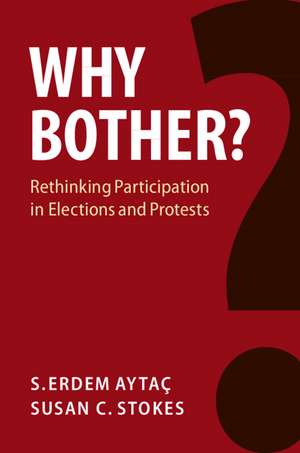
Why Bother?: Rethinking Participation in Elections and Protests: Cambridge Studies in Comparative Politics
Autor S. Erdem Aytaç, Susan C. Stokesen Limba Engleză Paperback – 9 ian 2019
În volumul Why Bother?, autorii S. Erdem Aytaç și Susan C. Stokes aduc o perspectivă inovatoare în științele politice, chestionând modelele clasice ale participării electorale. Ceea ce aduce nou această lucrare este introducerea conceptului de „costuri ale abținerii”. Dacă teoriile tradiționale se concentrează pe barierele logistice sau riscurile participării, această cercetare demonstrează că pasivitatea are propriile sale costuri psihice și intrinseci, pe care politicienii și activiștii învață să le manipuleze pentru a mobiliza masele.
Remarcăm rigoarea metodologică prin care autorii explică fenomene aparent paradoxale: de ce eforturile de suprimare a votului eșuează uneori sau de ce represiunea polițienească transformă proteste locale în mișcări naționale de amploare. Analiza nu este doar teoretică, ci este susținută de un volum impresionant de date din țări cu sisteme politice diverse, de la Suedia la Turcia. Cititorii familiarizați cu Voter Turnout de Meredith Rolfe vor aprecia modul în care acest volum extinde discuția de la rețelele sociale către mecanismele psihologice individuale de autoreglare în fața datoriei civice. Spre deosebire de abordarea lui Meredith Rolfe, care pune accent pe legăturile sociale, Why Bother? investighează tensiunea internă a cetățeanului care simte că „trebuie” să acționeze.
Structura cărții, publicată de Cambridge University Press, este adaptată mediului academic, oferind tabele comparative și exerciții care facilitează înțelegerea dinamicii dintre mobilizare și demobilizare. Subliniem echilibrul dintre analiza votului și cea a protestelor de stradă, oferind o viziune unificată asupra acțiunii colective.
Din seria Cambridge Studies in Comparative Politics
-
 Preț: 321.27 lei
 -
 Preț: 201.81 lei
 - 14%
 Preț: 666.49 lei
 -
 Preț: 390.29 lei
 -
 Preț: 286.56 lei
 -
 Preț: 254.51 lei
 - 11%
 Preț: 596.10 lei
 -
 Preț: 233.57 lei
 -
 Preț: 306.38 lei
 -
 Preț: 254.67 lei
 -
 Preț: 296.51 lei
 -
 Preț: 292.43 lei
 -
 Preț: 295.57 lei
 - 11%
 Preț: 566.04 lei
 - 11%
 Preț: 535.18 lei
 - 11%
 Preț: 564.22 lei
 -
 Preț: 298.92 lei
 - 14%
 Preț: 968.61 lei
 -
 Preț: 279.46 lei
 -
 Preț: 241.26 lei
 - 11%
 Preț: 622.95 lei
 -
 Preț: 271.58 lei
 -
 Preț: 270.48 lei
 - 11%
 Preț: 529.21 lei
 -
 Preț: 391.63 lei
 -
 Preț: 232.06 lei
 - 11%
 Preț: 664.96 lei
 -
 Preț: 320.49 lei
 -
 Preț: 229.58 lei
 - 14%
 Preț: 652.64 lei
 -
 Preț: 433.44 lei
 - 14%
 Preț: 752.95 lei
 -
 Preț: 285.24 lei
 -
 Preț: 272.89 lei
 - 14%
 Preț: 719.87 lei
 -
 Preț: 206.02 lei
 -
 Preț: 232.63 lei
 -
 Preț: 214.49 lei
 -
 Preț: 232.06 lei
 -
 Preț: 326.54 lei
 - 14%
 Preț: 689.27 lei
 -
 Preț: 275.85 lei
 - 11%
 Preț: 668.22 lei
Preț: 202.87 lei
Carte tipărită la comandă
Livrare economică 11-25 iulie
Specificații
ISBN-10: 1108465943
Pagini: 172
Ilustrații: 12 b/w illus. 28 tables 6 exercises
Dimensiuni: 152 x 228 x 10 mm
Greutate: 0.23 kg
Editura: Cambridge University Press
Colecția Cambridge University Press
Seria Cambridge Studies in Comparative Politics
Locul publicării:New York, United States
V-ar putea interesa
-
 Diplomacy and Ideology: From the French Revolution to the Digital AgeAlexander Stagnell-18%Preț: 1070.21 lei1305.13 lei
 -
 Digital Learning in OrganizationsSteve WheelerPreț: 339.46 lei
 -
 Social Media IntelligenceWendy W. Moe-20%Preț: 279.12 lei348.91 lei
 -
 Preț: 365.16 lei
 -
 Social Media and International RelationsSarah KrepsPreț: 145.91 lei
 -
 Contention in Times of CrisisHanspeter Kriesi-11%Preț: 624.56 lei701.75 lei
 -
 Europe's Migration CrisisVicki Squire-11%Preț: 620.92 lei697.67 lei
 -
 Digital Learning: The Key ConceptsFrank RenniePreț: 231.25 lei
 -
 Digital Diplomacy: Theory and PracticeCorneliu BjolaPreț: 453.87 lei
 -
 The Science and Politics of Global Climate ChangeAndrew E. DesslerPreț: 397.54 lei
 -
 Gândire rapidă, gândire lentăDaniel KahnemanPreț: 99.00 lei
De ce să citești această carte
Această carte este esențială pentru studenții și cercetătorii în politici comparative care doresc să înțeleagă de ce oamenii aleg să se implice în ciuda riscurilor. Cititorul câștigă un cadru teoretic nou pentru a interpreta reziliența mișcărilor democratice în fața represiunii. Este un instrument analitic valoros pentru a descifra mecanismele emoționale din spatele activismului contemporan și al prezenței la urne.
Despre autor
S. Erdem Aytaç este profesor asociat la Universitatea Koç, specializat în comportament politic și metodologie, în timp ce Susan C. Stokes este profesor de științe politice la Universitatea din Chicago și director al Chicago Center on Democracy. Expertiza lor combinată în politici comparative și procese democratice a condus la această lucrare fundamentală, publicată în seria Cambridge Studies in Comparative Politics. Susan C. Stokes este recunoscută la nivel internațional pentru studiile sale despre democrație, clientelism și responsabilitate politică, aducând în acest volum o profunzime analitică bazată pe decenii de cercetare de teren.
Cuprins
Recenzii
'This beautifully written book offers a simple theory to explain popular behavior in elections and protests. Aytaç and Stokes ask why people are sometimes not dissuaded from participation even when it becomes more difficult or dangerous. Why Bother? gives us hope that there are critical brakes on democratic backsliding. It comes at just the right moment.' Nicholas Valentino, University of Michigan
'It would be hard to overstate the importance of understanding the causal dynamics of political participation. And yet, despite massive social science investment in the topic, conventional theories in political science, sociology, and economics fail to explain empirical variation in participation. That's what makes Why Bother? so important. By taking seriously competing perspectives from different disciplines and attending to a range of real world cases, the authors have fashioned a compelling new theory of participation that promises to revolutionize our understanding of this most important political phenomenon.' Doug McAdam, Ray Lyman Wilbur Professor of Sociology, Stanford University, California
'The theoretical framework developed in this book gives students of political participation new tools to think about how these macrolevel factors influence individual decisions to vote and join protests … This book will undoubtedly become a classic in the political participation literature.' Miguel Carreras, Perspectives on Politics
Descriere
Why do vote-suppression efforts sometimes fail? Why does police repression of demonstrators sometimes turn localized protests into massive, national movements? How do politicians and activists manipulate people's emotions to get them involved? The authors of Why Bother? offer a new theory of why people take part in collective action in politics, and test it in the contexts of voting and protesting. They develop the idea that just as there are costs of participation in politics, there are also costs of abstention - intrinsic and psychological but no less real. That abstention can be psychically costly helps explain real-world patterns that are anomalies for existing theories, such as that sometimes increases in costs of participation are followed by more participation, not less. The book draws on a wealth of survey data, interviews, and experimental results from a range of countries, including the United States, Britain, Brazil, Sweden, and Turkey.