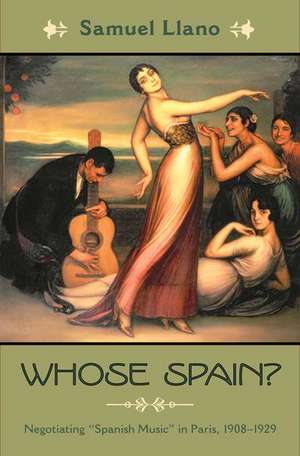
Whose Spain?: Negotiating Spanish Music in Paris, 1908-1929: Currents in Latin American and Iberian Music
Autor Samuel Llanoen Limba Engleză Hardback – 6 dec 2012
Din seria Currents in Latin American and Iberian Music
- 18%
 Preț: 274.53 lei
 - 29%
 Preț: 435.24 lei
 - 30%
 Preț: 536.41 lei
 - 29%
 Preț: 546.53 lei
 - 12%
 Preț: 298.08 lei
 - 31%
 Preț: 557.54 lei
 - 14%
 Preț: 605.13 lei
 - 21%
 Preț: 145.79 lei
 - 28%
 Preț: 438.38 lei
 - 11%
 Preț: 534.43 lei
 - 19%
 Preț: 364.12 lei
 -
 Preț: 267.19 lei
 - 13%
 Preț: 302.35 lei
 -
 Preț: 330.70 lei
 - 18%
 Preț: 371.46 lei
 - 28%
 Preț: 367.88 lei
 - 32%
 Preț: 566.50 lei
 - 21%
 Preț: 364.61 lei
 -
 Preț: 296.03 lei
 - 33%
 Preț: 591.85 lei
 - 29%
 Preț: 457.99 lei
 - 31%
 Preț: 693.52 lei
 - 19%
 Preț: 384.90 lei
 - 12%
 Preț: 302.16 lei
 - 31%
 Preț: 622.30 lei
 - 28%
 Preț: 445.39 lei
 - 28%
 Preț: 409.36 lei
 - 28%
 Preț: 504.51 lei
 - 28%
 Preț: 413.55 lei
 - 31%
 Preț: 635.67 lei
 - 16%
 Preț: 189.72 lei
 - 13%
 Preț: 265.65 lei
 - 11%
 Preț: 358.61 lei
 - 18%
 Preț: 344.19 lei
 - 9%
 Preț: 251.26 lei
 - 12%
 Preț: 304.40 lei
 - 28%
 Preț: 420.98 lei
Preț: 467.68 lei
Preț vechi: 651.38 lei
-28%
Puncte Express: 702
Carte tipărită la comandă
Livrare economică 27 noiembrie-02 decembrie
Livrare prin curier în România Termenul estimat este afișat lângă disponibilitate.
Transport gratuit pentru acest produs Plată online sau ramburs, în funcție de opțiunile comenzii.
Retur gratuit în 14 zile Comandă securizată și suport în română.
Specificații
ISBN-13: 9780199858460
ISBN-10: 0199858462
Pagini: 312
Dimensiuni: 239 x 163 x 31 mm
Greutate: 0.59 kg
Editura: Oxford University Press
Colecția OUP USA
Seria Currents in Latin American and Iberian Music
Locul publicării:New York, United States
ISBN-10: 0199858462
Pagini: 312
Dimensiuni: 239 x 163 x 31 mm
Greutate: 0.59 kg
Editura: Oxford University Press
Colecția OUP USA
Seria Currents in Latin American and Iberian Music
Locul publicării:New York, United States
V-ar putea interesa
-
 -28%Preț: 378.37 lei528.47 lei
 -
 Alexander and the East: The Tragedy of TriumphA.B. Bosworth-33%Preț: 636.35 lei946.99 lei
 -
 Consensus and Disunity: The Lloyd George Coalition Government 1918-1922Kenneth O. Morgan-19%Preț: 370.98 lei456.74 lei
 -
 -33%Preț: 675.69 lei1004.69 lei
 -
 Field Marshal Sir Henry Wilson: A Political SoldierKeith Jeffery-28%Preț: 416.01 lei577.68 lei
 -
 -30%Preț: 402.51 lei571.33 lei
 -
 -28%Preț: 452.88 lei631.88 lei
 -
 -28%Preț: 479.56 lei669.23 lei
 -
 Dialectics, Dogmas, and DissentJohn RoddenPreț: 262.61 lei
 -
 Guilds, Innovation and the European Economy, 1400-1800S. R. EpsteinPreț: 424.38 lei
 -
 Claudius CaesarJosiah OsgoodPreț: 311.58 lei
 -
 Down Down Deeper and Down: Ireland in the 70s and 80sEAMONN SWEENEYPreț: 101.34 lei
 -
 The Provisional IRA: From Insurrection to ParliamentTommy McKearneyPreț: 259.56 lei
 -
 The Metaxas Myth: Dictatorship and Propaganda in GreeceMarina Petrakis-24%Preț: 259.81 lei343.31 lei
Recenzii
In Whose Spain?, Llano invites his readers to question their assumptions about the meaning and identity of Spanish music during this crucial period. In response, he offers an original and substantial work of genuine scholarship, that will provoke and inspire future studies of the forces of exoticism and nationalism that contributed to the creation of a new Spanish music for the twentieth century.
Let us welcome the publication of a book that makes a substantial contribution to explaining the social, cultural, political and artistic context in which the most productive period of musical relations between France and Spain developed. This book will surely be very well received and I strongly recommend its reading.
Let us welcome the publication of a book that makes a substantial contribution to explaining the social, cultural, political and artistic context in which the most productive period of musical relations between France and Spain developed. This book will surely be very well received and I strongly recommend its reading.
Notă biografică
Samuel Llano is a cultural historian specialised in Spanish music and theatre of the nineteenth and twentieth centuries. He has published on the presence of Spanish music and culture in Paris in the early twentieth century. His current research deals with representations of "wrongdoing" on the Spanish stage and how they intersect with notions of gender, race, and class.