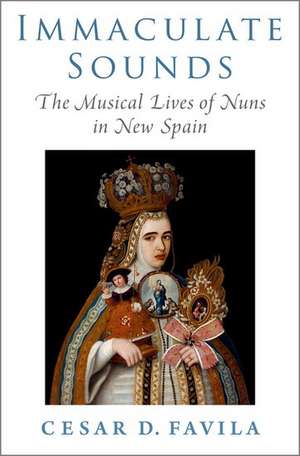
Immaculate Sounds: The Musical Lives of Nuns in New Spain: Currents in Latin American and Iberian Music
Autor Cesar D. Favilaen Limba Engleză Hardback – 14 dec 2023
Din seria Currents in Latin American and Iberian Music
- 18%
 Preț: 274.53 lei
 - 29%
 Preț: 432.02 lei
 - 30%
 Preț: 536.41 lei
 - 12%
 Preț: 298.08 lei
 - 31%
 Preț: 557.54 lei
 - 14%
 Preț: 605.13 lei
 - 21%
 Preț: 145.79 lei
 - 28%
 Preț: 438.38 lei
 - 11%
 Preț: 534.43 lei
 - 19%
 Preț: 364.12 lei
 -
 Preț: 267.19 lei
 - 13%
 Preț: 302.35 lei
 -
 Preț: 330.70 lei
 - 19%
 Preț: 362.88 lei
 - 28%
 Preț: 367.88 lei
 - 32%
 Preț: 566.50 lei
 - 21%
 Preț: 364.61 lei
 -
 Preț: 296.03 lei
 - 33%
 Preț: 591.85 lei
 - 29%
 Preț: 457.99 lei
 - 31%
 Preț: 693.52 lei
 - 28%
 Preț: 467.68 lei
 - 19%
 Preț: 384.90 lei
 - 12%
 Preț: 302.16 lei
 - 31%
 Preț: 622.30 lei
 - 28%
 Preț: 445.39 lei
 - 28%
 Preț: 409.36 lei
 - 28%
 Preț: 504.51 lei
 - 28%
 Preț: 413.55 lei
 - 31%
 Preț: 635.67 lei
 - 16%
 Preț: 189.60 lei
 - 13%
 Preț: 265.65 lei
 - 11%
 Preț: 358.61 lei
 - 18%
 Preț: 344.19 lei
 - 9%
 Preț: 251.26 lei
 - 12%
 Preț: 304.40 lei
 - 28%
 Preț: 420.98 lei
Preț: 546.53 lei
Preț vechi: 775.09 lei
-29%
Puncte Express: 820
Carte disponibilă
Livrare economică 30 octombrie-04 noiembrie
Livrare prin curier în România Termenul estimat este afișat lângă disponibilitate.
Transport gratuit pentru acest produs Plată online sau ramburs, în funcție de opțiunile comenzii.
Retur gratuit în 14 zile Comandă securizată și suport în română.
Specificații
ISBN-13: 9780197621899
ISBN-10: 0197621899
Pagini: 360
Ilustrații: 21 color illustrations, 19 music examples, 2 tables
Dimensiuni: 160 x 229 x 36 mm
Greutate: 0.77 kg
Editura: Oxford University Press
Colecția OUP USA
Seria Currents in Latin American and Iberian Music
Locul publicării:New York, United States
ISBN-10: 0197621899
Pagini: 360
Ilustrații: 21 color illustrations, 19 music examples, 2 tables
Dimensiuni: 160 x 229 x 36 mm
Greutate: 0.77 kg
Editura: Oxford University Press
Colecția OUP USA
Seria Currents in Latin American and Iberian Music
Locul publicării:New York, United States
Recenzii
Unlike preexisting studies of convent music, Favila's work cycles back to theological discourse and nuns' personal spirituality with every point he makes.
Favila shows a remarkable skill in switching between typically isolated disciplines.
"The meticulous and thorough analysis of the lyrics and music of these villancicos is remarkable." - Ascensión Mazuela-Anguita, Music & Letters
Immaculate Sounds offers a new approach to the significance of devotional music performance by creating synergy between music, literature and visual arts in the context of New Spanish convents. The book is generously illustrated with pictures, musical examples, and tables that guide the reader through a unique journey inside the resonant cloisters of New Spain.
Favila has given us a glimpse into a fascinating world where divinity and humanity meet.
Cesar D. Favila writes with compassion and curiosity, and with a love of storytelling that brings his material to life. He makes it possible for us to hear the long-silenced voices of women religious—chanting, singing, speaking— through meticulous scholarship, vivid biography, and fresh analysis of a wealth of sources. Immaculate Sounds weaves together the varied cultures of New Spain, creating textures and layers from strands of race, gender, faith, creativity, and community, in a multisensory, absorbing, and ultimately tender narrative.
Cesar D. Favila's compelling monograph expertly weaves together scores, archival documents, biographies, art, and architecture to create a richly colored tapestry depicting musical culture in the convents of New Spain. The organization of the book—with its emphasis on both individual stories and the larger historical context— allows him to illustrate the soundscape of monastic life with musical examples that reflect a 'timeless, cyclical, and cosmic' approach to women's history.
Favila discloses an expansive, new world of convent culture, abounding in fresh musical, visual, literary, biographical, and bibliographical information. Readers familiar with Western European traditions may sometimes nod in agreement as he situates New Spain's convent music in its devotional contexts. At other times, his eye-opening revelations might even make them blink.
Blending cultural history, musical theory, and archival research, this work will definitely change the interpretation of the musical heritage of women's convents in colonial Mexico.
Immaculate Sounds makes important strides towards understanding the musical experience of New Spanish nuns as part of a more extensive set of devotional practices. Furthermore, the study models an effective methodological strategy for overcoming the difficulties of scattered and incomplete archives, a challenge that plagues scholars of colonial Latin America and beyond. All in all, Favila offers readers a rare opportunity to hear inside the imposing walls of New Spanish convents. His thoughtful reflections upon cloistered women's music make long-forgotten voices audible and open our ears to new possibilities.
It is important to point out that this book serves as a valuable link between the extensive Latin American scholarship on female monasticism and the Anglo-Saxon literature that underpins much of this research.
As a concluding note, Immaculate Sounds: The Musical Lives of Nuns in New Spain offers a detailed view of the musical lives of nuns in New Spain, highlighting their role as spiritual intercessors in the pursuit of Christian salvation through devotional music. This allows Favila to create a multidisciplinary perspective on a musical practice deeply rooted in specific historical and cultural contexts. This approach could serve as a foundation for future research into colonial music and the history of spirituality.
Favila is to be commended for his diligence in excavating convent archives and other collections in search of the raw materials with which to build his case. It is a strong case, and it is bolstered by the author' skill in using theory and his resourcefulness in identifying other possible aids to understanding (for example, Fanny Calderón de la Barca's firsthand accounts of nineteenth-century convent singing), to help fill in gaps. It is also strengthened by felicitously expressed insights that derive not from theory but from the author's own sensitivity and historical imagination.
Favila shows a remarkable skill in switching between typically isolated disciplines.
"The meticulous and thorough analysis of the lyrics and music of these villancicos is remarkable." - Ascensión Mazuela-Anguita, Music & Letters
Immaculate Sounds offers a new approach to the significance of devotional music performance by creating synergy between music, literature and visual arts in the context of New Spanish convents. The book is generously illustrated with pictures, musical examples, and tables that guide the reader through a unique journey inside the resonant cloisters of New Spain.
Favila has given us a glimpse into a fascinating world where divinity and humanity meet.
Cesar D. Favila writes with compassion and curiosity, and with a love of storytelling that brings his material to life. He makes it possible for us to hear the long-silenced voices of women religious—chanting, singing, speaking— through meticulous scholarship, vivid biography, and fresh analysis of a wealth of sources. Immaculate Sounds weaves together the varied cultures of New Spain, creating textures and layers from strands of race, gender, faith, creativity, and community, in a multisensory, absorbing, and ultimately tender narrative.
Cesar D. Favila's compelling monograph expertly weaves together scores, archival documents, biographies, art, and architecture to create a richly colored tapestry depicting musical culture in the convents of New Spain. The organization of the book—with its emphasis on both individual stories and the larger historical context— allows him to illustrate the soundscape of monastic life with musical examples that reflect a 'timeless, cyclical, and cosmic' approach to women's history.
Favila discloses an expansive, new world of convent culture, abounding in fresh musical, visual, literary, biographical, and bibliographical information. Readers familiar with Western European traditions may sometimes nod in agreement as he situates New Spain's convent music in its devotional contexts. At other times, his eye-opening revelations might even make them blink.
Blending cultural history, musical theory, and archival research, this work will definitely change the interpretation of the musical heritage of women's convents in colonial Mexico.
Immaculate Sounds makes important strides towards understanding the musical experience of New Spanish nuns as part of a more extensive set of devotional practices. Furthermore, the study models an effective methodological strategy for overcoming the difficulties of scattered and incomplete archives, a challenge that plagues scholars of colonial Latin America and beyond. All in all, Favila offers readers a rare opportunity to hear inside the imposing walls of New Spanish convents. His thoughtful reflections upon cloistered women's music make long-forgotten voices audible and open our ears to new possibilities.
It is important to point out that this book serves as a valuable link between the extensive Latin American scholarship on female monasticism and the Anglo-Saxon literature that underpins much of this research.
As a concluding note, Immaculate Sounds: The Musical Lives of Nuns in New Spain offers a detailed view of the musical lives of nuns in New Spain, highlighting their role as spiritual intercessors in the pursuit of Christian salvation through devotional music. This allows Favila to create a multidisciplinary perspective on a musical practice deeply rooted in specific historical and cultural contexts. This approach could serve as a foundation for future research into colonial music and the history of spirituality.
Favila is to be commended for his diligence in excavating convent archives and other collections in search of the raw materials with which to build his case. It is a strong case, and it is bolstered by the author' skill in using theory and his resourcefulness in identifying other possible aids to understanding (for example, Fanny Calderón de la Barca's firsthand accounts of nineteenth-century convent singing), to help fill in gaps. It is also strengthened by felicitously expressed insights that derive not from theory but from the author's own sensitivity and historical imagination.
Notă biografică
Cesar D. Favila is Assistant Professor of Musicology at UCLA. His work focuses on Mexican music, ranging from colonial New Spain to the contemporary Chicano experience, and often residing at the intersections of music, religion, gender, and race. Favila's work has been funded by numerous grants and fellowships, including support from the American Council of Learned Societies, the American Philosophical Society, and the Fulbright Program, among others.