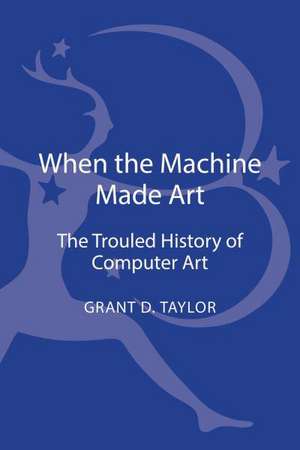
When the Machine Made Art
Autor Grant D. Tayloren Limba Engleză Hardback – 10 apr 2014
Preț: 1047.55 lei
Preț vechi: 1435.00 lei
-27%
Puncte Express: 1571
Carte tipărită la comandă
Livrare economică 17 noiembrie-01 decembrie
Livrare prin curier în România Termenul estimat este afișat lângă disponibilitate.
Transport gratuit pentru acest produs Plată online sau ramburs, în funcție de opțiunile comenzii.
Retur gratuit în 14 zile Comandă securizată și suport în română.
Specificații
ISBN-13: 9781623567958
ISBN-10: 1623567955
Pagini: 352
Ilustrații: 50 bw illus
Dimensiuni: 140 x 216 x 21 mm
Greutate: 0.56 kg
Ediția:New.
Editura: Bloomsbury Publishing
Locul publicării:New York, United States
ISBN-10: 1623567955
Pagini: 352
Ilustrații: 50 bw illus
Dimensiuni: 140 x 216 x 21 mm
Greutate: 0.56 kg
Ediția:New.
Editura: Bloomsbury Publishing
Locul publicării:New York, United States
V-ar putea interesa
-
 The Book of JobNanaPreț: 112.92 lei
 -
 Getting the Message: News, Truth, and PowerJohn EldridgePreț: 407.34 lei
 -
 Preț: 392.60 lei
 -
 Preț: 388.77 lei
 -
 The First Amendment and the Media in the Court of Public OpinionDavid Alistair YalofPreț: 441.27 lei
 -
 Jews and Judaism in The New York TimesChristopher Vecsey, Ph.D-33%Preț: 389.31 lei580.64 lei
 -
 City Branding and New MediaM. PaganoniPreț: 367.83 lei
 -
 Time and Media MarketsAlan B. Albarran-15%Preț: 416.38 lei489.87 lei
 -
 Thinking Through Digital MediaD. Hudson-15%Preț: 705.70 lei830.25 lei
 -
 Humor, Entertainment, and Popular Culture during World War IClémentine Tholas-Disset-15%Preț: 619.90 lei729.29 lei
 -
 Preț: 369.35 lei
 -
 Mediated AuthenticityGunn Enli-27%Preț: 957.75 lei1311.99 lei
 -
 Magazine Movements: Women's Culture, Feminisms and Media FormDr. Laurel Forster-24%Preț: 256.34 lei335.99 lei
 -
 Branded Bodies, Rhetoric, and the Neoliberal Nation-StateJennifer Wingard-23%Preț: 333.77 lei434.31 lei
 -
 Mass Media and Society in a Changing World (Revised Edition)Minabere Ibelema-23%Preț: 738.54 lei959.14 lei
 -
 Fernsehen als SinnproduzentAngela KepplerPreț: 244.13 lei
 -
 Preț: 282.78 lei
 -
 Preț: 376.68 lei
 -
 Preț: 295.03 lei
 -
 Preț: 369.08 lei
Caracteristici
Traces the heated debates between art and science since the emergence of computer-art in 1963
Notă biografică
Grant D. Taylor is Associate Professor of Art History at Lebanon Valley College, Pennsylvania, USA. He most recent article, "The Soulless Usurper: The Reception and Criticism of Early Computer-Generated Art", is published in Mainframe Experimentalism, edited by Douglas Kahn and Hannah Higgins.
Cuprins
Introduction: Unorthodox Chapter 1: Future Crashes Chapter 2: Coded Aesthetics Chapter 3: Virtual Renaissance Chapter 4: Frontier Exploration Chapter 5: Critical Impact Epilogue: Aftermath Bibliography Index
Recenzii
Taylor's 'troubled history of computer art' is subtle, complex, multi-layered and often paradoxical, so any attempt to summarize or synthesize its content fails to convey the scope and depth of what is covered ... I intend to champion Taylor's book whenever the lament arises about why the art world takes no notice of mathematical art ... I will urge everyone I know who has an interest in using the computer in any significant way in his or her art practice to read Taylor's book for the cautionary lessons it has to offer.
Taylor recovers and reassembles the fractured history of "computer art" from 1963, when the term came into use, until 1989, when "digital art" and "new media" became the preferred terms [.] Taylor's approach is integrative. He reconstructs the history of computer art not by isolating it from its scientific and mathematical nature but by combining that context with the "art and technology" and conceptual art movements of the 1960s. Summing Up: Recommended. Graduate students and researchers/faculty.
How astonishing that the pioneers of computer, digital, algorithmic, programming, and mash-up art are largely unknown at the very moment when the computer, or more specifically its handheld, lap bound, or otherwise omnipresent progeny are transforming virtually every aspect of existence! I read this, fascinated by the continued relevance of the artists (and their disputes) and delighted to know that finally, with this publication, there exists a portrait of an evolving movement that has worked assiduously at the boundaries of the art world for fifty years.
By questioning the reasons for which art critics, artists and curators rejected computer-generated artefacts during the 1960s, 1970s and 1980s, Grant Taylor makes a significant contribution to the historiography of 20th century culture.
Although computer-generated art was largely ignored by the art establishment in the 1960s and 70s, it's now viewed in a very different light. Grant Taylor's book provides an excellent - and much needed -overview of the beginnings of digital art and design.
Taylor recovers and reassembles the fractured history of "computer art" from 1963, when the term came into use, until 1989, when "digital art" and "new media" became the preferred terms [.] Taylor's approach is integrative. He reconstructs the history of computer art not by isolating it from its scientific and mathematical nature but by combining that context with the "art and technology" and conceptual art movements of the 1960s. Summing Up: Recommended. Graduate students and researchers/faculty.
How astonishing that the pioneers of computer, digital, algorithmic, programming, and mash-up art are largely unknown at the very moment when the computer, or more specifically its handheld, lap bound, or otherwise omnipresent progeny are transforming virtually every aspect of existence! I read this, fascinated by the continued relevance of the artists (and their disputes) and delighted to know that finally, with this publication, there exists a portrait of an evolving movement that has worked assiduously at the boundaries of the art world for fifty years.
By questioning the reasons for which art critics, artists and curators rejected computer-generated artefacts during the 1960s, 1970s and 1980s, Grant Taylor makes a significant contribution to the historiography of 20th century culture.
Although computer-generated art was largely ignored by the art establishment in the 1960s and 70s, it's now viewed in a very different light. Grant Taylor's book provides an excellent - and much needed -overview of the beginnings of digital art and design.
Descriere
Descriere de la o altă ediție sau format:
Considering how culturally indispensable digital technology is today, it is ironic that computer-generated art was attacked when it burst onto the scene in the early 1960s. In fact, no other twentieth-century art form has elicited such a negative and hostile response. When the Machine Made Art examines the cultural and critical response to computer art, or what we refer to today as digital art. Tracing the heated debates between art and science, the societal anxiety over nascent computer technology, and the myths and philosophies surrounding digital computation, Taylor is able to identify the destabilizing forces that shape and eventually fragment the computer art movement.
Considering how culturally indispensable digital technology is today, it is ironic that computer-generated art was attacked when it burst onto the scene in the early 1960s. In fact, no other twentieth-century art form has elicited such a negative and hostile response. When the Machine Made Art examines the cultural and critical response to computer art, or what we refer to today as digital art. Tracing the heated debates between art and science, the societal anxiety over nascent computer technology, and the myths and philosophies surrounding digital computation, Taylor is able to identify the destabilizing forces that shape and eventually fragment the computer art movement.