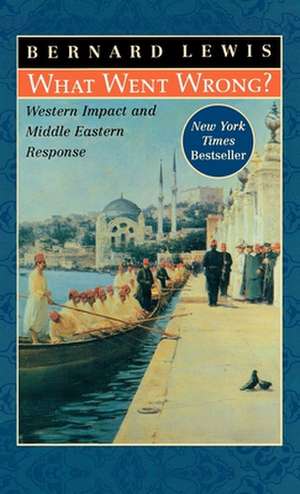
What Went Wrong?
Autor Bernard W. Lewisen Limba Engleză Hardback – 24 ian 2002
Ne-a atras atenția, în primul rând, modul în care Bernard W. Lewis utilizează comparațiile dintre ceas și calendar sau poziția femeii în societate pentru a ilustra o falie culturală profundă. What Went Wrong? nu este doar o cronică istorică, ci un studiu de caz extins asupra unei culturi în plină turbulență, care încearcă să înțeleagă pierderea supremației în fața Occidentului. Suntem de părere că forța acestui volum rezidă în analiza practică a modului în care Orientul Mijlociu a început să împrumute, adesea sub presiune, tactici militare, diplomație și sisteme educaționale europene.
Analiza acoperă aceeași arie tematică precum Islam and the West, dar cu o abordare mult mai focalizată pe mecanismele interne ale declinului și pe „angustia” unei civilizații care s-a văzut depășită în aproape toate aspectele vieții publice și private. Spre deosebire de The Muslim Discovery Of Europe, care explorează percepțiile inițiale, acest volum se concentrează pe consecințele dureroase ale modernizării forțate. Credem că What Went Wrong? ocupă un loc central în opera autorului, făcând legătura între cercetările sale clasice din The Middle East și analizele contemporane despre radicalism din The Crisis of Islam. Stilul este unul precis, specific unui istoric care a petrecut decenii studiind surse primare, oferind o perspectivă de lungă durată asupra relațiilor dintre creștinism și islam, fără a recurge la simplificări geopolitice de moment.
Preț: 352.36 lei
Carte tipărită la comandă
Livrare economică 08-22 iunie
Specificații
ISBN-10: 0195144201
Pagini: 192
Dimensiuni: 147 x 218 x 21 mm
Greutate: 0.38 kg
Editura: Oxford University Press
Locul publicării:Oxford, England, United States
V-ar putea interesa
-
 Preț: 151.42 lei
 -
 -6%Preț: 323.64 lei345.95 lei
 -
 Intercultural PragmaticsIstvan Kecskes-14%Preț: 675.98 lei786.02 lei
 -
 Humanity's LawRuti TeitelPreț: 279.23 lei
 -
 The Practice of Public DiplomacyW. RughPreț: 376.51 lei
 -
 Freedom's BattleGary J. BassPreț: 146.95 lei
 -
 Advocacy and Social Work PracticeTom Wilks-22%Preț: 187.11 lei240.19 lei
 -
 Branding Cities: Cosmopolitanism, Parochialism, and Social ChangeStephanie Hemelryk DonaldPreț: 453.04 lei
 -
 Preț: 295.57 lei
 -
 The Nature and Origins of Mass OpinionJohn R. ZallerPreț: 213.90 lei
 -
 -37%Preț: 250.76 lei398.75 lei
 -
 The Ethics of Armed Humanitarian InterventionDon E. ScheidPreț: 216.43 lei
 -
 International Law and International RelationsDavid ArmstrongPreț: 272.33 lei
 -
 International Public Relations and Public DiplomacyGuy J. GolanPreț: 415.54 lei
 -
 Managing the Public's Trust in Non-profit OrganizationsChristopher D.B. BurtPreț: 361.78 lei
De ce să citești această carte
Recomandăm această carte studenților la istorie și relații internaționale, dar și cititorilor pasionați de geopolitică. Veți câștiga o înțelegere nuanțată a rădăcinilor istorice ale tensiunilor actuale dintre Orient și Occident. Este o lectură esențială pentru a înțelege cum o civilizație care a condus lumea în știință și arte a ajuns să se confrunte cu o criză de identitate profundă în fața modernității.
Despre autor
Bernard W. Lewis este profesor emerit Cleveland E. Dodge de studii asupra Orientului Apropiat la Universitatea Princeton. Recunoscut la nivel mondial drept unul dintre cei mai distinși savanți în istoria islamului, Lewis a publicat peste două duzini de cărți fundamentale, printre care se numără The Arabs in History și The Emergence of Modern Turkey. Opera sa este caracterizată de o rigoare academică de neegalat, fiind adesea citat de istorici și politicieni deopotrivă pentru capacitatea sa de a sintetiza milenii de istorie orientală într-un limbaj accesibil, dar profund documentat.
Recenzii
"Lewis has done us all--Muslim and non-Muslim alike--a remarkable service.... The book's great strength, and its claim upon our attention, [is that] it offers a long view in the midst of so much short-term and confusing punditry on television, in the op-ed pages, on campuses and in strategic studies
think tanks." --Paul Kennedy, The New York Times Book Review
"When it comes to Islamic studies, Bernard Lewis is the father of us all. With brilliance, integrity, and extraordinary mastery of languages and sources, he has led the way for Jewish and Christian investigators seeking to understand the Muslim world."--National Review
"A timely and provocative contribution to the current raging debate about the tensions between the West and the Islamic world.... One wishes leaders in the Islamic world would pay heed to some of Lewis' themes." --Stanley Reed, Business Week
"A sobering picture, delivered with persuasive detail and respect. Bernard Lewis comes not to bury Islam, but to praise what it once was--and might be again."--Carlin Romano, Philadelphia Inquirer
"Lucidly argued and richly supported by telling quotations.... Lewis is a persuasive chronicler of Muslim resistance to change and modernity."--Robert Irwin, Washington Post Book World
"An accessible and excitingly knowledgeable antidote to today's natural sense of befuddlement." --Michael Pakenham, Baltimore Sun
"Replete with the exceptional historical insight that one has come to expect from the world's foremost Islamic scholar." --Karen Elliott House, Wall Street Journal
"A provocative and suggestive review of Islamicresponse to ideas and practices of the Christian West.... Lewis has given us a thoughtful treatment of the historical backdrop of the Sept. 11 tragedy." --Fritz Lanham, Houston Chronicle
"A compelling book. One of our most distinguished historians throws a floodlight on that cruel divide between the West and the societies of Islam. Learned and urgent at the same time." --Fouad Ajami, The Johns Hopkins University
Notă biografică
Bernard Lewis is the Cleveland E. Dodge Professor of Near Eastern Studies Emeritus at Princeton University. A highly eminent authority on Middle Eastern history, the author of over two dozen books, most notably The Arabs in History, The Emergence of Modern Turkey, The Political Language of Islam, The Muslim Discovery of Europe and The Middle East: A Brief History of the Last 2000 Years.
Descriere
In this intriguing volume, Bernard Lewis examines the anguished reaction of the Islamic world as it tried to understand why things had changed--how they had been overtaken, overshadowed, and to an increasing extent dominated by the West. Lewis provides a fascinating portrait of a culture in turmoil. He shows how the Middle East turned its attention to understanding European weaponry and military tactics, commerce and industry, government and diplomacy, education and culture. Lewis highlights the striking differences between the Western and Middle Eastern cultures from the 18th to the 20th centuries through thought-provoking comparisons of such things as Christianity and Islam, music and the arts, the position of women, secularism and the civil society, the clock and the calendar.
Hailed in The New York Times Book Review as "the doyen of Middle Eastern studies," Bernard Lewis is one of the West's foremost authorities on Islamic history and culture. In this striking volume, he offers an incisive look at the historical relationship between the Middle East and Europe.