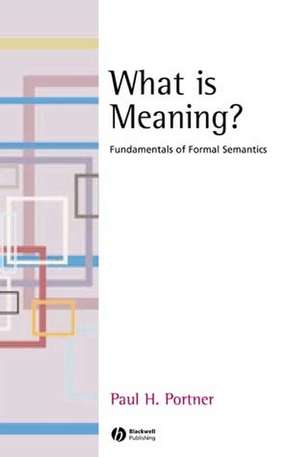
What is Meaning
Autor Portneren Limba Engleză Paperback – 28 ian 2005
Preț: 405.46 lei
Puncte Express: 608
Carte tipărită la comandă
Livrare economică 13-27 noiembrie
Livrare prin curier în România Termenul estimat este afișat lângă disponibilitate.
Transport gratuit pentru acest produs Plată online sau ramburs, în funcție de opțiunile comenzii.
Retur gratuit în 14 zile Comandă securizată și suport în română.
Specificații
ISBN-13: 9781405109185
ISBN-10: 1405109181
Pagini: 248
Dimensiuni: 152 x 229 x 14 mm
Greutate: 0.37 kg
Ediția:New.
Editura: Wiley
Locul publicării:Chichester, United Kingdom
ISBN-10: 1405109181
Pagini: 248
Dimensiuni: 152 x 229 x 14 mm
Greutate: 0.37 kg
Ediția:New.
Editura: Wiley
Locul publicării:Chichester, United Kingdom
V-ar putea interesa
-
 Metaphor: A Practical IntroductionZoltan Kövescses-13%Preț: 274.53 lei314.22 lei
 -
 -21%Preț: 421.88 lei534.37 lei
 -
 Rhetoric: A Very Short IntroductionRichard Toye-21%Preț: 55.29 lei69.84 lei
 -
 The Code BookSimon SinghPreț: 114.56 lei
 -
 Toward a History of American LinguisticsE.F.K. KoernerPreț: 470.52 lei
 -
 On DialogueDavid BohmPreț: 226.95 lei
 -
 Another Word A DayAnu GargPreț: 121.45 lei
 -
 Formal SemanticsPortner-8%Preț: 577.40 lei627.61 lei
 -
 Multilingualism OnlineCarmen LeePreț: 404.47 lei
 -
 Linguistics in a Colonial WorldErringtonPreț: 367.77 lei
 -
 The Pronunciation of EnglishCharles W Kreidler-8%Preț: 442.96 lei481.47 lei
 -
 A World of Others' WordsBaumanPreț: 366.95 lei
 -
 Language, Frogs and SavantsNeilson Voyne SmithPreț: 243.96 lei
 -
 -25%Preț: 278.87 lei371.36 lei
 -
 Understanding SemanticsSebastian LöbnerPreț: 450.03 lei
 -
 Deutsch-französische Übersetzungsübungen für das GrundstudiumCatherine RampfPreț: 141.92 lei
Public țintă
undergraduate and graduate students studying semantics theory, as well as some general readersNotă biografică
Paul H. Portner is Associate Professor of Linguistics and Director of the Interdisciplinary Program in Cognitive Science at Georgetown University. He is co-editor of Formal Semantics: The Essential Readings (with Barbara H. Partee, Blackwell, 2002) as well as the author of numerous articles on topics such as mood and modality, tense and aspect, and the syntax/semantics interface.
Cuprins
Acknowledgments x
1 The Fundamental Question 1
1.1 What is a Meaning? 3
1.2 Meanings are Out in the World 11
1.3 We should Think of the Meaning of Sentences in Terms of Truth-Conditions 12
2 Putting a Meaning Together from Pieces 28
2.1 Names Refer 29
2.2 Incomplete Propositions 30
2.3 Prediction is Saturation 31
2.4 Compositionality 33
2.5 Syntax and Semantics 34
3 More about Predicates 40
3.1 Other Types of Predicates: Adjectives, Predicate Nominals 40
3.2 Transitive Verbs 44
3.3 Relative Clauses 45
3.4 Topicalization 48
3.5 Sub-atomic Semantics 49
3.6 Modeling Properties with Sets and Functions 54
4 Modifiers 61
4.1 Adjective + N Combination 61
4.2 More Issues with Adjectives 65
4.3 Relative Clauses as Modifier 68
4.4 Adverbs 69
4.5 The Form of Meanings and their World-describing Content 74
5 Complexities of Referring Expressions 78
5.1 Definite NPs 78
5.2 Some Subtleties 80
5.3 A Bit about Indefinite NPs 83
5.4 Theories of Reference 84
5.5 Plurals and Mass Terms 95
5.6 Kinds 99
5.7 Pronouns and Anaphora 102
6 Quantifiers 112
6.1 Generalized Quantifiers: Predicate of Predicates, or Sets of Sets 113
6.2 NP Conjunction 120
6.3 Negative Polarity Items 122
6.4 Quantifiers in Object Position 127
7 Extensional vs. Intensional Contexts 132
8 Tense, Aspect, and Modality 137
8.1 Tense 138
8.2 Aspect 146
8.3 Modality 154
9 Propositional Attitudes 161
9.1 A Possible Worlds Semantics for Belief and Desire 162
9.2 Logical Consequences of the Modal Analysis of Propositional Attitude Verbs 164
9.3 Two foundational Problems: Coreferential Terms and Logical Truths 166
9.4 Structure and Meaning 170
9.5 Or, Have We Reached the Limits of Semantics? 174
10 The Pragmatics of What's Given 176
10.1 Indexicality and Deixis 177
10.2 Presupposition 178
10.3 Speech Acts 190
10.4 Focus and Topic 195
11 The Pragmatics of Inference 199
11.1 Properties Implicature 203
12 Formal Semantics Today 206
12.1 Diversity within Formal Semantics 206
12.2 Relationships with Other Varieties of Semantics 213
12.3 Relationships with Other Fields 214
Appendix: Answers to Selected Exercises 218
References 223
Index 230
1 The Fundamental Question 1
1.1 What is a Meaning? 3
1.2 Meanings are Out in the World 11
1.3 We should Think of the Meaning of Sentences in Terms of Truth-Conditions 12
2 Putting a Meaning Together from Pieces 28
2.1 Names Refer 29
2.2 Incomplete Propositions 30
2.3 Prediction is Saturation 31
2.4 Compositionality 33
2.5 Syntax and Semantics 34
3 More about Predicates 40
3.1 Other Types of Predicates: Adjectives, Predicate Nominals 40
3.2 Transitive Verbs 44
3.3 Relative Clauses 45
3.4 Topicalization 48
3.5 Sub-atomic Semantics 49
3.6 Modeling Properties with Sets and Functions 54
4 Modifiers 61
4.1 Adjective + N Combination 61
4.2 More Issues with Adjectives 65
4.3 Relative Clauses as Modifier 68
4.4 Adverbs 69
4.5 The Form of Meanings and their World-describing Content 74
5 Complexities of Referring Expressions 78
5.1 Definite NPs 78
5.2 Some Subtleties 80
5.3 A Bit about Indefinite NPs 83
5.4 Theories of Reference 84
5.5 Plurals and Mass Terms 95
5.6 Kinds 99
5.7 Pronouns and Anaphora 102
6 Quantifiers 112
6.1 Generalized Quantifiers: Predicate of Predicates, or Sets of Sets 113
6.2 NP Conjunction 120
6.3 Negative Polarity Items 122
6.4 Quantifiers in Object Position 127
7 Extensional vs. Intensional Contexts 132
8 Tense, Aspect, and Modality 137
8.1 Tense 138
8.2 Aspect 146
8.3 Modality 154
9 Propositional Attitudes 161
9.1 A Possible Worlds Semantics for Belief and Desire 162
9.2 Logical Consequences of the Modal Analysis of Propositional Attitude Verbs 164
9.3 Two foundational Problems: Coreferential Terms and Logical Truths 166
9.4 Structure and Meaning 170
9.5 Or, Have We Reached the Limits of Semantics? 174
10 The Pragmatics of What's Given 176
10.1 Indexicality and Deixis 177
10.2 Presupposition 178
10.3 Speech Acts 190
10.4 Focus and Topic 195
11 The Pragmatics of Inference 199
11.1 Properties Implicature 203
12 Formal Semantics Today 206
12.1 Diversity within Formal Semantics 206
12.2 Relationships with Other Varieties of Semantics 213
12.3 Relationships with Other Fields 214
Appendix: Answers to Selected Exercises 218
References 223
Index 230
Descriere
What is Meaning? Fundamentals of Formal Semantics is a concise introduction to the field of semantics as it is actually practiced. Through simple examples, pictures, and metaphors, Paul Portner presents the field's key ideas about how language works.