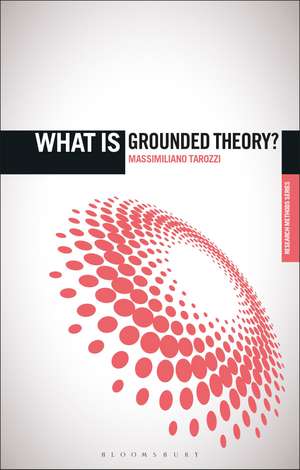
What is Grounded Theory?: The 'What is?' Research Methods Series
Autor Professor Massimiliano Tarozzien Limba Engleză Hardback – 6 aug 2020
Drawing on two decades of research practice and teaching, Tarozzi explains what Grounded Theory (GT) is, exploring its historical context, the many and sometimes antithetical approaches that have emerged of it and the epistemological implications of its application to different disciplines. With chapter summaries, further reading lists and a wealth of practical examples, the author shows how to do GT, accompanying the reader through the various phases of the research project.
Using GT in research is an adventurous journey: one can only understand what GT is by doing it.
| Toate formatele și edițiile | Preț | Express |
|---|---|---|
| Paperback (1) | 162.15 lei 6-8 săpt. | |
| Bloomsbury Publishing – 6 aug 2020 | 162.15 lei 6-8 săpt. | |
| Hardback (1) | 509.80 lei 6-8 săpt. | |
| Bloomsbury Publishing – 6 aug 2020 | 509.80 lei 6-8 săpt. |

Preț: 509.80 lei
Preț vechi: 702.97 lei
-27%
Puncte Express: 765
Preț estimativ în valută:
90.12€ • 104.42$ • 77.94£
90.12€ • 104.42$ • 77.94£
Carte tipărită la comandă
Livrare economică 07-21 mai
Specificații
ISBN-13: 9781350085244
ISBN-10: 1350085243
Pagini: 184
Dimensiuni: 138 x 216 mm
Greutate: 0.36 kg
Editura: Bloomsbury Publishing
Colecția Bloomsbury Academic
Seria The 'What is?' Research Methods Series
Locul publicării:London, United Kingdom
ISBN-10: 1350085243
Pagini: 184
Dimensiuni: 138 x 216 mm
Greutate: 0.36 kg
Editura: Bloomsbury Publishing
Colecția Bloomsbury Academic
Seria The 'What is?' Research Methods Series
Locul publicării:London, United Kingdom
V-ar putea interesa
-
 -9%Preț: 1087.30 lei1194.84 lei
 -
 Crafting Phenomenological ResearchMark D. Vagle-18%Preț: 960.65 lei1171.53 lei
 -
 Empirical Political Analysis: Quantitative and Qualitative Research MethodsCraig Leonard Brians-18%Preț: 1203.06 lei1467.14 lei
 -
 -18%Preț: 971.45 lei1184.69 lei
 -
 -18%Preț: 684.55 lei834.81 lei
 -
 -18%Preț: 1013.74 lei1236.26 lei
 -
 Strategies for Quantitative Research: Archaeology by NumbersGrant S. McCall-18%Preț: 1070.76 lei1305.80 lei
 -
 Research Methods for Educational DialogueRuth Kershner-26%Preț: 173.25 lei232.74 lei
 -
 Research Methods for Classroom DiscourseDr Jenni IngramPreț: 161.48 lei
 -
 GIS: Research MethodsNick Bearman-18%Preț: 143.49 lei175.34 lei
 -
 Community Studies: Research MethodsProf. Graham Crow-17%Preț: 127.85 lei154.89 lei
 -
 Quantitative Longitudinal Data Analysis: Research MethodsProfessor Vernon Gayle-17%Preț: 129.63 lei155.66 lei
 -
 Global Citizenship Education and the Crises of Multiculturalism: Comparative PerspectivesProfessor Massimiliano Tarozzi-26%Preț: 244.59 lei330.77 lei
 -
 -16%Preț: 287.83 lei342.21 lei
 -
 Research Methods for Understanding Professional LearningDr Elaine Hall-16%Preț: 185.06 lei220.50 lei
 -
 A Guide to Qualitative Field ResearchCarol R. Bailey-23%Preț: 643.41 lei835.60 lei
 -
 Understanding Statistical Analysis and ModelingRobert H. Bruhl-23%Preț: 865.56 lei1124.10 lei
 -
 Ethics in Social Science Research: Becoming Culturally ResponsiveMaria K. E. Lahman-20%Preț: 485.17 lei606.46 lei
 -
 Case Study Research and ApplicationsRobert K. Yin-11%Preț: 593.76 lei667.14 lei
 -
 Introduction to Power Analysis: Two-Group StudiesE. C. HedbergPreț: 340.54 lei
 -
 What is Social Network Analysis?Prof. John Scott-19%Preț: 167.79 lei206.08 lei
 -
 Comparison – A Methodological Introduction for the Social SciencesLeonardo MorlinoPreț: 143.58 lei
Cuprins
Series Editor Introduction
Introduction
Part I: Understanding Grounded Theory
1. What is Grounded Theory?
2. Historical Context
3. The Grounded Theory Process
Part II: Doing Grounded Theory
4. Starting the Research
5. Coding and Analysing
6. Writing and Evaluating Grounded Theory
Conclusions: Theoretical Sensitivity as a Virtue
References
Index
Introduction
Part I: Understanding Grounded Theory
1. What is Grounded Theory?
2. Historical Context
3. The Grounded Theory Process
Part II: Doing Grounded Theory
4. Starting the Research
5. Coding and Analysing
6. Writing and Evaluating Grounded Theory
Conclusions: Theoretical Sensitivity as a Virtue
References
Index
Recenzii
Tarozzi's encyclopedic knowledge of grounded theory makes this a great book for both methodologists interested in studying the evolution of this approach as well as for students interested in reading a clear description of one way to conduct studies using grounded theory. By showing how he analyzed the data in his own study of how families manage children's television watching, Tarozzi shows the elegant complexities of using grounded theory to systematically analyze data and build theory from the ground up.
Gives a brief and very personal introduction to Grounded Theory which makes it a very valuable resource for the novice students interested in using Grounded Theory for their own research.
Gives a brief and very personal introduction to Grounded Theory which makes it a very valuable resource for the novice students interested in using Grounded Theory for their own research.