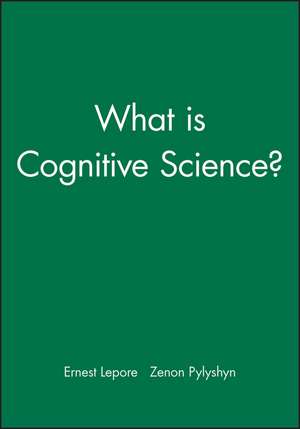
What is Cognitive Science
Autor Lepore, Pylyshynen Limba Engleză Paperback – 6 oct 1999
Preț: 521.74 lei
Puncte Express: 783
Carte tipărită la comandă
Livrare economică 16-30 noiembrie
Livrare prin curier în România Termenul estimat este afișat lângă disponibilitate.
Transport gratuit pentru acest produs Plată online sau ramburs, în funcție de opțiunile comenzii.
Retur gratuit în 14 zile Comandă securizată și suport în română.
Specificații
ISBN-13: 9780631204947
ISBN-10: 0631204946
Pagini: 448
Dimensiuni: 178 x 254 x 24 mm
Greutate: 0.84 kg
Editura: Wiley
Locul publicării:Chichester, United Kingdom
ISBN-10: 0631204946
Pagini: 448
Dimensiuni: 178 x 254 x 24 mm
Greutate: 0.84 kg
Editura: Wiley
Locul publicării:Chichester, United Kingdom
V-ar putea interesa
-
 Moonwalking with EinsteinJoshua Foer-19%Preț: 63.25 lei78.29 lei
 -
 The Future of the MindMichio KakuPreț: 78.65 lei
 -
 -33%Preț: 62.95 lei94.28 lei
 -
 Consciousness and the BrainStanislas DehaenePreț: 103.00 lei
 -
 Atlas of Human Brain ConnectionsMarco Catani-30%Preț: 823.41 lei1180.80 lei
 -
 The Compositionality PapersJerry A. Fodor-23%Preț: 494.11 lei641.22 lei
 -
 Donald Davidson's Truth-Theoretic SemanticsErnest Lepore-21%Preț: 512.81 lei651.87 lei
 -
 -13%Preț: 291.85 lei336.69 lei
 -
 TouchDavid J. Linden-32%Preț: 62.34 lei91.10 lei
 -
 Brain and MusicStefan KoelschPreț: 357.58 lei
 -
 Cognitive Neuroscience of ActionJeannerodPreț: 368.73 lei
 -
 COGNITIVE NEUROSCIENCEGazzaniga-23%Preț: 583.78 lei758.16 lei
 -
 Can Neuroscience Change Our MindsHilary Rose-5%Preț: 445.15 lei468.59 lei
 -
 NeurostereologyP R Mouton-23%Preț: 838.13 lei1088.48 lei
 -
 Neuronal MitochondriaGribkoff-5%Preț: 1279.95 lei1347.32 lei
 -
 -27%Preț: 1271.02 lei1734.26 lei
 -
 The Power of HabitCharles DuhiggPreț: 85.65 lei
Public țintă
upper level students, academics, and researchers in cognitive science, the philosophy of mind, cognitive psychology, and linguisticsNotă biografică
Ernest Lepore is Director of the Centre for Cognitive Science at Rutgers University. He is the author of numerous articles in philosophy of mind and is co-author (with Jerry Fodor) of Holism (Blackwell 1991). He is editor of Truth and Interpretation (Blackwell 1989) and co-editor (with Robert Van Gulick) of John Searle and His Critics (Blackwell 1992), as well as general editor of the series "Philosophers and Their Critics", also published by Blackwell.
Zenon Pylyshyn joined the faculty of Rutgers University as Board of Governors Professor of Cognitive Science and Director of the Rutgers Center for Cognitive Science in 1994. Pylyshyn has published over 60 scientific articles and book chapters, including a paper designated as a Science Citation Classic, What the Mind's Eye Tells the Mind's Brain, Psychological Bulletin, (1973). He is on the editorial boards of eight scientific journals and on the International Scientific Advisory Board of the BC Advanced Systems Institute.
Zenon Pylyshyn joined the faculty of Rutgers University as Board of Governors Professor of Cognitive Science and Director of the Rutgers Center for Cognitive Science in 1994. Pylyshyn has published over 60 scientific articles and book chapters, including a paper designated as a Science Citation Classic, What the Mind's Eye Tells the Mind's Brain, Psychological Bulletin, (1973). He is on the editorial boards of eight scientific journals and on the International Scientific Advisory Board of the BC Advanced Systems Institute.
Cuprins
Preface vii
Acknowledgements ix
1 What's in your mind? 1
Zenon W. Pylyshyn
2 Explaining the infant's object concept: Beyond the perception/cognition dichotomy 26
Brian J. Scholl and Alan M. Leslie
3 Rethinking rationality: From bleak implications to Darwinian modules 74
Richard Samuels, Stephen Stich, and Patrice D. Tremoulet
4 New foundations for perception 121
Michael Leyton
5 Object representation and recognition 172
Sven J. Dickinson
6 Does vision work? Towards a semantics of perception 208
Jacob Feldman
7 The brain as a hypothesis-constructing-and-testing agent 230
Thomas V. Papathomas
8 What movements of the eye tell us about the mind 248
Eileen Kowler
9 Visual dilemmas: Competition between eyes and between percepts in binocular rivalry 263
Thomas V. Papathomas, Ilona Kovacs, Akos Feher, and Bela Julesz
10 Linguistic and cognitive explanation in optimality theory 295
Bruce Tesar, Jane Grimshaw, and Alan Prince
11 Impossible words? 327
Jerry Fodor and Ernest Lepore
12 Bridging the symbolic-connectionist gap in language comprehension 336
Suzanne Stevenson
13 Cognitive and neural aspects of language acquisitions 356
Karin Stromswold
14 Connectionist neuroscience: representational and learning issues for neuroscience 401
Stephen Jose Hanson
Index 429
Acknowledgements ix
1 What's in your mind? 1
Zenon W. Pylyshyn
2 Explaining the infant's object concept: Beyond the perception/cognition dichotomy 26
Brian J. Scholl and Alan M. Leslie
3 Rethinking rationality: From bleak implications to Darwinian modules 74
Richard Samuels, Stephen Stich, and Patrice D. Tremoulet
4 New foundations for perception 121
Michael Leyton
5 Object representation and recognition 172
Sven J. Dickinson
6 Does vision work? Towards a semantics of perception 208
Jacob Feldman
7 The brain as a hypothesis-constructing-and-testing agent 230
Thomas V. Papathomas
8 What movements of the eye tell us about the mind 248
Eileen Kowler
9 Visual dilemmas: Competition between eyes and between percepts in binocular rivalry 263
Thomas V. Papathomas, Ilona Kovacs, Akos Feher, and Bela Julesz
10 Linguistic and cognitive explanation in optimality theory 295
Bruce Tesar, Jane Grimshaw, and Alan Prince
11 Impossible words? 327
Jerry Fodor and Ernest Lepore
12 Bridging the symbolic-connectionist gap in language comprehension 336
Suzanne Stevenson
13 Cognitive and neural aspects of language acquisitions 356
Karin Stromswold
14 Connectionist neuroscience: representational and learning issues for neuroscience 401
Stephen Jose Hanson
Index 429
Descriere
Provides a non-technical introduction to cognitive science, and the key issues that animate the field. This work explores subject areas such as Mind, Vision, Language, and Neuroscience, and contains selections on the foundations of cognitive science, cognition development, reasoning, object recognition, eye movements, and visual recognition.