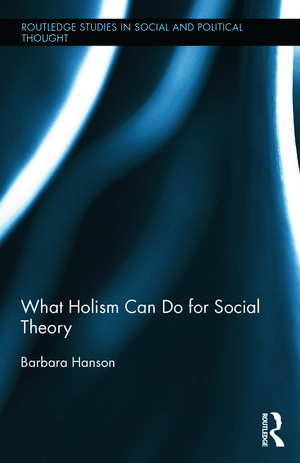
What Holism Can Do for Social Theory: Routledge Studies in Social and Political Thought
Autor Barbara Hansonen Limba Engleză Hardback – 8 iul 2014
| Toate formatele și edițiile | Preț | Express |
|---|---|---|
| Paperback (1) | 344.60 lei 6-8 săpt. | |
| Taylor & Francis – 7 mar 2018 | 344.60 lei 6-8 săpt. | |
| Hardback (1) | 1116.86 lei 6-8 săpt. | |
| Taylor & Francis – 8 iul 2014 | 1116.86 lei 6-8 săpt. |
Din seria Routledge Studies in Social and Political Thought
-
 Preț: 164.44 lei
 - 8%
 Preț: 405.23 lei
 -
 Preț: 368.03 lei
 -
 Preț: 335.97 lei
 -
 Preț: 335.35 lei
 -
 Preț: 352.50 lei
 -
 Preț: 348.26 lei
 -
 Preț: 334.51 lei
 -
 Preț: 351.93 lei
 -
 Preț: 367.82 lei
 -
 Preț: 383.12 lei
 -
 Preț: 233.87 lei
 -
 Preț: 385.65 lei
 -
 Preț: 383.78 lei
 -
 Preț: 336.05 lei
 -
 Preț: 354.35 lei
 -
 Preț: 318.05 lei
 -
 Preț: 384.56 lei
 -
 Preț: 435.10 lei
 - 18%
 Preț: 1119.60 lei
 - 18%
 Preț: 1066.82 lei
 - 18%
 Preț: 1064.55 lei
 - 29%
 Preț: 560.79 lei
 - 15%
 Preț: 542.99 lei
 - 18%
 Preț: 1119.31 lei
 - 15%
 Preț: 412.51 lei
 - 18%
 Preț: 1015.11 lei
 -
 Preț: 411.41 lei
 -
 Preț: 410.48 lei
 - 31%
 Preț: 510.84 lei
 - 18%
 Preț: 1066.82 lei
 - 18%
 Preț: 1072.90 lei
 - 18%
 Preț: 1220.77 lei
 - 34%
 Preț: 872.75 lei
 -
 Preț: 416.68 lei
 - 18%
 Preț: 1066.08 lei
 - 31%
 Preț: 792.45 lei
 - 18%
 Preț: 1065.31 lei
 - 15%
 Preț: 412.96 lei
 - 18%
 Preț: 1073.34 lei
 - 18%
 Preț: 1117.64 lei
 -
 Preț: 393.21 lei
 - 45%
 Preț: 183.56 lei
 - 31%
 Preț: 846.64 lei
 - 18%
 Preț: 1220.00 lei
 - 18%
 Preț: 1068.95 lei
Preț: 1116.86 lei
Preț vechi: 1362.03 lei
-18% Nou
Puncte Express: 1675
Preț estimativ în valută:
197.64€ • 230.48$ • 173.53£
197.64€ • 230.48$ • 173.53£
Carte tipărită la comandă
Livrare economică 16-30 ianuarie 26
Preluare comenzi: 021 569.72.76
Specificații
ISBN-13: 9780415743907
ISBN-10: 0415743907
Pagini: 224
Dimensiuni: 152 x 229 x 15 mm
Greutate: 0.41 kg
Ediția:New.
Editura: Taylor & Francis
Colecția Routledge
Seria Routledge Studies in Social and Political Thought
Locul publicării:Oxford, United Kingdom
ISBN-10: 0415743907
Pagini: 224
Dimensiuni: 152 x 229 x 15 mm
Greutate: 0.41 kg
Ediția:New.
Editura: Taylor & Francis
Colecția Routledge
Seria Routledge Studies in Social and Political Thought
Locul publicării:Oxford, United Kingdom
V-ar putea interesa
-
 PolicyH Colebatch-31%Preț: 171.13 lei247.29 lei
 -
 Thinking SpaceMike CrangPreț: 435.35 lei
 -
 Preț: 448.48 lei
 -
 Development Sociology: Actor PerspectivesNorman LongPreț: 427.78 lei
 -
 Non-Representational Theory: Space, Politics, AffectNigel ThriftPreț: 402.90 lei
 -
 Preț: 434.94 lei
 -
 -15%Preț: 405.36 lei476.89 lei
 -
 Preț: 411.97 lei
 -
 Key Ideas in SociologyPeter Kivisto-15%Preț: 644.82 lei758.62 lei
 -
 Preț: 353.88 lei
 -
 Preț: 264.61 lei
 -
 Voyage to Utopias: A fictional guide through social philosophyTony FitzpatrickPreț: 140.39 lei
 -
 Social theory for beginnersPaul RansomePreț: 263.15 lei
Public țintă
Postgraduate and UndergraduateCuprins
1. Where Have We Been? Where Might We Go? 2. Facticity 3. How Have We Come to Be Doing Mechanism? 4. How Do We Do Mechanism? 5. Beyond Mechanism 6. Sociality 7. Holism, Blame, and Power 8. Moment, Monument, Movement
Descriere
This book reconsiders the nature of positivist philosophy in social science theory based on classical and medieval thought in what later became "Europe." It argues that social theory is being held back by antagonistic debates over science, positivism, objectivity, and universal law - debates which appear unnecessary, narrow, and acontextual when their origins are examined. Positing that solutions to these impasses can be found by moving to alternative holistic epistemology, and looking at issues in terms of interrelations rather than parts, the book shows the promise of a social theory that provides a unit of analysis that mediates between local and global relations.