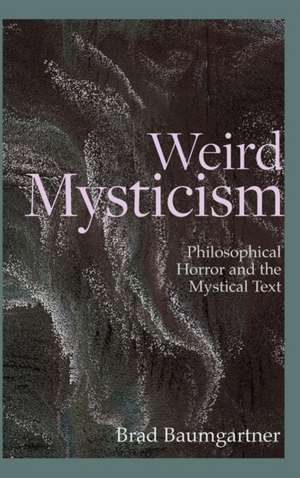
Weird Mysticism: Philosophical Horror and the Mystical Text: Critical Conversations in Horror Studies
Autor Brad Baumgartneren Limba Engleză Hardback – 17 noi 2020
Recomandăm lucrarea Weird Mysticism ca pe o resursă de nivel de doctorat și referință profesională pentru cercetătorii interesați de intersecția dintre studiile literare, filozofia speculativă și teologia apofatică. Brad Baumgartner propune o teză riguroasă prin care identifică un nou gen de scriere mistică modernă, situat la granița dintre performanța estetică și provocarea autorității filozofice. Structura volumului este organizată în jurul a trei piloni fundamentali ai gândirii „eretice” moderne: orizontul cosmologic și poetica întunericului la Thomas Ligotti, infinitul imposibil al lui Georges Bataille și, într-o secțiune de interes major pentru cititorul român, oroarea de a fi tu însuți în opera lui E. M. Cioran.
Subliniem modul în care autorul utilizează conceptul de „weird” pentru a reevalua limitele gândirii în fața crizelor ecologice și culturale actuale. Cartea este comparabilă cu In the Dust of This Planet de Eugene Thacker în ceea ce privește utilizarea genului horror ca instrument de explorare a lumii „negândibile”, însă Baumgartner aduce o nuanță suplimentară prin ancorarea analizei în tradiția misticismului medieval și a discursului aforistic. Reținem progresia logică a textului, care pornește de la o introducere teoretică despre „calea spre nicăieri” și culminează cu un postfață despre moartea mistică a criticului speculativ.
În contextul operei sale, Weird Mysticism extinde interfața dintre impersonalitate și meontologie explorată anterior în Quantum Mechantics, transferând însă focusul de la fizica cuantică spre literatura de factură pesimistă. Prin această abordare, Brad Baumgartner reușește să valideze și, în același timp, să problematizeze relația noastră critică cu estetica ororii, oferind un cadru teoretic nou pentru înțelegerea absolutului în modernitate.

Preț: 524.04 lei
Preț vechi: 790.48 lei
-34%
Carte tipărită la comandă
Livrare economică 01-15 iunie
Specificații
ISBN-10: 1683932870
Pagini: 190
Dimensiuni: 160 x 230 x 19 mm
Greutate: 0.42 kg
Editura: Bloomsbury Publishing
Colecția Lehigh University Press
Seria Critical Conversations in Horror Studies
Locul publicării:New York, United States
De ce să citești această carte
Suntem de părere că această carte este esențială pentru universitarii și criticii care studiază filozofia horror-ului și misticismul contemporan. Cititorul câștigă o perspectivă academică profundă asupra modului în care autori precum Cioran sau Ligotti folosesc „negativitatea” pentru a sonda limitele cunoașterii umane. Este un instrument teoretic prețios pentru oricine dorește să înțeleagă rădăcinile intelectuale ale curentului „weird fiction” dincolo de simpla etichetă de gen literar.
Despre autor
Brad Baumgartner este profesor asistent de engleză la Penn State University, fiind o voce emergentă în studiile interdisciplinare care corelează literatura, filozofia și științele de frontieră. Preocupările sale academice vizează în mod special zonele de incertitudine, aporeticul și misticismul, teme pe care le-a explorat anterior în lucrarea Quantum Mechantics. În acest volum, Baumgartner analizează modul în care mecanica cuantică și criptografia se intersectează cu impersonalitatea mistică. Prin Weird Mysticism, el își consolidează poziția în cadrul seriei Critical Conversations in Horror Studies, aducând o contribuție semnificativă la înțelegerea formelor moderne de gândire speculativă.
Descriere
In Weird Mysticism: Philosophical Horror and the Mystical Text, Brad Baumgartner identifies a new genre of modern mystical writing and examines the interconnections among horror fiction, philosophy, and apophatic mysticism. He reveals how an innovative form of negative thinking is conjoined to a writing practice which engages in an interdisciplinary type of intellectual and aesthetic performance to allow for a simultaneous challenge to literary and philosophical authority via the speculative (i.e., the mystical text). Along the way, Baumgartner examines how genre-bending, literary experimentation, and aphoristic discourse are often rooted in conjunction with perennial themes such as the beyond and the Outside.
Through a theoretical lens which includes the traditions of apophatic theology, "the weird," and work in the "speculative turn" in philosophy, Baumgartner looks at how perennial themes such as the beyond and the Outside might benefit from a textual analysis which validates and yet problematizes our critical relationship to horror. The works of Thomas Ligotti, Georges Bataille, and E. M.
Cioran are considered alongside the voices of several medieval mystics and modern philosophers. At a time marked by cultural, ecological, and economic crises, Weird Mysticism acknowledges the absolute's very importance to human life and recognizes how the mystical in some way recuperates the limits of thought in order to think through them.
Cuprins
1. Piercing the Cosmological Horizon
2. Thomas Ligotti: The Poetics of Darkness
3. Georges Bataille: Opening Up the Infinite
4. E. M. Cioran: The Horror of Being Oneself
Afterword: The Mystical Death of the Speculative Critic
Recenzii
Brad Baumgartner's Weird Mysticism moves with freedom through three modern heretics: the irreal hell of Thomas Ligotti, the impossible purgatory of Georges Bataille, and the pessimal paradise of E. M. Cioran. The music that emerges is a quiet friendly imperative to laugh in the face of the void and an indelible new vision of the inevitable impossibility of writing itself.
Notă biografică
Brad Baumgartner is assistant teaching professor of English at Penn State University.
Descriere scurtă
Weird Mysticism identifies and evaluates a new category of theoretical inquiry by showing the influence of speculative writing on three intersecting critical categories: horror fiction, apophatic mysticism, and philosophical pessimism. Exploring the work of Thomas Ligotti, Georges Bataille, and E. M. Cioran, Baumgartner argues that these "weird mystics" employ an innovative mode of negative writing that seeks to merge new conceptions of reality. While exploring perennial questions about "the absolute," the Outside, and other philosophical concepts, these authors push the limits of representation, experimenting with literary form, genre-bending, and aphoristic discourse. As their works reveal, the category of weird mysticism both conjoins and obscures the link between traditional mysticism and philosophical horror fiction, with weirdness itself being the central magnet that draws the seemingly disparate realms of horror fiction, philosophy, and mysticism together. Highlighting the theoretical stakes of the horror genre, Baumgartner's study reveals how the mystical potentially recuperates the limits of philosophical thinking, enabling reflection on-and possibly challenging-the limits of human understanding.