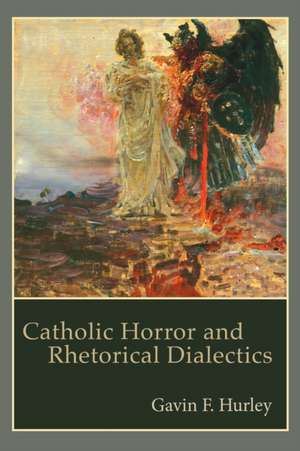
Catholic Horror and Rhetorical Dialectics: Critical Conversations in Horror Studies
Autor Gavin F. Hurleyen Limba Engleză Hardback – 24 iun 2024


Preț: 525.34 lei
Preț vechi: 816.02 lei
-36%
Puncte Express: 788
Carte tipărită la comandă
Livrare economică 07-21 decembrie
Livrare prin curier în România Termenul estimat este afișat lângă disponibilitate.
Transport gratuit pentru acest produs Plată online sau ramburs, în funcție de opțiunile comenzii.
Retur gratuit în 14 zile Comandă securizată și suport în română.
Specificații
ISBN-13: 9781611463620
ISBN-10: 1611463629
Pagini: 202
Dimensiuni: 154 x 230 x 20 mm
Greutate: 0.47 kg
Editura: Bloomsbury Publishing
Colecția Lehigh University Press
Seria Critical Conversations in Horror Studies
Locul publicării:New York, United States
ISBN-10: 1611463629
Pagini: 202
Dimensiuni: 154 x 230 x 20 mm
Greutate: 0.47 kg
Editura: Bloomsbury Publishing
Colecția Lehigh University Press
Seria Critical Conversations in Horror Studies
Locul publicării:New York, United States
V-ar putea interesa
-
 The Sacred Space BetweenKalie ReidPreț: 110.66 lei
 -
 -19%Preț: 98.09 lei120.87 lei
 -
 Conjectures of a Guilty BystanderThomas MertonPreț: 108.89 lei
 -
 Feeding the MonsterAnna BogutskayaPreț: 92.94 lei
 -
 All the Fear of the FairEdward ParnellPreț: 76.89 lei
 -
 The Wax ChildOlga RavnPreț: 110.22 lei
 -
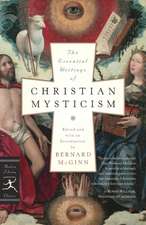 The Essential Writings of Christian MysticismBernard McGinn-18%Preț: 102.25 lei125.22 lei
 -
 Darker DaysThomas Olde HeuveltPreț: 110.60 lei
 -
 Catholicism: End or Beginning?Mary DalyPreț: 237.92 lei
 -
 Religion for ThoughtPaul RicoeurPreț: 168.80 lei
 -
 The Horror Theory ReaderJeffrey Andrew WeinstockPreț: 226.96 lei
 -
 The Lost RoadSean McgrathPreț: 117.88 lei
 -
 Horror of PhilosophyEugene ThackerPreț: 245.71 lei
 -
 Black FlameGretchen Felker-MartinPreț: 86.98 lei
 -
 The Library at HelleboreCassandra KhawPreț: 144.40 leiRecomandat
 -
 Light on Darkness: The Untold Story of the LiturgyCosima Clara GillhammerPreț: 119.38 lei
 -
 The Sound of the DarkDaniel ChurchPreț: 61.46 lei
 -
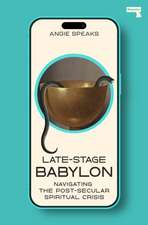 Late-Stage BabylonAngie SpeaksPreț: 79.96 lei
 -
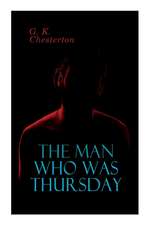 The Man Who Was ThursdayG. K. ChestertonPreț: 38.95 lei
Cuprins
Introduction: Contemplative Horror and Rhetoric
Chapter One: What is Catholic Horror Literature?
Chapter Two: What are Rhetorical Dialectics?
Chapter Three: Rhetorical Dialectics of J.K. Huysmans's Là-Bas (1891)
Chapter Four: Rhetorical Dialectics of Robert Hugh Benson's The Light Invisible (1903)
Chapter Five: Rhetorical Dialectics of Robert Hugh Benson's A Mirror of Shallot (1907)
Chapter Six: Rhetorical Dialectics of William Peter Blatty's The Exorcist (1971)
Conclusion: Orienting the Head and Heart
Chapter One: What is Catholic Horror Literature?
Chapter Two: What are Rhetorical Dialectics?
Chapter Three: Rhetorical Dialectics of J.K. Huysmans's Là-Bas (1891)
Chapter Four: Rhetorical Dialectics of Robert Hugh Benson's The Light Invisible (1903)
Chapter Five: Rhetorical Dialectics of Robert Hugh Benson's A Mirror of Shallot (1907)
Chapter Six: Rhetorical Dialectics of William Peter Blatty's The Exorcist (1971)
Conclusion: Orienting the Head and Heart
Recenzii
In textually applying his established criteria, Hurley also effectively sets up a framework that future critics could use in their own analyses of Catholic (or even Catholic-inflected) horror . If one of the goals of Catholic horror is to open up a thoughtful dialogue on transcendental matters through tales of terror, then Hurley's book could surely stand as a good conversation starter.
Catholic Horror and Rhetorical Dialectics successfully argues that Catholic truths can be perceived and understood through works of horror literature ranging from nineteenth-century novels to The Exorcist. In asserting that rhetorical dialectics is an ideal methodology for a distinctively Catholic mode of horror, this eminently readable and thought-provoking study reminds us that horror fiction should be taken seriously rather than seen as mere entertainment.
There is a difference between the dark arts and the art of darkness which is as wide as the distance that separates hell from heaven. The art of darkness exposes the evil and ugliness of the dark arts, exorcising its power with the light of goodness, truth, and beauty. In this much needed volume, Gavin Hurley explores the power of some of the great classics of horror fiction to exercise reason and rhetoric to exorcise demons, demonstrating the power of fiction to convey the deepest truths.
Catholic Horror and Rhetorical Dialectics is a welcome contribution to the growing studies on horror and religion. Gavin Hurley offers penetrating insight on Catholic horror literature that is not content to leave anything simply on the surface in what is perhaps an unexpected juxtaposition.
Catholic Horror and Rhetorical Dialectics successfully argues that Catholic truths can be perceived and understood through works of horror literature ranging from nineteenth-century novels to The Exorcist. In asserting that rhetorical dialectics is an ideal methodology for a distinctively Catholic mode of horror, this eminently readable and thought-provoking study reminds us that horror fiction should be taken seriously rather than seen as mere entertainment.
There is a difference between the dark arts and the art of darkness which is as wide as the distance that separates hell from heaven. The art of darkness exposes the evil and ugliness of the dark arts, exorcising its power with the light of goodness, truth, and beauty. In this much needed volume, Gavin Hurley explores the power of some of the great classics of horror fiction to exercise reason and rhetoric to exorcise demons, demonstrating the power of fiction to convey the deepest truths.
Catholic Horror and Rhetorical Dialectics is a welcome contribution to the growing studies on horror and religion. Gavin Hurley offers penetrating insight on Catholic horror literature that is not content to leave anything simply on the surface in what is perhaps an unexpected juxtaposition.