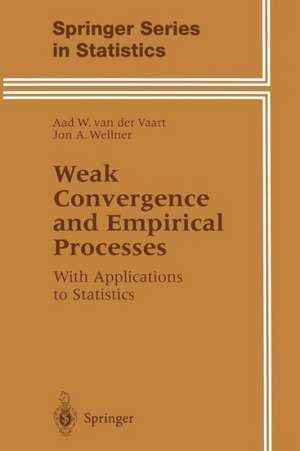
Weak Convergence and Empirical Processes: With Applications to Statistics: Springer Series in Statistics
Autor Aad van der vaart, Jon Wellneren Limba Engleză Paperback – 24 dec 2012
Această monografie de cercetare publicată de Springer reprezintă o resursă fundamentală pentru statisticieni și probabiliști, fiind concepută să unifice teoria modernă a proceselor empirice cu aplicațiile sale practice. Weak Convergence and Empirical Processes pornește de la premisa că teoria clasică, rezumată anterior de Billingsley, a devenit insuficientă pentru nevoile actuale ale statisticii, unde procesele empirice sunt vizualizate natural în spații Banach neseparabile. Suntem de părere că rigoarea cu care Aad van der vaart și Jon Wellner abordează integrala exterioară și măsurabilitatea supremului transformă acest text într-un instrument indispensabil pentru înțelegerea convergenței în distribuție.
Structura volumului este una progresivă: prima parte stabilește bazele teoretice ale convergenței stocastice, partea a doua detaliază procesele empirice indexate prin clase de mulțimi și funcții, iar ultima parte se concentrează pe aplicații statistice concrete, precum ratele de convergență pentru M-estimatori. Această organizare permite o tranziție fluidă de la abstract la aplicat. Cartea acoperă aceeași arie tematică precum Convergence of Stochastic Processes de D. Pollard, dar oferă o tratare mult mai extinsă a elementelor nemăsurabile Borel și a tehnicilor de simetrizare. Spre deosebire de abordarea lui Rm Dudley din Uniform Central Limit Theorems, lucrarea de față pune un accent mai mare pe utilitatea acestor teoreme limită în contextul inferenței statistice moderne.
Prin centralizarea unor rezultate care anterior erau dispersate în literatura de specialitate, autorii reușesc să facă accesibile concepte complexe precum numerele de acoperire, entropia uniformă și teoremele limită centrală pentru procese. Este un text dens, cu un ton academic precis, ce servește drept referință standard în domeniu.
Din seria Springer Series in Statistics
- 15%
 Preț: 641.17 lei
 - 18%
 Preț: 1438.75 lei
 - 18%
 Preț: 1606.27 lei
 - 18%
 Preț: 1368.25 lei
 - 18%
 Preț: 997.98 lei
 - 18%
 Preț: 1108.15 lei
 - 18%
 Preț: 1611.20 lei
 - 20%
 Preț: 1370.05 lei
 - 18%
 Preț: 2061.70 lei
 - 15%
 Preț: 663.36 lei
 - 15%
 Preț: 664.69 lei
 - 18%
 Preț: 922.58 lei
 - 15%
 Preț: 671.15 lei
 - 15%
 Preț: 668.53 lei
 - 15%
 Preț: 666.00 lei
 - 15%
 Preț: 678.42 lei
 - 15%
 Preț: 669.04 lei
 - 18%
 Preț: 927.93 lei
 - 18%
 Preț: 1150.28 lei
 - 18%
 Preț: 2167.11 lei
 - 15%
 Preț: 521.02 lei
 - 18%
 Preț: 1148.21 lei
 - 15%
 Preț: 667.64 lei
 - 18%
 Preț: 940.61 lei
 - 15%
 Preț: 663.81 lei
 - 18%
 Preț: 751.06 lei
 - 18%
 Preț: 1284.83 lei
 - 18%
 Preț: 1039.20 lei
 - 18%
 Preț: 1369.10 lei
 - 18%
 Preț: 1223.93 lei
 - 18%
 Preț: 988.03 lei
 - 18%
 Preț: 1000.64 lei
 -
 Preț: 404.57 lei
 -
 Preț: 405.63 lei
 - 18%
 Preț: 991.51 lei
 - 18%
 Preț: 1429.06 lei
 - 18%
 Preț: 988.40 lei
 - 18%
 Preț: 911.08 lei
 - 5%
 Preț: 1480.28 lei
 - 18%
 Preț: 1293.99 lei
 - 18%
 Preț: 992.48 lei
 - 18%
 Preț: 980.26 lei
 - 18%
 Preț: 909.25 lei
 - 18%
 Preț: 1090.44 lei
 - 18%
 Preț: 1160.96 lei
 - 15%
 Preț: 673.74 lei
 - 18%
 Preț: 814.56 lei
 - 15%
 Preț: 667.91 lei
 - 18%
 Preț: 1597.63 lei
 - 15%
 Preț: 663.36 lei
Preț: 1395.29 lei
Preț vechi: 1701.57 lei
-18%
Carte disponibilă
Livrare economică 11-25 noiembrie
Specificații
ISBN-10: 1475725477
Pagini: 528
Ilustrații: XVI, 510 p.
Dimensiuni: 155 x 235 x 28 mm
Greutate: 0.74 kg
Ediția:Softcover reprint of the original 1st ed. 1996
Editura: Springer
Colecția Springer
Seria Springer Series in Statistics
Locul publicării:New York, NY, United States
Public țintă
ResearchDe ce să citești această carte
Recomandăm această lucrare cercetătorilor și doctoranzilor în statistică matematică. Cititorul câștigă o înțelegere profundă a convergenței slabe în spații metrice generale, depășind limitările teoriei clasice. Este volumul esențial pentru oricine dorește să stăpânească instrumentele matematice necesare pentru a analiza proprietățile asimptotice ale estimatorilor complecși și ale proceselor stocastice moderne.