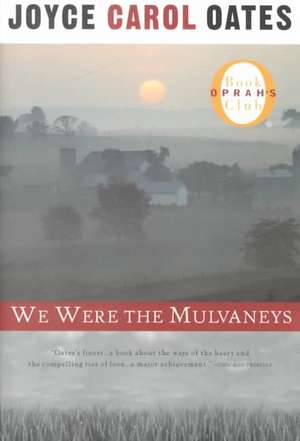
We Were the Mulvaneys
Autor Joyce Carol Oatesen Limba Engleză Paperback – 24 ian 2001
În universul creat de Joyce Carol Oates, forțele opuse ale idilei pastorale și ale tragismului domestic se ciocnesc cu o forță devastatoare. Notăm cu un interes profund modul în care We Were the Mulvaneys deconstruiește mitul familiei americane perfecte, binecuvântate cu noroc și carismă la ferma High Point, pentru a expune vulnerabilitatea extremă a acestor legături în fața hazardului. Subliniem faptul că, spre deosebire de viziunile macabre din Flint Kill Creek sau tensiunea viscerală din Butcher, acest roman alege o cale a contemplării și a reconcilierii. Reținem perspectiva lui Judd, mezinul familiei, care devine arheologul propriei istorii traumatice. Pe parcursul a două decenii și jumătate, observăm cum o singură violare a ordinii morale transformă un clan unit într-o colecție de suflete solitare și exilate. Stilul autoarei este aici mai cald, aproape protector, deși nu evită să descrie cu precizie chirurgicală eroziunea speranței. Cei care au parcurs Man Crazy de Joyce Carol Oates vor fi pregătiți pentru această explorare a redempțiunii umane, însă în We Were the Mulvaneys vor găsi o structură narativă mai vastă și o concluzie marcată de o rară bunătate sufletească. Ritmul este cel al unei vieți care se scurge lent spre dezastru, doar pentru a fi recuperată, fragment cu fragment, prin puterea iertării. Este o lucrare care se distanțează de cinism, căutând sursa de lumină ascunsă chiar și în cele mai întunecate unghere ale experienței umane.
Preț: 123.21 lei
Carte disponibilă
Livrare economică 17 noiembrie-01 decembrie
Specificații
ISBN-10: 0452282829
Pagini: 464
Dimensiuni: 151 x 223 x 31 mm
Greutate: 0.53 kg
Editura: Penguin Publishing Group
V-ar putea interesa
-
 The FallsJoyce Carol OatesPreț: 108.69 lei
 -
 Night. Sleep. Death. the Stars.Joyce Carol OatesPreț: 136.12 lei
 -
 The SurvivorsAlex Schulman-25%Preț: 59.16 lei79.20 lei
 -
 Heap Earth Upon It - EXPORT EDITIONChloe Michelle Howarth-18%Preț: 89.17 lei108.67 lei
 -
 A Long WinterColm TòibìnPreț: 92.71 lei
 -
 After AnnieAnna Quindlen-19%Preț: 57.69 lei71.01 lei
 -
 Preț: 71.08 lei
 -
 Preț: 122.34 lei
 -
 Nights When Nothing HappenedSimon Han-24%Preț: 82.71 lei109.22 lei
 -
 -23%Preț: 90.98 lei118.12 lei
 -
 Groundwater: ‘Complex, chilling, masterful' Financial TimesThomas McMullan-26%Preț: 99.21 lei134.96 lei
 -
 The Bright YearsSarah DamoffPreț: 158.02 leiRecomandat
 -
 -18%Preț: 59.82 lei72.72 lei
 -
 Like FamilyErin WhitePreț: 108.42 lei
 -
 New YearLeila AboulelaPreț: 9.24 lei
 -
 Land of HopeCate Baum-18%Preț: 77.11 lei93.71 lei
 -
 Saturday Night at the Lakeside Supper ClubJ. Ryan StradalPreț: 105.19 lei
De ce să citești această carte
Recomandăm acest roman celor care caută o cronică de familie profundă, care nu se mulțumește doar cu expunerea suferinței, ci caută activ vindecarea. Cititorul va câștiga o înțelegere nuanțată a modului în care secretele pot fragmenta o comunitate și, mai important, a modului în care onestitatea poate reconstrui punți dărâmate de decenii. Este o lectură esențială pentru a înțelege latura mai empatică a operei lui Oates.
Despre autor
Joyce Carol Oates, născută în 1938, este una dintre cele mai prolifice și respectate figuri ale literaturii americane contemporane. Cu o carieră ce cuprinde peste 50 de romane și numeroase premii prestigioase, inclusiv National Book Award și nominalizări repetate la Premiul Pulitzer, Oates este cunoscută pentru capacitatea sa de a sonda adâncimile psihicului uman. Profesor emerit la Princeton University, ea explorează constant teme precum clasa socială, tensiunile rasiale și dinamica violentă a puterii, transformând adesea peisajul rural din New York într-un teatru al conflictelor universale.
Descriere scurtă
Recenzii
“New testimony to Oates' great intelligence and dead-on imaginative powers. It is a book that will break your heart, heal it, then break it again every time you think about it.” --Los Angeles Times Book Review
“What keeps us coming back to Oates Country is her uncanny gift of making the page a window, with something happening on the other side that we’d swear was like life itself.” --The New York Times Book Review
“A major achievement that stands with Oates’ finest studies of American life...the novel is a testament to the tenacious bonds of the family, the restorative power of love and capacity to endure and prevail.” --The Chicago Tribune
Extras
You may have thought our family was larger, often I'd meet people who believed we Mulvaneys were a virtual clan, but in fact there were only six of us: my dad who was Michael John Mulvaney, Sr., my mom Corinne, my brothers Mike Jr. and Patrick and my sister Marianne, and me—Judd.
From summer 1955 to spring 1980 when my dad and mom were forced to sell the property there were Mulvaneys at High Point Farm, on the High Point Road seven miles north and east of the small city of Mt. Ephraim in upstate New York, in the Chautauqua Valley approximately seventy miles south of Lake Ontario.
High Point Farm was a well-known property in the Valley, in time to be designated a historical landmark, and "Mulvaney" was a well-known name.
For a long time you envied us, then you pitied us.
For a long time you admired us, then you thought Good!—that's what they deserve.
"Too direct, Judd!"—my mother would say, wringing her hands in discomfort. But I believe in uttering the truth, even if it hurts. Particularly if it hurts.
For all of my childhood as a Mulvaney I was the baby of the family. To be the baby of such a family is to know you're the last little caboose of a long roaring train. They loved me so, when they paid any attention to me at all. I was like a creature dazed and blinded by intense, searing light that might suddenly switch off and leave me in darkness. I couldn't seem to figure out who I was, if I had an actual name, or many names, all of them affectionate and many of them teasing, like "Dimple," "Pretty Boy" or, alternately, "Sourpuss," or "Ranger"—my favourite. I was "Baby" or "Babyface" much of the time while growing up. "Judd" was a name associated with a certain measure of sternness, sobriety, though in fact we Mulvaney children were rarely scolded and even more rarely punished. "Judson Andrew" which is my baptismal name was a name of such dignity and aspiration I never came to feel it could be mine, only something borrowed like a Hallowe'en mask.
You'd get the impression, at least I did, that "Judd" who was "Baby" almost didn't make it. Getting born, I mean. The train had pulled out, the caboose was being rushed to the track. Not that Corinne Mulvaney was so very old when I was born—she was only thirty-three. Which certainly isn't "old" by today's standards. I was born in 1963, the year Dad used to say, with a grim shake of his head, a sick-at-heart look in his eyes, "tore history in two" for Americans. What worried me was I'd come along so belatedly, everyone else was here except me! A complete Mulvaney family without Judd.
Always it seemed, hard as I tried I could never hope to catch up with all their good times, secrets, jokes—their memories. What is a family, after all, except memories?—haphazard and precious as the contents of a catchall drawer in the kitchen (called the "junk drawer" in our household, for good reason). My handicap, I gradually realized, was that by the time I got around to being born, my brother Mike was already ten years old and for children that's equivalent to another generation. Where's Baby?—who's got Baby? the cry would commence, and whoever was nearest would scoop me up and off we'd go. A scramble of dogs barking, exaggerated as animals are often exaggerations of human beings, emotions so rawly exposed. Who's got Baby? Don't forget Baby!
The dogs, cats, horses, even the cars and pickups Dad and Mom drove before I was born, those big flashy-sexy Fifties models—all these I would pore over in Mom's overstuffed snapshot albums, determined to attach myself to their memories. Sure, I remember! Sure, I was there! Mike's first pony Crackerjack who was a sorrel with sand-coloured markings. Our setter Foxy as a puppy. The time Dad ran the tractor into a ditch. The time Mom threw corncobs to scare away strange dogs she believed were threatening the chickens and the dogs turned out to be a black bear and two cubs. The time Dad invited 150 people to Mulvaney's Fourth of July cookout assuming that only about half would show up, and everyone showed up—and a few more. The time a somewhat disreputable friend of Dad's flew over to High Point Farm from an airport in Marsena in a canary-yellow Piper Cub and landed—"Crash-landed, almost," Mom would say dryly—in one of the pastures, and though the baby in the snapshots commemorating this occasion would have to have been my sister Marianne, in July 1960, I was able to convince myself Yes I was there, I remember. I do!
And when in subsequent years they would speak of the incident, recalling the way the wind buffeted the little plane when Wally Parks, my Dad's friend, took Dad up for a brief flight, I was positive I'd been there, I could recall how excited I was, how excited we all were, Mike, Patrick, Marianne and me, and of course Mom, watching as the Piper Cub rose higher and higher shuddering in the wind, grew smaller and smaller with distance until it was no larger than a sparrow hawk, high above the Valley, looking as if a single strong gust of wind could bring it down. And Mom prayed aloud, "God, bring those lunatics back alive and I'll never complain about anything again, I promise. Amen."
I'd swear even now, I'd been there.
For the Mulvaneys were a family in which everything that happened to them was precous and everything that was precious was stored in memory and everyone had a history.
Which is why many of you envied us, I think. Before the events of 1976 when everything came apart for us and was never again put together in quite the same way.
Descriere
A masterful novel about a violent crime and its reverberations throughout a community - as timely and relevant in 2019 as it was when first published in 2001