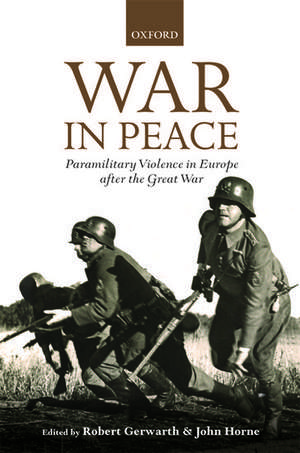
War in Peace: Paramilitary Violence in Europe after the Great War: The Greater War
Editat de Robert Gerwarth, John Horneen Limba Engleză Hardback – 27 sep 2012
Din seria The Greater War
- 32%
 Preț: 728.67 lei
 - 21%
 Preț: 371.72 lei
 - 16%
 Preț: 215.47 lei
 - 27%
 Preț: 354.70 lei
 - 19%
 Preț: 300.16 lei
 - 13%
 Preț: 296.65 lei
 - 17%
 Preț: 276.06 lei
 - 22%
 Preț: 403.47 lei
 - 31%
 Preț: 677.08 lei
 - 21%
 Preț: 369.37 lei
 - 25%
 Preț: 370.06 lei
 - 11%
 Preț: 341.99 lei
 - 31%
 Preț: 626.86 lei
 - 19%
 Preț: 623.02 lei
 - 16%
 Preț: 182.74 lei
Preț: 1041.19 lei
Preț vechi: 1516.52 lei
-31%
Puncte Express: 1562
Carte tipărită la comandă
Livrare economică 12-18 noiembrie
Livrare prin curier în România Termenul estimat este afișat lângă disponibilitate.
Transport gratuit pentru acest produs Plată online sau ramburs, în funcție de opțiunile comenzii.
Retur gratuit în 14 zile Comandă securizată și suport în română.
Specificații
ISBN-13: 9780199654918
ISBN-10: 0199654913
Pagini: 256
Ilustrații: 12 black and white images
Dimensiuni: 161 x 241 x 21 mm
Greutate: 0.53 kg
Editura: OUP OXFORD
Colecția OUP Oxford
Seria The Greater War
Locul publicării:Oxford, United Kingdom
ISBN-10: 0199654913
Pagini: 256
Ilustrații: 12 black and white images
Dimensiuni: 161 x 241 x 21 mm
Greutate: 0.53 kg
Editura: OUP OXFORD
Colecția OUP Oxford
Seria The Greater War
Locul publicării:Oxford, United Kingdom
V-ar putea interesa
-
 Queen AnneAnne SomersetPreț: 122.11 lei
 -
 To Hell and BackIan Kershaw-27%Preț: 99.54 lei135.75 lei
 -
 -33%Preț: 966.62 lei1434.95 lei
 -
 -31%Preț: 850.90 lei1238.22 lei
 -
 -31%Preț: 961.15 lei1400.08 lei
 -
 Wilhelm II and the Germans: A Study in LeadershipThomas A. Kohut-23%Preț: 221.03 lei285.85 lei
 -
 -21%Preț: 429.06 lei543.16 lei
 -
 -28%Preț: 349.73 lei484.54 lei
 -
 -31%Preț: 1135.69 lei1641.67 lei
 -
 The Waffen-SS: A European HistoryJochen Böhler-31%Preț: 824.70 lei1195.19 lei
 -
 Imperial Germany 1871-1918James Retallack-13%Preț: 288.58 lei330.74 lei
 -
 Twisted Paths: Europe 1914-1945Robert Gerwarth-21%Preț: 364.99 lei460.55 lei
 -
 A People of One Book: The Bible and the VictoriansTimothy Larsen-17%Preț: 283.41 lei339.94 lei
 -
 Europe Isn't WorkingLarry ElliottPreț: 80.40 lei
 -
 -18%Preț: 1421.08 lei1733.02 lei
 -
 The Last Great FrenchmanCharles WilliamsPreț: 154.69 lei
 -
 She-WolvesHelen CastorPreț: 93.66 lei
 -
 Russia and the RussiansGeoffrey Hosking-22%Preț: 112.41 lei143.63 lei
 -
 -26%Preț: 67.80 lei92.13 lei
 -
 The Balfour Declaration: The Origins of the Arab-Israeli ConflictJonathan Schneer-26%Preț: 89.38 lei120.91 lei
 -
 Coming Up TrumpsJean Trumpington-31%Preț: 45.14 lei65.77 lei
 -
 -25%Preț: 74.71 lei100.23 lei
 -
 Preț: 361.73 lei
Recenzii
The quality of the individual essays is for the most part high, and a majority of the essays engages productively with each other, particularly those by the editors, and those on Russia, Italy, the Balkans and the Ottoman Empire.
essential reading for anyone interested in the way violence at the end of the Great War led into the post-war period with profound and devastating effects. This innovative collection of essays helps shift the centre of gravity of twentieth-century European studies to the east, and does so through illuminating studies of the breakdown of the state's monopoly on violence from Ireland to Turkey and beyond.
a volume that not only eases the inherent difficulty in understanding post-war themes of societal disillusionment, and political and ethnic struggle, but is committed to advancing the discourse on the social, cultural, and psychological impact of the Great War.
this collection is undoubtedly a major contribution to the debate. It brings together an impressive selection of concise yet substantial introductions to complex cases, many of which Western scholars often overlook. Indeed, the book eloquently demonstrates the inadequacy of other histories of Europe that concentrate on West European experiences in that it shows how events in Central and Eastern Europe are integral parts of the continent's past, not aberrations to a Western norm.
War in Peace offers a valuable look not only at the 'war after the war' but also on the nature of paramilitary conflict, and the origins of fascism and collaborationism.
War in Peace is a thorough, incisive read for any scholar and enthusiast of 20th century European history ... an ideal book for understanding more about the internecine politics that led to both world wars.
essential reading for anyone interested in the way violence at the end of the Great War led into the post-war period with profound and devastating effects. This innovative collection of essays helps shift the centre of gravity of twentieth-century European studies to the east, and does so through illuminating studies of the breakdown of the state's monopoly on violence from Ireland to Turkey and beyond.
a volume that not only eases the inherent difficulty in understanding post-war themes of societal disillusionment, and political and ethnic struggle, but is committed to advancing the discourse on the social, cultural, and psychological impact of the Great War.
this collection is undoubtedly a major contribution to the debate. It brings together an impressive selection of concise yet substantial introductions to complex cases, many of which Western scholars often overlook. Indeed, the book eloquently demonstrates the inadequacy of other histories of Europe that concentrate on West European experiences in that it shows how events in Central and Eastern Europe are integral parts of the continent's past, not aberrations to a Western norm.
War in Peace offers a valuable look not only at the 'war after the war' but also on the nature of paramilitary conflict, and the origins of fascism and collaborationism.
War in Peace is a thorough, incisive read for any scholar and enthusiast of 20th century European history ... an ideal book for understanding more about the internecine politics that led to both world wars.
Notă biografică
Robert Gerwarth was born in Berlin and educated at Oxford where he also held a British Academy Postdoctoral Fellowship. He has been Professor of Modern History at University College Dublin and Director of UCD's Centre for War Studies since 2009. He is the author of several monographs and edited books on modern European history, most recently of a biography on Reinhard Heydrich.John Horne was educated in Australia and Britain, and has taught modern European history for many years at Trinity College Dublin. He has published extensively on French history and on the comparative and transnational history of the Great War. He is a member of the board of the Centre for Research at the Historial de la Grande Guerre, Péronne, a founder member of EurohistXX, the research consortium in contemporary European history, and a member of the Royal Irish Academy.