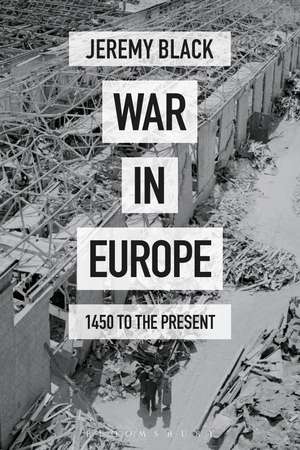
War in Europe: 1450 to the Present
Autor Jeremy Blacken Limba Engleză Paperback – 11 feb 2016
long-term military developments, notably in the way war is waged and battle conducted
the relationship between war and transformations in the European international system
the linkage between military requirements and state developments
the consequences of these requirements, and of the experience of war, for the nature of society
Adopting a clear chronological approach, Black weaves a rich and detailed narrative of the development of war in relation to transformations in the European international system, demonstrating the links between its causes and consequences in the military, political and social spheres. Assimilating decades of important research as well as bringing new perspectives to the topic, War in Europe is a key text for students taking courses in European history, international relations and war studies.
Preț: 192.60 lei
Preț vechi: 258.70 lei
-26%
Puncte Express: 289
Carte tipărită la comandă
Livrare economică 02-16 decembrie
Livrare prin curier în România Termenul estimat este afișat lângă disponibilitate.
Transport gratuit de la 400.00 lei Plată online sau ramburs, în funcție de opțiunile comenzii.
Retur gratuit în 14 zile Comandă securizată și suport în română.
Specificații
ISBN-13: 9781474235020
ISBN-10: 1474235026
Pagini: 256
Ilustrații: 10 bw illus
Dimensiuni: 154 x 232 x 14 mm
Greutate: 0.4 kg
Editura: Bloomsbury Publishing
Colecția Bloomsbury Academic
Locul publicării:London, United Kingdom
ISBN-10: 1474235026
Pagini: 256
Ilustrații: 10 bw illus
Dimensiuni: 154 x 232 x 14 mm
Greutate: 0.4 kg
Editura: Bloomsbury Publishing
Colecția Bloomsbury Academic
Locul publicării:London, United Kingdom
V-ar putea interesa
-
 Preț: 233.09 lei
 -
 -27%Preț: 86.05 lei117.49 lei
 -
 Hirohito's War: The Pacific War, 1941-1945Dr Francis Pike-17%Preț: 246.28 lei295.89 lei
 -
 Christmas and the British: A Modern HistoryMartin Johnes-16%Preț: 189.48 lei225.52 lei
 -
 Russian History through the Senses: From 1700 to the PresentProfessor Matthew P. Romaniello-26%Preț: 195.96 lei265.67 lei
 -
 A History of Pan-African RevoltCLR James-19%Preț: 92.60 lei114.52 lei
 -
 Preț: 246.84 lei
 -
 Geschichte der Welt. Band 06: 1945 bis heuteAkira IriyePreț: 418.88 lei
 -
 Risse in der Großen MauerJan-Philipp SendkerPreț: 74.07 lei
Cuprins
1. Introduction
2. The Fracturing of the European System, 1450-1600
3. The Creation of Lasting Standing Forces, 1600-1700
4. The Aristocratic Order and the Pressures on it, 1700-1800
5. The Rise of the Bureaucratic State and of Mass Society, 1800-1900
6. The Challenges of Total War and Ideology, 1900-1950
7. The Erosion of the Nation-Army, 1950-2000
8. Modern Society and the Abandonment of War, 2000-
9. Conclusions
Selected Further Reading
Index
2. The Fracturing of the European System, 1450-1600
3. The Creation of Lasting Standing Forces, 1600-1700
4. The Aristocratic Order and the Pressures on it, 1700-1800
5. The Rise of the Bureaucratic State and of Mass Society, 1800-1900
6. The Challenges of Total War and Ideology, 1900-1950
7. The Erosion of the Nation-Army, 1950-2000
8. Modern Society and the Abandonment of War, 2000-
9. Conclusions
Selected Further Reading
Index
Recenzii
War in Europe is an important addition to every military history collection, and worth reading by any serious student of military history.
A bold, tightly-conceived overview of European military history from 1450 to the present, which combines a wealth of often unfamiliar detail with characteristically provocative and challenging re-interpretations of traditional opinion on warfare, state and society. From scepticism about the role of "military revolution" during the early modern centuries, through challenges to the "nation in arms" of the Revolutionary Wars, or to his stress on the increase in civilian control over armies as a phenomenon of WW2 and thereafter, War in Europe draws upon patterns, changes and continuities in conflict from the Hundred Years War to the War in Iraq. The book will not disappoint those already familiar with Professor Black's iconoclastic and revisionist approaches, and provides a point of departure for students and other interested readers wanting an accessible but distinctive approach to the history of organizing and fighting war in Europe.
Addressing the relationship between war and state formation, Jeremy Black offers a skeptical examination of Charles Tilly's formulation that war made the state and the state made war. Black's study suggests that Tilly's adage tells us more about the centrality of national governments for citizens (and social scientists) in the nineteenth and twentieth centuries than it does about pre-modern states, societies, and war. Black's historiographical breadth and global scope will challenge readers' assumptions regarding well established models, such as the rise of the State, the rise of the West, and the gunpowder revolution.
A thoughtful and wide-ranging reappraisal of the role of war in European history from early modernity to the present, stressing the complexities and ambiguities in the interaction of military and political change.
A bold, tightly-conceived overview of European military history from 1450 to the present, which combines a wealth of often unfamiliar detail with characteristically provocative and challenging re-interpretations of traditional opinion on warfare, state and society. From scepticism about the role of "military revolution" during the early modern centuries, through challenges to the "nation in arms" of the Revolutionary Wars, or to his stress on the increase in civilian control over armies as a phenomenon of WW2 and thereafter, War in Europe draws upon patterns, changes and continuities in conflict from the Hundred Years War to the War in Iraq. The book will not disappoint those already familiar with Professor Black's iconoclastic and revisionist approaches, and provides a point of departure for students and other interested readers wanting an accessible but distinctive approach to the history of organizing and fighting war in Europe.
Addressing the relationship between war and state formation, Jeremy Black offers a skeptical examination of Charles Tilly's formulation that war made the state and the state made war. Black's study suggests that Tilly's adage tells us more about the centrality of national governments for citizens (and social scientists) in the nineteenth and twentieth centuries than it does about pre-modern states, societies, and war. Black's historiographical breadth and global scope will challenge readers' assumptions regarding well established models, such as the rise of the State, the rise of the West, and the gunpowder revolution.
A thoughtful and wide-ranging reappraisal of the role of war in European history from early modernity to the present, stressing the complexities and ambiguities in the interaction of military and political change.
Notă biografică
Jeremy Black is Professor of History at the University of Exeter, UK, and a Senior Fellow at the Center for the Study of America and the West at the Foreign Policy Research Institute in Philadelphia, USA.