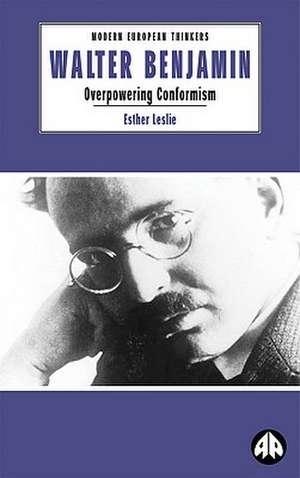
Walter Benjamin: Overpowering Conformism: Modern European Thinkers
Autor Esther Leslieen Limba Engleză Paperback – 20 iul 2000
| Toate formatele și edițiile | Preț | Express |
|---|---|---|
| Paperback (2) | 86.34 lei 3-4 săpt. | +35.11 lei 7-11 zile |
| REAKTION BOOKS – 15 ian 2008 | 86.34 lei 3-4 săpt. | +35.11 lei 7-11 zile |
| PLUTO PRESS – 20 iul 2000 | 248.66 lei 6-8 săpt. |



Preț: 248.66 lei
Puncte Express: 373
Preț estimativ în valută:
44.02€ • 51.26$ • 38.24£
44.02€ • 51.26$ • 38.24£
Carte tipărită la comandă
Livrare economică 24 februarie-10 martie
Preluare comenzi: 021 569.72.76
Specificații
ISBN-13: 9780745315683
ISBN-10: 0745315682
Pagini: 320
Dimensiuni: 135 x 215 x 25 mm
Greutate: 0.4 kg
Editura: PLUTO PRESS
Colecția Pluto Press
Seria Modern European Thinkers
ISBN-10: 0745315682
Pagini: 320
Dimensiuni: 135 x 215 x 25 mm
Greutate: 0.4 kg
Editura: PLUTO PRESS
Colecția Pluto Press
Seria Modern European Thinkers
V-ar putea interesa
-
 The Lodger ShakespeareCharles NichollPreț: 171.41 lei
 -
 Learned LadyRobert BrowningPreț: 391.70 lei
 -
 Stan Brakhage the Realm BusterMarco LoriPreț: 148.83 lei
 -
 Mad PrideTed CurtisPreț: 134.55 lei
 -
 Preț: 268.22 lei
 -
 Saint GermainSandor A. MarkusPreț: 151.29 lei
 -
 Rider HaggardMR Geoffrey ClarkePreț: 51.05 lei
 -
 Dix ANS de BohemeEmile GoudeauPreț: 85.10 lei
 -
 The Crack in the TeacupJoan BodgerPreț: 137.06 lei
 -
 Hollywood FlatlandsEsther LesliePreț: 165.80 lei
 -
 Dissonant WavesEsther Leslie-9%Preț: 240.43 lei263.74 lei
 -
 Preț: 117.56 lei
 -
 Meditations with Henry David ThoreauMadonna Sophia ComptonPreț: 65.61 lei
 -
 Pedro Antonio de AlarconLucien Louis-LandePreț: 55.21 lei
 -
 Antonio de TruebaLucien Louis-LandePreț: 54.99 lei
 -
 As Radical as Reality ItselfMatthew Beaumont-23%Preț: 620.68 lei806.08 lei
 -
 William Somerset MaughamKlaus W. JonasPreț: 283.74 lei
Descriere
Powerful new insights into a key twentieth-century political thinker
Notă biografică
Esther Leslie is professor of political aesthetics in the School of English and Humanities at Birkbeck, University of London. She is also author of Walter Benjamin: Overpowering Conformism, Hollywood Flatlands, and Synthetic Worlds, the last published by Reaktion Books.
Cuprins
Abbreviations
1 Benjamin's Remnants
2 Youth Culture, 1892-1916
3 Making a Mark, 1917-24
4 Books after Books, 1925-9
5 Man of Letters, 1930-32
6 Noms de Plume, 1933-7
7 Writer's Block, 1938-40
8 Afterwords
References
Select Bibliography
Photo Acknowledgements
Recenzii
"Leslie has inhaled the author of The Arcades Project as Kazin inhaled Blake. Benjamin, in fact, seems more coherent in her page than in his own. . . . It is as if, by evoking the tactile vitality of all that he touched with his thought, Leslie brings him back alive and kicking from the last border he crossed. Argue if you wish with his idea of 'aura,' his 'hierarchies of meaning,' or whether mechanical reproduction is good for the masses. But the mind that put Kafka and Chaplin into the same conceptual frame is his very own Klee painting, an Angelus Novus--the angel of history."
"Clear and welcome. . . . Leslie records some of the many conjectures about [his death] and some of the fantasies about his survival and purported later life. So much about this man feels unfinished that we cannot let him go."