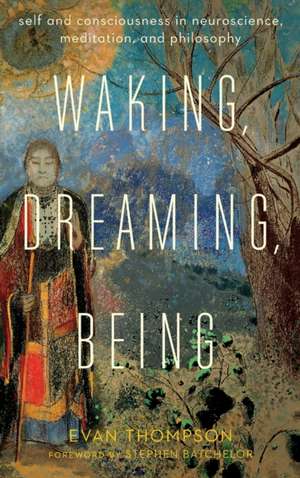
Waking, Dreaming, Being
Autor Evan Thompsonen Limba Engleză Hardback – 18 noi 2014
În capitolul dedicat „Ființării” (Being), Evan Thompson explorează conceptul de conștiință pură, propunând o perspectivă în care sinele nu este o entitate fixă, ci un proces fluid. Notăm cu interes modul în care autorul, un expert recunoscut în științe cognitive, reușește să pună în dialog rigurozitatea neuroștiinței moderne cu profunzimea tradițiilor filozofice indiene. Volumul publicat de Columbia University Press reprezintă o sinteză interdisciplinară care extinde cadrul propus de Sleeping, Dreaming, and Dying de Dalai Lama cu date noi din cercetările contemporane asupra creierului în timpul meditației și al visării lucide. Structura narativă și analitică a cărții este organizată progresiv, pornind de la percepția vizuală și starea de veghe (Waking), trecând prin fenomenologia visului (Dreaming) și a proiecțiilor mentale, până la analiza stărilor limită, precum somnul profund fără vise și procesul morții. Reținem că fiecare capitol folosește neuroștiința pentru a ilumina experiențele contemplative, în timp ce dovezile științifice sunt îmbogățite de introspecția fenomenologică. Spre deosebire de The Science of Consciousness de Trevor A. Harley, care funcționează ca un manual introductiv axat pe psihologie și patologii, lucrarea lui Thompson este o monografie densă care chestionează natura ontologică a identității umane. Suntem de părere că forța acestui text rezidă în capacitatea de a explica modul în care ne construim sentimentul de „eu” în diferite stări de conștiință. De la plutirea resimțită în experiențele extracorporale până la disoluția sinelui în meditație, Thompson demonstrează că ceea ce numim conștiință este o interacțiune dinamică între procesele biologice și fluxul experiențial, oferind un răspuns complex la întrebarea dacă sinele este sau nu o iluzie.
Preț: 234.90 lei
Carte tipărită la comandă
Livrare economică 03-17 decembrie
Specificații
ISBN-10: 0231137095
Pagini: 496
Dimensiuni: 159 x 236 x 40 mm
Greutate: 0.86 kg
Editura: Columbia University Press
V-ar putea interesa
-
 -16%Preț: 176.83 lei211.03 lei
 -
 -5%Preț: 331.90 lei349.37 lei
 -
 Preț: 35.82 lei
 -
 The Wheel of Time Premium Boxed Set IIIRobert JordanPreț: 260.38 lei
 -
 Stoicism TodayPatrick UssherPreț: 78.70 lei
 -
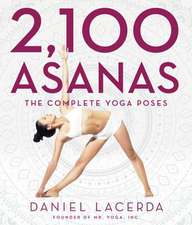 2,100 Asanas: The Complete Yoga PosesDaniel Lacerda-20%Preț: 254.87 lei318.17 lei
 -
 The Telomere Effect: A Revolutionary Approach to Living Younger, Healthier, LongerDr Elizabeth Blackburn-25%Preț: 75.42 lei101.10 lei
 -
 FiccionesJorge Luis BorgesPreț: 115.08 lei
De ce să citești această carte
Recomandăm această carte cititorilor interesați de intersecția dintre neuroștiință și filozofia orientală. Veți câștiga o înțelegere profundă a modului în care mintea funcționează în stări de tranziție, precum visul lucid sau meditația profundă. Este o lectură esențială pentru cei care doresc să exploreze natura conștiinței dincolo de limitele psihologiei tradiționale, beneficiind de expertiza unui filozof care stăpânește ambele tradiții de gândire.
Cuprins
Prologue: The Dalai Lama's Conjecture
Acknowledgments
Introduction
1. Seeing: What Is Consciousness?
2. Waking: How Do We Perceive?
3. Being: What Is Pure Awareness?
4. Dreaming: Who Am I?
5. Witnessing: Is This a Dream?
6. Imagining: Are We Real?
7. Floating: Where Am I?
8. Sleeping: Are We Conscious in Deep Sleep?
9. Dying: What Happens When We Die?
10. Knowing: Is the Self an Illusion?
Notes
Bibliography
Index
Descriere scurtă
Descriere
A renowned philosopher of the mind, also known for his groundbreaking work on Buddhism and cognitive science, Evan Thompson combines the latest neuroscience research on sleep, dreaming, and meditation with Indian and Western philosophy of mind, casting new light on the self and its relation to the brain. Thompson shows how the self is a changing process, not a static thing. When we are awake we identify with our body, but if we let our mind wander or daydream, we project a mentally imagined self into the remembered past or anticipated future. As we fall asleep, the impression of being a bounded self distinct from the world dissolves, but the self reappears in the dream state. If we have a lucid dream, we no longer identify only with the self within the dream. Our sense of self now includes our dreaming self, the "I" as dreamer. Finally, as we meditate--either in the waking state or in a lucid dream--we can observe whatever images or thoughts arise and how we tend to identify with them as "me." We can also experience sheer awareness itself, distinct from the changing contents that make up our image of the self. Contemplative traditions say that we can learn to let go of the self, so that when we die we can witness its dissolution with equanimity. Thompson weaves together neuroscience, philosophy, and personal narrative to depict these transformations, adding uncommon depth to life's profound questions. Contemplative experience comes to illuminate scientific findings, and scientific evidence enriches the vast knowledge acquired by contemplatives.