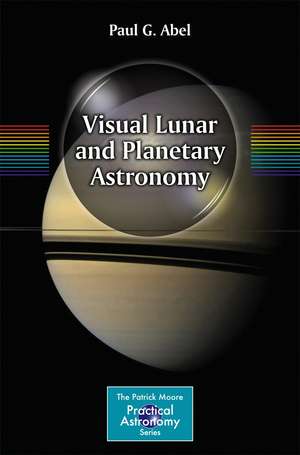
Visual Lunar and Planetary Astronomy: The Patrick Moore Practical Astronomy Series
Autor Paul G. Abelen Limba Engleză Paperback – 21 aug 2013
Visual Lunar and Planetary Astronomy is a comprehensive modern treatment of visual lunar and planetary astronomy, showing that even in the age of space telescopes and interplanetary probes it is still possible to contribute scientifically with no more than a moderately-priced commercially made astronomical telescope.
It is believed that imaging and photography is somehow more objective and more accurate than the eye, and this has led to a peculiar “crisis of faith” in the human visual system and its amazing processing power. But by analyzing observations from the past, we can see how accurate visual astronomy really is! Measuring the rotational period of Mars and making accurate lunar charts for American astronauts were all done by eye.
The book includes sections on how the human visual system works, how to view an object through an eyepiece, and how to record observations and keep a scientific notebook. The book also looks at how to make an astronomical, rather than an artistic, drawing. Finally, everything here will also be of interest to those imagers who wish to make their images more scientifically applicable by combining the methods and practices of visual astronomy with imaging.
Din seria The Patrick Moore Practical Astronomy Series
-
 Preț: 391.89 lei
 -
 Preț: 268.64 lei
 -
 Preț: 316.44 lei
 -
 Preț: 205.17 lei
 -
 Preț: 251.75 lei
 -
 Preț: 279.21 lei
 -
 Preț: 218.99 lei
 -
 Preț: 212.82 lei
 -
 Preț: 260.31 lei
 -
 Preț: 288.66 lei
 -
 Preț: 277.52 lei
 -
 Preț: 263.67 lei
 -
 Preț: 220.59 lei
 -
 Preț: 319.42 lei
 -
 Preț: 416.96 lei
 -
 Preț: 327.16 lei
 -
 Preț: 266.56 lei
 -
 Preț: 176.21 lei
 -
 Preț: 245.59 lei
 -
 Preț: 363.78 lei
 -
 Preț: 200.10 lei
 -
 Preț: 152.91 lei
 -
 Preț: 248.56 lei
 -
 Preț: 206.44 lei
 -
 Preț: 204.34 lei
 -
 Preț: 261.25 lei
 -
 Preț: 196.74 lei
 -
 Preț: 291.70 lei
 -
 Preț: 249.17 lei
 -
 Preț: 207.71 lei
 -
 Preț: 186.35 lei
 -
 Preț: 295.69 lei
 -
 Preț: 317.26 lei
 -
 Preț: 290.85 lei
 -
 Preț: 201.79 lei
 -
 Preț: 200.32 lei
 -
 Preț: 234.37 lei
 -
 Preț: 293.13 lei
 - 15%
 Preț: 671.63 lei
 -
 Preț: 298.21 lei
 -
 Preț: 307.39 lei
 -
 Preț: 314.69 lei
 -
 Preț: 296.95 lei
 -
 Preț: 211.92 lei
 -
 Preț: 311.99 lei
 -
 Preț: 151.14 lei
 -
 Preț: 306.46 lei
 -
 Preț: 252.95 lei
 -
 Preț: 251.75 lei
 -
 Preț: 292.10 lei
Preț: 311.11 lei
Puncte Express: 467
Preț estimativ în valută:
55.01€ • 63.57$ • 47.53£
55.01€ • 63.57$ • 47.53£
Carte tipărită la comandă
Livrare economică 04-18 mai
Specificații
ISBN-13: 9781461470182
ISBN-10: 1461470188
Pagini: 200
Ilustrații: XVIII, 219 p. 113 illus., 29 illus. in color.
Dimensiuni: 155 x 235 x 15 mm
Greutate: 0.45 kg
Ediția:2013
Editura: Springer
Colecția Springer
Seria The Patrick Moore Practical Astronomy Series
Locul publicării:New York, NY, United States
ISBN-10: 1461470188
Pagini: 200
Ilustrații: XVIII, 219 p. 113 illus., 29 illus. in color.
Dimensiuni: 155 x 235 x 15 mm
Greutate: 0.45 kg
Ediția:2013
Editura: Springer
Colecția Springer
Seria The Patrick Moore Practical Astronomy Series
Locul publicării:New York, NY, United States
V-ar putea interesa
-
 Thinking, Fast and SlowDaniel Kahneman-19%Preț: 84.64 lei104.33 leiRecomandat
 -
 Superintelligence: Paths, Dangers, StrategiesNick Bostrom-18%Preț: 72.07 lei87.85 lei
 -
 MindwiseNicholas Epley-21%Preț: 59.43 lei75.06 lei
 -
 Intuition Pumps and Other Tools for ThinkingDaniel C. DennettPreț: 103.45 lei
 -
 Our Mathematical UniverseMax Tegmark-31%Preț: 62.16 lei89.80 lei
 -
 The Vestibular System: Function and MorphologyT. GualtierottiPreț: 388.20 lei
 -
 In Vitro Aspects of ErythropoiesisM.J. Jr. MurphyPreț: 384.48 lei
 -
 Dog, Inc.: The Uncanny Inside Story of Cloning Man's Best FriendJohn WoestendiekPreț: 121.11 lei
 -
 Astronomy: A Self-Teaching GuideDinah L MochePreț: 164.36 lei
 -
 The Rise of the RobotsMartin FordPreț: 70.10 lei
 -
 Universal: A Guide Through the CosmosBrian CoxPreț: 149.72 lei
 -
 Preț: 307.94 lei
 -
 Preț: 402.00 lei
 -
 Nature TechnologyEmile H IshidaPreț: 294.87 lei
 -
 Peak: Secretele performanței de top și noua știință a expertizeiAnders EricssonPreț: 65.00 lei
 -
 -18%Preț: 1747.79 lei2131.46 lei
 -
 -18%Preț: 1175.96 lei1434.09 lei
 -
 Genesis and Propagation of Cosmic RaysM.M. Shapiro-18%Preț: 1178.53 lei1437.23 lei
Public țintă
Popular/generalCuprins
Acknowledgements.- Foreword by Sir Patrick Moore.- Chapter 1: Introduction.- Chapter 2: Instruments and Techniques.- Chapter 3: Mercury.- Chapter 4: Venus.- Chapter 5: Mars.- Chapter 6: Jupiter.- Chapter 7: Saturn.- Chapter 8: Uranus.- Index.
Notă biografică
A lifelong amateur astronomer based in Leicester in the UK, Paul Abel earned his degree in Mathematics at the University of Leicester, specializing in general relativity and black holes during his final year His Ph.D. is in Theoretical Physics and was concerned with Hawking Radiation and Black Hole Thermodynamics. He is a co-presenter on the BBC's 'The Sky at Night' TV show, where he tries to promote scientific visual observation aand general amateur astronomy. Paul is a Fellow of the Royal Astronomical Society (FRAS), and Assistant Director of Saturn section of the British Astronomical Association. He has published many articles and contributed to various astronomy books, including Patrick Moore's Yearbook of Astronomy, 2010, published by Macmillan.
Textul de pe ultima copertă
With the advent of CCDs and webcams, the focus of amateur astronomy has to some extent shifted from science to art. The object of many amateur astronomers is now to produce “stunning images” that, although beautiful, are not intended to have scientific merit. Paul Abel has been addressing this issue by promoting visual astronomy wherever possible – at talks to astronomical societies, in articles for popular science magazines, and on BBC TV’s The Sky at Night.
Visual Lunar and Planetary Astronomy is a comprehensive modern treatment of visual lunar and planetary astronomy, showing that even in the age of space telescopes and interplanetary probes it is still possible to contribute scientifically with no more than a moderately priced commercially made astronomical telescope.
It is believed that imaging and photography is somehow more objective and more accurate than the eye, and this has led to a peculiar “crisis of faith” in the human visual system and its amazing processing power. But by analyzing observations from the past, we can see how accurate visual astronomy really is! Measuring the rotational period of Mars and making accurate lunar charts for American astronauts were all done by eye.
The book includes sections on how the human visual system works, how to view an object through an eyepiece, and how to record observations and keep a scientific notebook. The book also looks at how to make an astronomical, rather than an artistic, drawing. Finally, everything here will also be of interest to those imagers who wish to make their images more scientifically applicable by combining the methods and practices of visual astronomy with imaging.
Visual Lunar and Planetary Astronomy is a comprehensive modern treatment of visual lunar and planetary astronomy, showing that even in the age of space telescopes and interplanetary probes it is still possible to contribute scientifically with no more than a moderately priced commercially made astronomical telescope.
It is believed that imaging and photography is somehow more objective and more accurate than the eye, and this has led to a peculiar “crisis of faith” in the human visual system and its amazing processing power. But by analyzing observations from the past, we can see how accurate visual astronomy really is! Measuring the rotational period of Mars and making accurate lunar charts for American astronauts were all done by eye.
The book includes sections on how the human visual system works, how to view an object through an eyepiece, and how to record observations and keep a scientific notebook. The book also looks at how to make an astronomical, rather than an artistic, drawing. Finally, everything here will also be of interest to those imagers who wish to make their images more scientifically applicable by combining the methods and practices of visual astronomy with imaging.
Caracteristici
Stimulates amateur observers to make real scientific contributions instead of mere stunning images Presents the rich history of scientific observation of solar system objects Explains how to produce an accurate scientific record of visual observations Includes supplementary material: sn.pub/extras